
Lawn Care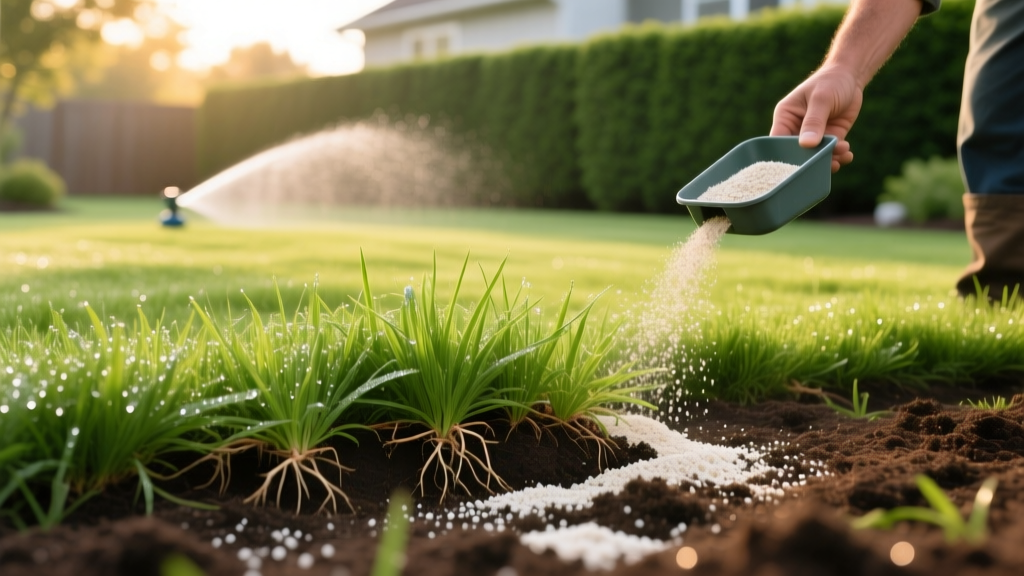
When to Apply New Grass Fertilizer: Timing and N-P-K Guide
Establishing turf from seed, hydroseed, or sod demands a fundamentally different nutritional approach than maintaining mature lawns. While established grass thrives on high-nitrogen maintenance fertilizers, germinating seeds and sprouting stolons require immediate phosphorus access for ATP production and rapid root cell division. Applying a standard 32-0-4 maintenance blend to tender seedlings is a primary cause of establishment failure, resulting in fertilizer burn and shallow root systems. This guide details the exact N-P-K ratios, application windows, and product formulations required for new grass fertilizer success.
The Science of Starter Fertilizers: Decoding N-P-K for Seedlings
Fertilizer bags display three numbers representing the percentage by weight of Nitrogen (N), Phosphorus (P), and Potassium (K). For new grass, the middle number (Phosphorus) is the most critical variable. Phosphorus is largely immobile in soil; it does not leach downward easily with water. Therefore, it must be incorporated into the top 2 to 3 inches of soil exactly where the nascent root zone will develop.
According to Purdue University Turfgrass Science, a proper starter fertilizer should contain a nitrogen-to-phosphorus ratio of approximately 1:2 or 1:3. This ensures that while the seedling has enough nitrogen to push its first cotyledon blade above the soil, it has an abundance of phosphorus to drive the energy-intensive process of root branching.
The Phosphorus Runoff Exemption: Many municipalities and states (including New York, Minnesota, and Washington) strictly ban phosphorus in lawn fertilizers to prevent aquatic algae blooms. However, nearly all these regulations include a legal exemption for new establishment. You can legally apply a high-phosphorus new grass fertilizer when seeding or sodding, but you must transition to zero-phosphorus maintenance fertilizers once the lawn is established.
Exact Timing: The 90-Day New Grass Fertilizer Schedule
Timing your application is just as critical as the chemical formulation. Seedlings have an incredibly low cation exchange capacity (CEC), meaning they cannot store excess nutrients. Overloading them early will cause osmotic stress (salt burn). Follow this precise 90-day timeline for optimal establishment.
- Day 0 (Seeding or Sodding Day): Apply your starter fertilizer immediately before or immediately after spreading the seed. If seeding, use a drop spreader to apply the granules, then spread seed, and finally rake lightly to incorporate both into the top 0.25 inches of soil. Target an application rate of 0.5 to 1.0 lbs of actual nitrogen per 1,000 square feet. Water immediately with a light mist (0.1 inches) to begin dissolving the granules without washing the seed away.
- Days 14 to 21 (Germination Phase): Do not apply any additional fertilizer. The seedling is currently drawing on the endosperm energy reserves inside the seed hull and the phosphorus provided on Day 0. Keep the top inch of soil consistently moist.
- Day 30 to 45 (First Mow): Once the grass reaches 3 inches and you perform the first mow (cutting only the top 1/3), the initial starter fertilizer reserves will be depleting. However, the root system is still too fragile for a heavy synthetic nitrogen hit. Hold off on fertilizing, but consider applying a liquid kelp or humic acid supplement to stimulate root hairs.
- Day 60 (The Transition Feed): At the 8-week mark, the turf has established a functional root zone. It is time to apply a second round of fertilizer. Transition to a balanced or high-nitrogen formulation (e.g., 20-5-10 or 24-8-16) at a rate of 1.0 lb of actual nitrogen per 1,000 square feet. This fuels lateral tillering and rhizome spread, thickening the lawn before the stress of summer heat or winter freeze.
Top New Grass Fertilizer Formulations Compared
As of early 2026, fertilizer supply chains have stabilized, but pricing varies significantly based on the nitrogen source (quick-release urea vs. slow-release methylene urea) and organic certification. Below is a comparison of the most effective starter formulations on the market.
| Product | N-P-K Ratio | Coverage & Price | Best Use Case |
|---|---|---|---|
| Scotts Turf Builder Starter Food | 24-25-4 | 5,000 sq ft / ~$38.00 | Standard residential overseeding and patch repair. High quick-release nitrogen for rapid green-up. |
| Jonathan Green Green-Up for Seeding | 12-25-12 | 5,000 sq ft / ~$46.00 | Full lawn renovations from bare dirt. Lower nitrogen prevents burn on bare soil; high P and K build deep roots. |
| Espoma Organic Lawn Starter | 9-8-6 | 5,000 sq ft / ~$52.00 | Eco-sensitive zones and organic programs. Slow-release feather meal and bone meal prevent leaching entirely. |
| Lesco Professional Starter | 18-24-12 | 5,000 sq ft / ~$42.00 | Professional sod farms and high-end landscaping. Includes MESA (methylene urea) for extended 6-week feeding. |
Troubleshooting Seedling Fertilizer Burn
Seedling fertilizer burn occurs when the salt index of the granular fertilizer draws moisture out of the tender root hairs via osmosis, effectively dehydrating the plant from the inside out. If you notice the tips of your new grass turning yellow or white within 48 hours of application, you are likely experiencing salt burn.
- Failure Mode 1: Clumping from Spreader Overlap. Broadcast spreaders often overlap at the wheel tracks, depositing double the intended rate of fertilizer in narrow stripes. Fix: Always use a drop spreader for small seeded areas, or calibrate your broadcast spreader to a 50% application rate and make two perpendicular passes.
- Failure Mode 2: Applying to Dry Soil. Dropping synthetic urea-based starter fertilizer onto bone-dry topsoil guarantees burn. The granules will sit on the surface, and when dew forms overnight, it creates a highly concentrated, caustic liquid brine that coats the seed. Fix: Water the bare soil lightly 2 hours before applying fertilizer to ensure the granules begin dissolving into a moist matrix immediately upon contact.
- Failure Mode 3: Using 'Weed and Feed' Products. Standard weed preventers (like prodiamine or dithiopyr) are designed to stop cell division in germinating seeds. If you apply a weed-and-feed to a newly seeded lawn, you will kill your grass seed. Fix: If crabgrass prevention is absolutely necessary during a spring seeding, use a product containing Mesotrione (e.g., Tenacity), which is the only pre-emergent legally labeled and biologically safe for use at the time of seeding most cool-season grasses.
Expert FAQs: Soil Health and New Grass
Do I need to adjust my soil pH before applying new grass fertilizer?
Yes. If your soil pH is below 6.0 (highly acidic) or above 7.5 (alkaline), the phosphorus in your starter fertilizer will chemically bind to iron, aluminum, or calcium in the soil, becoming completely unavailable to the grass roots. According to the University of Minnesota Extension, turfgrass absorbs nutrients most efficiently between a pH of 6.2 and 6.8. You must apply pelletized lime (to raise pH) or elemental sulfur (to lower pH) at least 4 to 6 weeks before seeding. Do not apply lime and starter fertilizer on the same day, as they will react and neutralize each other's efficacy.
Can I use Milorganite as a new grass fertilizer?
Milorganite (5-4-0) is an excellent, low-burn organic nitrogen source, but it is fundamentally flawed as a standalone starter fertilizer. Its N-P-K ratio lacks the heavy phosphorus concentration required for initial root explosion. If you prefer Milorganite, mix it with a high-phosphorus bone meal or use it for your Day 60 transition feed rather than your Day 0 seeding application.
How much actual nitrogen is in a 40lb bag of 10-20-10 fertilizer?
To calculate actual nitrogen, multiply the bag weight by the first number (expressed as a decimal). A 40lb bag of 10-20-10 contains 4.0 lbs of actual nitrogen (40 x 0.10). If your target application rate is 0.5 lbs of actual nitrogen per 1,000 square feet, that single 40lb bag will cover exactly 8,000 square feet. Always calculate by actual nutrient weight, not total bag weight, to prevent accidental over-application.

