
Lawn Care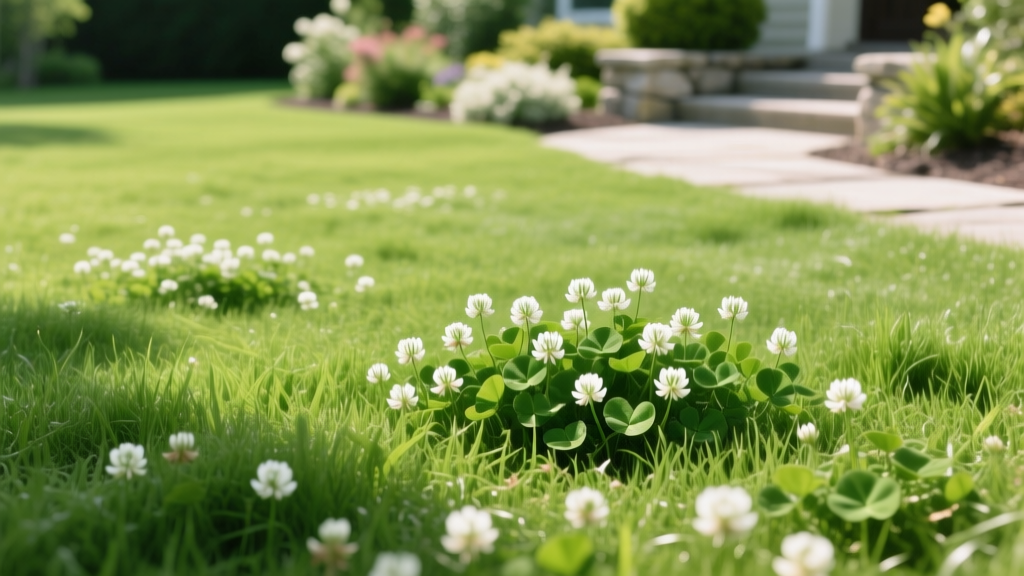
White Clover Lawn Weed Control: Spot-Treatment & Eradication Guide
White clover (Trifolium repens) is a perennial broadleaf weed that aggressively colonizes nitrogen-deficient turf. Because it spreads via above-ground stolons that root at every node, manually pulling it almost guarantees regrowth from severed root fragments. If you are battling a white clover lawn invasion, broadcast spraying the entire yard is often a waste of chemicals, damages your soil microbiome, and increases the risk of herbicide resistance. Targeted spot-treatment delivers lethal active ingredients directly to the clover's stolon network while preserving your desirable turfgrass.
Identifying White Clover vs. Common Lookalikes
Before mixing any herbicides, confirm the weed species. Misidentifying white clover leads to ineffective chemical selection. White clover is frequently confused with black medic and oxalis, but their biological differences dictate entirely different treatment protocols.
| Feature | White Clover (Trifolium repens) | Black Medic (Medicago lupulina) | Oxalis (Oxalis stricta) |
|---|---|---|---|
| Leaf Structure | Three oval leaflets, often with white 'V' chevron markings | Three teardrop leaflets, center leaflet on a longer stem | Three heart-shaped leaflets (resembles shamrock) |
| Flowers | Spherical white or pinkish heads | Small, clustered yellow spikes | Solitary yellow flowers with 5 distinct petals |
| Growth Habit | Creeping stolons rooting at nodes | Upright, branching taproot | Upright stems, explosive seed pods |
| Primary Herbicide | Triclopyr + 2,4-D + Carfentrazone | 2,4-D + Dicamba | Fluroxypyr + Triclopyr |
The Chemistry of Clover Eradication
White clover leaves possess a thick, waxy cuticle that repels water-based sprays. Furthermore, its deep taproot and extensive stolon network require systemic herbicides that translocate from the foliage down to the root crown. Using a single active ingredient like 2,4-D amine will burn the top growth but fail to kill the root, resulting in rapid regrowth within 14 days.
According to University of California Integrated Pest Management, effective control requires a multi-way herbicide formulation. The most reliable professional-grade combination includes:
- Carfentrazone-ethyl: A PPO inhibitor that provides rapid foliar burndown (visible wilting in 24 hours), stripping the waxy cuticle.
- Triclopyr: A synthetic auxin that excels at translocating through the phloem to destroy the stolon nodes and taproot.
- 2,4-D & Dicamba: Secondary auxins that disrupt cellular division in broadleaf plants, preventing recovery.
⚠️ Temperature & Volatility Warning: Never apply ester-based herbicides when daytime temperatures exceed 85°F (29°C). High heat causes esters to vaporize and drift, which will severely damage nearby desirable turf, ornamental shrubs, and garden vegetables. If treating in mid-summer, switch to amine formulations and spray in the early morning.
The 3-Step Spot-Treatment Protocol
Step 1: Soil and Turf Preparation
Do not mow your lawn for 48 hours before application. Allowing the clover leaves to fully expand maximizes the surface area for herbicide absorption. Ensure the soil is slightly moist; drought-stressed clover shuts down its vascular system, preventing the systemic herbicide from reaching the roots. If the ground is bone dry, water the lawn lightly the evening before treatment.
Step 2: Mixing the Solution with a Surfactant
For a highly effective spot-treatment mix, use a product like SpeedZone Broadleaf Herbicide for Turf (approx. $45 for 20 oz). This formulation contains carfentrazone, 2,4-D, MCPP-p, and dicamba.
The Exact Mix Ratio:
- Add 1.5 fluid ounces of SpeedZone to a 2-gallon pump sprayer.
- Add 0.5 fluid ounces of a Non-Ionic Surfactant (NIS) (e.g., Southern Ag Surfactant, approx. $15). This is non-negotiable; the surfactant breaks the surface tension of the water, allowing the chemical to penetrate the clover's waxy leaf cuticle rather than beading up and rolling onto the soil.
- Fill the sprayer with water to the 2-gallon mark and agitate thoroughly. This volume is sufficient to treat approximately 1,500 to 2,000 square feet of scattered clover patches.
Step 3: Precision Application Technique
Equip your sprayer with a flat-fan nozzle (such as a TeeJet 8002VS) rather than a cone nozzle. Flat-fan nozzles produce uniform droplets that coat the leaf surface evenly without excessive runoff. Hold the wand 12 to 18 inches above the turf and spray the clover patches until the leaves are uniformly wet, but not dripping. Avoid overlapping passes, which can cause localized turf phytotoxicity.
'White clover fixes its own atmospheric nitrogen via Rhizobium bacteria in its root nodules. When you see a white clover lawn invasion, it is a biological indicator that your soil's available nitrogen levels have dropped below 20 ppm, giving the clover a massive competitive advantage over your nitrogen-starved turfgrass.' — Penn State Extension
Post-Treatment Lawn Recovery and Prevention
Killing the clover is only 50% of the battle. If you do not address the underlying soil deficiency, white clover seeds—which can remain viable in the soil seed bank for up to 5 years—will germinate and reclaim the bare spots.
Cost Analysis: Spot-Treatment vs. Full Lawn Renovation
Targeted Spot-Treatment: $60 total (Herbicide + Surfactant + Fertilizer) | Timeframe: 3 weeks to full recovery
Full Lawn Kill & Reseeding: $450 - $800+ (Glyphosate, aeration, seed, starter fertilizer, topsoil) | Timeframe: 8 to 12 weeks
Verdict: Spot-treatment yields a 90%+ cost savings and preserves your established turf root system, which is critical for drought resistance.
The 21-Day Recovery Timeline
- Days 1-3: Clover leaves will exhibit severe epinasty (twisting and curling) and begin to yellow. Do not mow.
- Days 7-10: Clover foliage turns brown and necrotic. You may now mow the lawn at your standard height, bagging the clippings to remove dead clover thatch.
- Day 14: Apply a high-nitrogen, zero-phosphorus fertilizer (e.g., a 32-0-4 NPK ratio) at a rate of 1.0 lb of actual nitrogen per 1,000 square feet. This rapid nitrogen influx forces your turfgrass to thicken and aggressively outcompete any remaining clover seedlings.
- Day 21: Inspect the treated areas. If any isolated clover plants show signs of green regrowth at the crown, perform a secondary micro-spray using a ready-to-use ortho-foam applicator directly on the surviving crowns.
Frequently Asked Questions
Will vinegar or boiling water kill white clover?
Horticultural vinegar (20% acetic acid) and boiling water are non-selective contact burners. They will destroy the top foliage of the clover but will not penetrate the stolon network or kill the taproot. Furthermore, they will kill your surrounding turfgrass and temporarily lower soil pH, making recovery harder. Stick to systemic selective herbicides for permanent eradication.
Can I use a hose-end sprayer for spot-treatment?
No. Hose-end sprayers lack the precision required for spot-treatment and drastically increase the risk of over-applying herbicides to desirable grass, leading to severe turf burn. Always use a dedicated 1- or 2-gallon pump sprayer with a calibrated wand for targeted applications.
Is white clover entirely bad for my lawn?
While considered a weed in traditional turf management, some homeowners intentionally overseed with micro-clover (Trifolium repens var. Pirouette) to create a low-input, drought-tolerant, eco-lawn. However, if you are maintaining a traditional Kentucky Bluegrass, Fescue, or Bermuda lawn, standard white clover will aggressively choke out your turf during summer stress periods and must be managed.

