
Lawn Care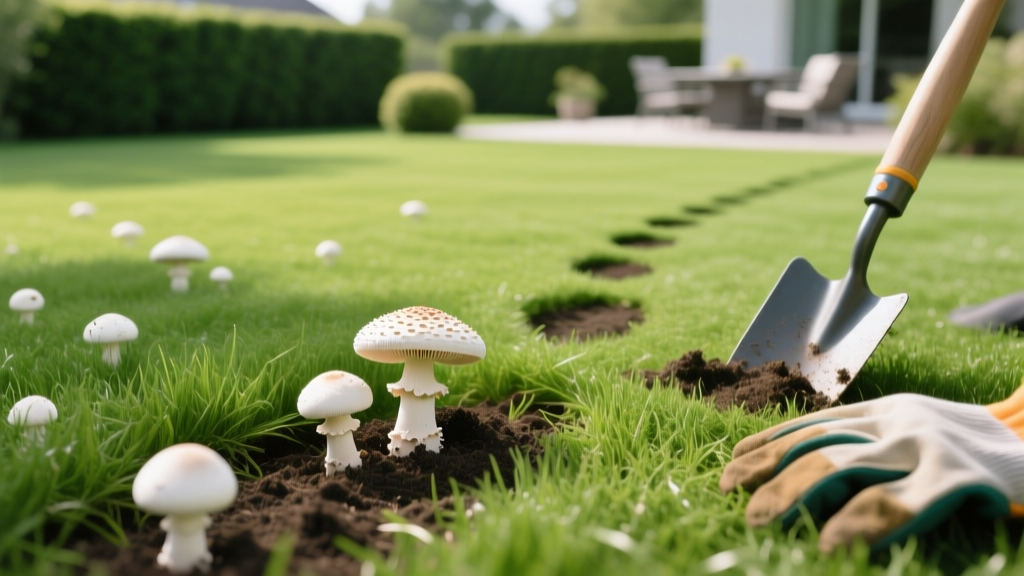
Eliminating White Mushrooms in Lawn: Step-by-Step Care Guide
The Biology of White Mushrooms in Lawn
White mushrooms in lawn environments are not pathogens attacking your living grass; they are the fruiting bodies of saprophytic fungi. These fungi perform a vital ecological function: decomposing buried organic matter such as dead tree roots, buried construction lumber, and excessive thatch. When soil moisture remains consistently high and temperatures hover between 60°F and 80°F, the subterranean mycelial network pushes up mushrooms to release spores.
Eradicating them permanently requires shifting your maintenance procedures to alter the soil microclimate. According to the University of Minnesota Extension, simply knocking over the mushrooms does nothing to stop the underlying mycelium. You must systematically remove the food source and correct the moisture retention issues.
Diagnostic Matrix: Identifying Your Mushroom Issue
| Mushroom Presentation | Underlying Cause | Primary Maintenance Fix |
|---|---|---|
| Scattered, random white caps | Excessive thatch layer (>0.5 inches) and overwatering | Dethatching and irrigation cycle-soak calibration |
| Circular ring (Fairy Ring) | Buried decaying wood/roots; localized hydrophobic soil | Deep-tine aeration and soil surfactant application |
| Clustered white puffballs | Decomposing buried construction debris or old stumps | Physical excavation of debris; high-nitrogen fertilization |
Phase 1: Immediate Physical Removal Protocol
While physical removal will not kill the fungus, it prevents the release of millions of new spores and improves the immediate aesthetics of the lawn. Do not use a lawnmower to mulch the mushrooms, as this violently distributes spores across the turf canopy.
- Timing: Remove mushrooms early in the morning before the caps fully open and release spores.
- Technique: Wear nitrile gardening gloves. Grasp the mushroom at the very base of the stipe (stem) and twist gently to extract the entire structure.
- Disposal: Drop them directly into a sealed plastic bag. Do not compost them, as home compost piles rarely reach the 140°F+ temperatures required to kill fungal spores.
- Sanitation: Wash your gloves and boots to avoid tracking spores to unaffected areas of the yard.
Phase 2: Irrigation Calibration and Cycle-Soak
Fungi thrive in perpetually damp thatch. Most homeowners overwater by running sprinklers daily for short durations, which keeps the top 1 inch of soil saturated while the root zone remains dry. Transitioning to a deep, infrequent watering schedule starves the surface mycelium.
Calculating Your Precipitation Rate
You must match your watering time to your sprinkler head type to deliver exactly 1 to 1.5 inches of water per week.
- Fixed Spray Heads: Output approximately 1.5 inches per hour. To deliver 1 inch, run for 40 minutes total per week.
- Gear-Drive Rotors: Output approximately 0.4 to 0.5 inches per hour. To deliver 1 inch, run for 120 to 150 minutes total per week.
Pro Tip: The Cycle-and-Soak Method
If your soil is heavy clay and water pools on the surface before the required time is up, split the runtime. For example, instead of running spray heads for 40 continuous minutes, run them for 20 minutes, wait 2 hours for absorption, and run them for another 20 minutes. Always set your timer to water between 4:00 AM and 6:00 AM to minimize evaporation and ensure the grass blades dry quickly once the sun rises.
If your soil is heavy clay and water pools on the surface before the required time is up, split the runtime. For example, instead of running spray heads for 40 continuous minutes, run them for 20 minutes, wait 2 hours for absorption, and run them for another 20 minutes. Always set your timer to water between 4:00 AM and 6:00 AM to minimize evaporation and ensure the grass blades dry quickly once the sun rises.
Phase 3: Thatch Reduction and Core Aeration
Thatch is a tightly intermingled layer of living and dead stems and roots. When it exceeds 0.5 inches in thickness, it acts like a sponge, trapping the exact moisture levels white mushrooms need to fruit.
Step-by-Step Aeration Procedure
- Moisture Prep: Water the lawn heavily 24 hours before aeration. The soil must be moist enough for the tines to penetrate 3 inches deep, but not so muddy that it clogs the machine.
- Equipment Selection: Rent a walk-behind core aerator (e.g., Ryan Renovation or Classen models). Avoid liquid aeration products or spike aerators, which do not physically remove the thatch layer or relieve deep compaction.
- Pattern Execution: Make one pass horizontally and a second pass diagonally. Target 15 to 20 holes per square foot.
- Post-Aeration: Leave the extracted soil cores on the lawn. They contain beneficial soil microbes that will naturally break down the remaining thatch layer within 2 to 3 weeks.
Phase 4: The Nitrogen Acceleration Method
The biological hack for eliminating the food source of white mushrooms is to accelerate the decomposition of buried organic matter. Saprophytic fungi break down carbon-heavy materials (wood, roots). By introducing high levels of nitrogen, you stimulate native soil bacteria to outcompete the fungi and rapidly consume the buried carbon.
The Nitrogen Math
You need to apply 1 pound of actual nitrogen per 1,000 square feet. Read the N-P-K ratio on the fertilizer bag. The first number is the percentage of nitrogen.
- Example: A 32-0-4 fertilizer (like Scotts Turf Builder) contains 32% nitrogen.
- Calculation: Divide 100 by the nitrogen percentage (100 / 32 = 3.12).
- Application Rate: Apply 3.12 pounds of this specific product per 1,000 square feet to deliver exactly 1 pound of actual nitrogen.
Apply this high-nitrogen fertilizer in the early fall when the grass is actively storing nutrients and soil bacteria are highly active. Avoid using slow-release organic fertilizers like Milorganite for this specific procedure, as the rapid nitrogen spike from synthetic urea or ammonium sulfate is required to shift the bacterial-to-fungal ratio in the soil.
Warning: The Fungicide Fallacy
Do not waste money on over-the-counter fungicides containing Myclobutanil or Azoxystrobin for white mushrooms. These chemicals are designed to stop pathogenic fungi (like Brown Patch or Dollar Spot) that attack living plant tissue. They are entirely ineffective against saprophytic fungi digesting dead wood deep in the soil profile. As noted by UMN Turfgrass Science, chemical control of saprophytic lawn mushrooms is largely a myth marketed to frustrated homeowners.
Do not waste money on over-the-counter fungicides containing Myclobutanil or Azoxystrobin for white mushrooms. These chemicals are designed to stop pathogenic fungi (like Brown Patch or Dollar Spot) that attack living plant tissue. They are entirely ineffective against saprophytic fungi digesting dead wood deep in the soil profile. As noted by UMN Turfgrass Science, chemical control of saprophytic lawn mushrooms is largely a myth marketed to frustrated homeowners.
Advanced Troubleshooting: Type 1 Fairy Rings
If your white mushrooms are forming a distinct circle and the grass inside the ring is turning brown and dying, you are dealing with a Type 1 Fairy Ring. The dense mycelial mat becomes completely hydrophobic (water-repellent), preventing water from reaching the grass roots.
The Fix: You must break the hydrophobic barrier. Purchase a professional-grade soil surfactant (wetting agent) such as Aquatrols Revolution or Cascade Plus. These products cost between $60 and $90 per quart but are highly concentrated. Mix 3 ounces of surfactant per 1,000 square feet in a pump sprayer, apply directly to the ring, and immediately water it in with 0.5 inches of irrigation. This reduces the surface tension of the water, allowing it to penetrate the waxy fungal mat.
Frequently Asked Questions
Are white mushrooms in the lawn toxic to dogs?
While many common lawn mushrooms like the meadow mushroom (*Agaricus campestris*) are non-toxic, it is nearly impossible for a layperson to distinguish them from highly toxic look-alikes like the Destroying Angel (*Amanita bisporigera*). If you have pets that forage or chew on lawn debris, treat all white mushrooms as toxic and remove them immediately via the Phase 1 protocol.
Will removing the buried tree stump stop the mushrooms?
Yes, but the timeline is lengthy. If a tree was recently removed, the remaining root system will continue to feed saprophytic fungi for 3 to 5 years. Accelerating the process requires the high-nitrogen fertilization outlined in Phase 4 to speed up the bacterial decomposition of the remaining roots.
Does adjusting soil pH kill lawn mushrooms?
No. Applying lime to alter soil pH will not eradicate mushrooms. Most turfgrasses prefer a pH of 6.0 to 7.0, and the fungi responsible for lawn mushrooms thrive across this exact same spectrum. Focus on moisture control and thatch reduction instead.

