
Lawn Care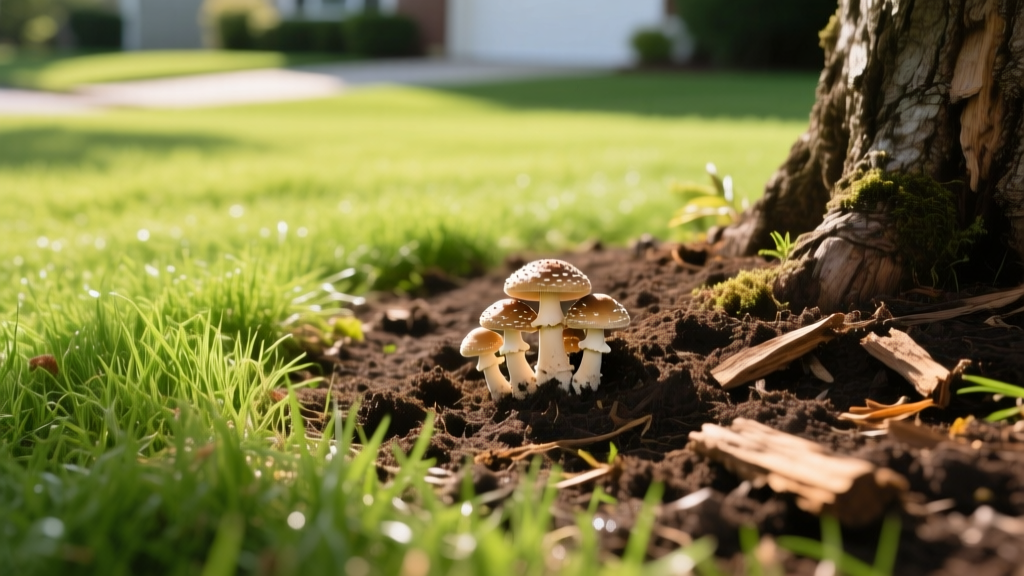
Why Do Mushrooms Grow in My Lawn? 5 Soil Causes and Fixes
The Mycelium Iceberg: What You See vs. What’s Underground
Homeowners frequently search for answers to the question, "why do mushrooms grow in my lawn?" The short answer is that mushrooms are simply the reproductive fruiting bodies of a much larger, hidden organism called mycelium. While the mushroom itself may only appear for a few days after a heavy rain, the mycelial network beneath your turfgrass has likely been establishing itself for months or even years.
According to Penn State Extension, lawn fungi are not parasitic invaders attacking your grass; they are saprophytic decomposers. They exist to break down complex organic carbon—such as dead tree roots, buried construction lumber, and excessive thatch—into bioavailable nutrients. When environmental conditions align (typically high soil moisture combined with temperatures between 60°F and 80°F), the mycelium pushes fruiting bodies to the surface to release spores.
Expert Insight: The presence of mushrooms is actually a biological indicator of active soil ecology. However, excessive fruiting indicates an imbalance in your soil's moisture retention, aeration, or organic matter decomposition rate that needs correction to maintain turf density.
5 Soil Conditions That Trigger Mushroom Fruiting
Mushrooms do not grow randomly. They require specific micro-environmental triggers to fruit. If you are seeing consistent fungal flushes, your lawn is exhibiting one or more of these five measurable soil conditions:
- Subsurface Compaction (Penetrometer Reading > 250 PSI): When soil becomes heavily compacted, water cannot percolate into the subsoil. This creates a perched water table in the top 2 inches of the root zone, providing the constant moisture mycelium requires to fruit.
- Excessive Thatch Accumulation (> 0.5 inches): A thatch layer thicker than half an inch acts like a sponge. Fungi colonize this undecomposed layer of dead stolons and rhizomes, feeding aggressively when the thatch remains damp for more than 48 hours.
- Buried Organic Debris: Old tree stumps, buried roots from removed shrubs, or even discarded plywood left by builders act as massive, slow-release food sources for saprophytic fungi.
- Acidic Soil pH (< 5.5): Most turfgrasses thrive at a pH of 6.0 to 7.0. When soil drops below 5.5, bacterial activity (which competes with fungi for organic matter) slows down significantly, allowing fungal networks to dominate the soil food web.
- Poor Surface Drainage and Shade: North-facing slopes or areas under dense tree canopies where sunlight penetration is less than 4 hours a day prevent surface evaporation, keeping the topsoil perpetually damp.
Lawn Mushroom Identification Matrix
Identifying the specific mushroom can tell you exactly what is happening in your soil. Below is a diagnostic matrix of the most common lawn species encountered in North American turf.
| Species / Common Name | Visual Identifier | Soil Indicator | Toxicity Risk |
|---|---|---|---|
| Marasmius oreades (Fairy Ring) | Forms distinct circles or arcs; grass inside the ring is often dark green or dead. | High thatch; sandy soils; low nitrogen. | Non-toxic, but ruins turf aesthetics. |
| Chlorophyllum molybites (False Parasol) | Large, scaly brown cap; white spore print; prominent ring on the stem. | Rich, heavily amended soils; mulch edges. | Highly Toxic (causes severe gastrointestinal distress). |
| Coprinus spp. (Inky Caps) | Tall, slender, bell-shaped caps that dissolve into black ink-like liquid. | Buried wood; decaying roots; high moisture. | Non-toxic, but causes reactions if consumed with alcohol. |
| Panaeolus foenisecii (Brown Mower's) | Small, brown, conical caps; thin stems; often appears after mowing. | Compact clay soils; moderate thatch. | Mildly toxic to pets and small children. |
The 4-Step Soil Remediation Protocol
Many homeowners attempt to solve this problem with chemical fungicides like azoxystrobin or propiconazole. This is a fundamental misunderstanding of fungal biology. Contact and systemic fungicides only suppress the fruiting body temporarily; they cannot penetrate deep enough to eradicate the main mycelial network. To stop mushrooms permanently, you must alter the soil environment so it no longer supports fungal dominance. Follow this exact protocol:
- Mechanical Thatch Removal and Core Aeration: Rent a vertical dethatcher (power rake) and set the blades to penetrate exactly 1/4 inch into the soil to tear out the thatch mat. Follow this immediately with core aeration, pulling 3-inch to 4-inch soil plugs spaced no more than 3 inches apart. Expect to pay $60 to $85 per day for equipment rentals. This introduces oxygen into the root zone, accelerating bacterial decomposition of organic matter.
- Neutralize Soil Acidity: Perform a soil test. If your pH is below 6.0, apply pelletized calcitic limestone. The standard application rate is 40 lbs per 1,000 square feet to raise the pH by approximately 0.5 points. A 40 lb bag typically costs around $15 at agricultural supply stores. Apply in the fall or early spring when the soil is moist to facilitate chemical breakdown.
- Accelerate Organic Decay with Nitrogen: Mycelium thrives in high-carbon, low-nitrogen environments (like rotting wood or thatch). By applying a fast-release nitrogen source (like ammonium sulfate, 21-0-0) at a rate of 0.5 lbs of actual nitrogen per 1,000 square feet, you feed the soil bacteria. The bacteria will then outcompete the fungi and rapidly consume the buried carbon sources.
- Apply a Soil Surfactant: If water is pooling on the surface due to hydrophobic thatch, apply a yucca-extract based soil surfactant (such as Aqua-Aid or a generic wetting agent). Mix 1 oz per gallon of water and spray over 1,000 square feet. This breaks the surface tension of the water, allowing it to drain through the soil profile rather than sitting on top and feeding surface fungi.
Frequently Asked Questions
Will picking the mushrooms stop them from spreading?
No. Plucking the mushroom only removes the "apple" from the "apple tree." The mycelium remains underground and will simply produce more fruiting bodies the next time it rains. However, picking them is highly recommended if you have pets or small children, as it removes the immediate ingestion hazard. Dispose of them in a sealed yard waste bag, not in your compost bin, to prevent spore redistribution.
Are lawn mushrooms a sign of a healthy lawn?
In moderation, yes. The Royal Horticultural Society notes that fungi are vital for nutrient cycling. However, a massive, sudden flush of mushrooms usually indicates an underlying drainage or compaction issue that will eventually suffocate your turfgrass roots and lead to lawn decline.
How do I get rid of a Fairy Ring?
Fairy rings (Marasmius oreades) are notoriously difficult to eradicate because the mycelium forms a dense, hydrophobic mat that repels water, causing the grass inside the ring to die of drought stress. The most effective non-chemical treatment is to use a soil probe to punch holes 10 inches deep along the inner and outer edges of the ring, then soak the area with water mixed with a soil surfactant to break through the hydrophobic fungal mat.
Can I eat the mushrooms growing in my yard?
Never consume wild-foraged mushrooms without absolute, expert-level identification. As noted by Oregon State University Extension, many toxic species closely resemble edible varieties, and lawn environments can concentrate heavy metals or absorb chemical residues from previous lawn treatments.

