
Lawn Care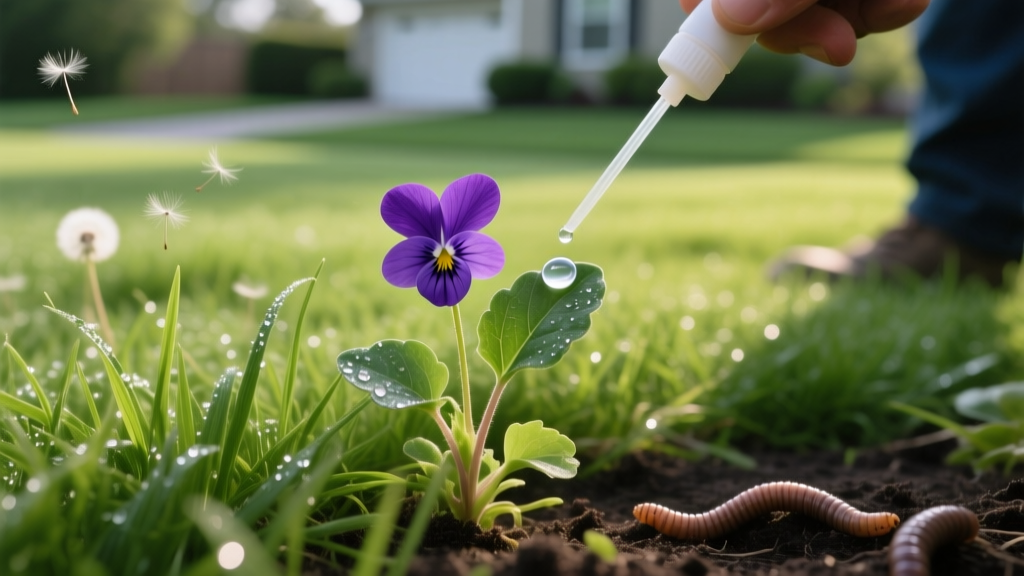
Wild Violet Weed Control: A Targeted Spot-Treatment Guide for Lawns
The Botanical Challenge: Why Wild Violets Resist Standard Herbicides
Wild violets (Viola sororia and Viola papilionacea) are perennial broadleaf weeds that frequently frustrate homeowners attempting standard lawn maintenance. Unlike annual weeds that complete their lifecycle in one season, wild violets survive via thick, fleshy underground rhizomes. When you pull a violet by hand, the rhizome almost inevitably snaps, leaving a fragment behind that rapidly regenerates into a new, larger rosette.
Furthermore, the leaves of the wild violet feature a dense, waxy cuticle. This evolutionary adaptation repels water and causes standard aqueous herbicide solutions to bead up and roll off the leaf surface before the active ingredients can penetrate the plant tissue. Achieving successful wild violet weed control requires a targeted spot-treatment approach that addresses both the waxy barrier and the deep root system.
Quick Identification & Biology Facts
- Scientific Name: Viola sororia (Common Blue Violet)
- Growth Habit: Low-growing perennial rosette, spreading via rhizomes and seeds.
- Leaf Structure: Heart-shaped (cordate) with a heavy waxy cuticle.
- Optimal Treatment Window: Early to mid-autumn (soil temperatures between 55°F and 65°F).
The Secret Weapon: Cleistogamous Flowers
One of the most critical, yet overlooked, aspects of wild violet biology is its dual-flower reproductive strategy. In spring, violets produce the showy purple or white flowers most people recognize. However, in late summer and fall, they produce cleistogamous flowers. These are small, closed, self-pollinating flowers that develop near the soil surface, hidden beneath the leaves. They never open, but they deposit viable seeds directly into the thatch layer. This means even if you prevent the spring flowers from going to seed, the plant is still silently populating your lawn in the fall. Spot-treating in autumn disrupts this secondary reproductive cycle while the plant is actively pulling nutrients—and herbicides—down into its rhizomes for winter storage.
Active Ingredient Matrix: Selecting the Right Herbicide
Not all broadleaf herbicides are created equal when it comes to wild violet weed control. Many off-the-shelf 'weed and feed' granular products lack the specific active ingredients required to translocate down to the violet's rhizome. Below is a comparison of the most effective liquid active ingredients for spot-treatment.
| Active Ingredient | Example Products (2026) | Efficacy on Violets | Notes & Constraints |
|---|---|---|---|
| Triclopyr (Ester) | Turflon Ester, Hi-Yield Triclopyr 61.6% | Excellent | Superior cuticle penetration. Best for cool-weather fall applications. |
| Three-Way Blend (2,4-D + MCPP + Dicamba) |
SpeedZone Broadleaf, Trimec Classic | Good to Very Good | Requires multiple applications (2-3) spaced 21 days apart for full rhizome kill. |
| Carfentrazone | Quicksilver, SpeedZone (as an additive) | Poor (Burn-down only) | Provides rapid visual burn of leaves but fails to kill the underground rhizome. Will regrow. |
| Quinclorac | Drive XLR8, Bayer Advanced Crabgrass Killer | Ineffective | Excellent for grassy weeds and clover, but virtually useless against wild violets. |
The Surfactant Multiplier: Breaking the Waxy Cuticle
The most common point of failure in DIY wild violet weed control is omitting a surfactant. Because of the leaf's waxy cuticle, water has a high contact angle on violet leaves, causing the spray to bead up. You must lower the surface tension of the spray solution to ensure the herbicide spreads evenly and penetrates the stomata.
For wild violets, a Methylated Seed Oil (MSO) is vastly superior to a standard Non-Ionic Surfactant (NIS). MSO contains fatty acids that actively soften and dissolve the waxy cuticle layer, allowing the herbicide to enter the plant tissue rapidly. According to turfgrass extension research from Penn State University, the inclusion of an MSO or high-quality crop oil concentrate can increase violet control efficacy by over 40% compared to herbicide applied with water alone.
Exact Mixing Ratios for a 1-Gallon Pump Sprayer
For spot-treating isolated patches of wild violets, a 1-gallon or 2-gallon hand-pump sprayer offers the precision needed to avoid wasting chemicals and to protect surrounding desirable turf. Use the following exact measurements for a 1-gallon batch:
- Triclopyr Ester (61.6% concentration): 1.0 to 1.5 fluid ounces.
- Methylated Seed Oil (MSO): 1.5 tablespoons (approx. 0.5% v/v ratio).
- Water: Fill to the 1-gallon mark.
Cost Analysis: A 16 oz bottle of professional-grade Triclopyr Ester costs approximately $45 in 2026. At a rate of 1.5 oz per gallon, that single bottle yields over 10 gallons of finished spot-treatment solution, bringing your chemical cost down to roughly $4.50 per gallon—a fraction of the cost of hiring a commercial lawn care service.
Step-by-Step Spot-Treatment Protocol
Timing and application technique are just as critical as the chemical selection. Follow this protocol for maximum rhizome destruction.
- Time the Application for Autumn: Apply between early September and mid-October. During this window, soil temperatures drop to the 55°F–65°F range, and the violet is actively translocating carbohydrates from the leaves down to the rhizomes for winter dormancy. The herbicide will hitch a ride directly to the root system.
- Pause Mowing: Do not mow your lawn for 48 hours before application. You need maximum leaf surface area to absorb the chemical. Similarly, wait 48 hours after spraying before mowing again.
- Check the Forecast: Ensure no rain is expected for at least 6 hours post-application. Avoid spraying if ambient air temperatures are below 45°F (plant metabolism is too slow to move the herbicide) or above 85°F (risk of chemical volatility and vapor drift damaging nearby ornamental shrubs).
- Mix and Agitate: Add water to the sprayer first, then the MSO, and finally the herbicide. Shake vigorously to emulsify the oil and water.
- Spray to Wetness, Not Runoff: Use a fine mist nozzle. Coat the violet leaves until they are uniformly wet, but stop before the liquid begins to drip onto the soil. Soil contact wastes the product and increases the risk of turf root uptake.
- Evaluate and Re-treat: Wait 14 to 21 days. The leaves will yellow, curl, and necroticize. If the center of the rosette is still producing new green growth, apply a second spot-treatment.
Expert Warning on Mechanical Removal: Never use a dethatching machine or a mechanical tiller to remove wild violets from a lawn. The blades will chop the fleshy rhizomes into dozens of tiny pieces, effectively planting a new violet from every single fragment. Always rely on chemical translocation or careful, deep hand-digging with a soil knife to extract the entire root mass intact.
Post-Treatment Lawn Recovery and Overseeding
Once the wild violets have been eradicated, they leave behind bare patches in the turf canopy that must be filled to prevent new weed seeds from germinating. However, broadleaf herbicides leave active residues in the soil that can severely stunt or kill germinating grass seed.
If you used a Triclopyr-based product, you must wait a minimum of 21 to 28 days after the final application before overseeding with cool-season grasses like Kentucky Bluegrass or Tall Fescue. If you utilized a Three-Way (2,4-D + MCPP + Dicamba) blend, the waiting period is generally 14 to 21 days. Always consult the specific manufacturer's label on your product for the exact reseeding interval, as adjuvants and formulation concentrations can alter soil residual activity. For comprehensive seasonal timing and turfgrass recovery strategies, refer to the Royal Horticultural Society's guidelines on violet management and local university extension turf programs.

