
Lawn Care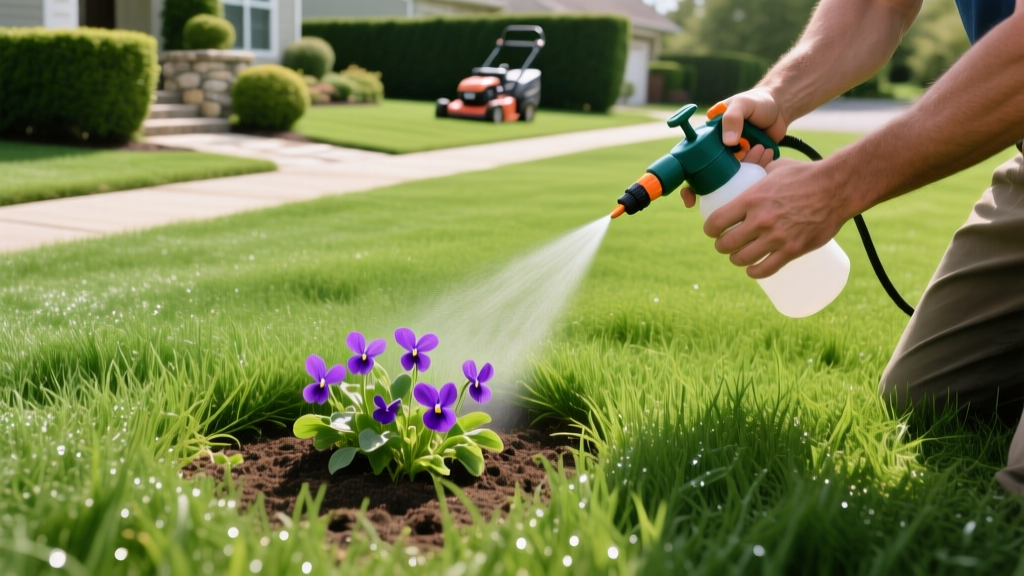
How to Eradicate Wild Violet Weed: Lawn Spot-Treatment Guide
The Biology of Wild Violet Weed: Why It Resists Standard Herbicides
Wild violet weed (Viola sororia and Viola pratincola) is a perennial broadleaf weed that frequently infiltrates thin, shaded, or poorly maintained turfgrass. Unlike annual weeds that rely on seed production, wild violets spread primarily through fleshy, underground rhizomes and above-ground stolons. This subterranean network stores massive amounts of carbohydrates, allowing the plant to regenerate rapidly even if the top growth is completely destroyed by a contact herbicide.
The primary reason homeowners fail to eradicate wild violet weed is its leaf structure. Violet leaves possess a thick, waxy cuticle that creates a high contact angle for water-based solutions. When you spray a standard off-the-shelf weed killer, the droplets bead up and roll off the leaf surface before the active ingredient can penetrate the plant tissue. According to University of Minnesota Extension, overcoming this waxy barrier is the single most critical factor in achieving systemic control of the rhizome network.
⚠️ The Waxy Cuticle Warning: Never rely on ready-to-use (RTU) aerosol or pump sprays from big-box stores for wild violets. These formulations rarely contain adequate surfactant levels to break the leaf's surface tension, resulting in superficial leaf burn while the rhizomes remain entirely unaffected.
Active Ingredient Comparison for Violet Control
Not all broadleaf herbicides are created equal. While 2,4-D is the backbone of most lawn weed killers, it is notoriously weak against wild violets when used alone. Triclopyr, a synthetic auxin herbicide, is the undisputed gold standard for violet control because it efficiently translocates through the phloem down into the rhizomes, causing fatal epinasty (uncontrolled, twisting growth) and eventual root starvation.
| Active Ingredient | Efficacy on Violets | Example Professional Product | Approx. Cost per 1,000 sq ft |
|---|---|---|---|
| Triclopyr (Ester or Amine) | Excellent (90-100%) | T-Zone SE, Turflon Ester Ultra | $0.15 - $0.25 |
| 2,4-D + Dicamba + MCPP | Fair (40-60%) | Trimec Classic, 3-Way Max | $0.08 - $0.12 |
| Quinclorac | Poor (10-20%) | Drive XLR8, QuinKill Max | $0.20 - $0.30 |
| Sulfentrazone + Triclopyr | Excellent (Fast burn + root kill) | SpeedZone Broadleaf | $0.18 - $0.28 |
The Surfactant Mandate: Breaking the Surface Tension
To force a Triclopyr-based herbicide through the violet's waxy cuticle, you must add a high-quality surfactant. NC State Extension emphasizes that omitting a surfactant can reduce herbicide efficacy on hard-to-kill broadleaves by up to 70%.
Non-Ionic Surfactant (NIS) vs. Methylated Seed Oil (MSO)
- Non-Ionic Surfactant (NIS): The safest and most reliable choice for spot-treating wild violets in residential lawns. It reduces water's surface tension without increasing the risk of turfgrass phytotoxicity (chemical burn). Mix at a rate of 0.25% v/v (approximately 1/2 teaspoon per gallon of water).
- Methylated Seed Oil (MSO): A heavier, oil-based penetrant that is highly effective at stripping waxy cuticles. However, MSO can severely burn cool-season grasses like Kentucky Bluegrass and Tall Fescue if applied when daytime temperatures exceed 80°F. Reserve MSO for late fall applications when temperatures are consistently below 75°F.
Step-by-Step Fall Spot-Treatment Protocol
Timing is everything. While you can spray wild violets in the spring, fall (September through November) is the optimal window. During autumn, the plant is actively translocating carbohydrates from the leaves down into the rhizomes to prepare for winter dormancy. This biological process acts as a conveyor belt, pulling the systemic herbicide directly into the root zone.
- Prepare the Canopy: Mow your lawn to a height of 2.5 inches exactly 48 hours before application. This removes excess turfgrass competition and ensures the herbicide reaches the low-growing violet rosettes.
- Calibrate Your Sprayer: Fill a 2-gallon pump sprayer with exactly 1 gallon of water. Walk at a normal, steady pace while spraying in a 4-foot wide swath. Mark the distance it takes to empty the gallon. If you cover 500 square feet with 1 gallon, your application rate is 2 gallons per 1,000 sq ft. Adjust your walking speed or nozzle pressure to hit exactly 1 to 1.5 gallons per 1,000 sq ft.
- Mix the Solution: For a 2-gallon tank targeting 1,000 sq ft, add 1.5 fluid ounces of a Triclopyr-heavy mix (like T-Zone SE), followed by 1 teaspoon of NIS surfactant. Fill the rest of the tank with water and agitate gently to avoid excessive foaming.
- Apply with Precision: Use a fan-nozzle tip to apply a fine, even mist directly over the violet patches. Do not spray to the point of runoff; the leaves should look uniformly damp but not dripping.
- Observe the Weather Window: Apply only when daytime temperatures are between 60°F and 80°F, and ensure no rain is forecasted for at least 24 hours. Avoid spraying during temperature inversions (early morning fog) to prevent herbicide drift.
Edge Cases: Treating Near Ornamental Beds
Wild violets frequently bridge the gap between the lawn and landscaped flower beds. Triclopyr, particularly in ester formulations, has a moderate vapor drift potential and can be absorbed by the shallow roots of ornamental shrubs if sprayed too close to the drip line. When treating violets within 3 feet of ornamental beds, switch to an amine-based Triclopyr product (which has lower volatility) and use a shielded spray nozzle or a foam brush to physically paint the herbicide onto the violet leaves, eliminating drift entirely.
Cultural Prevention: Closing the Canopy and Adjusting Soil
Chemical eradication is only a temporary fix if the underlying environmental conditions favor weed growth. Wild violets are highly shade-tolerant and thrive in compacted, acidic soils where turfgrass struggles. To prevent recolonization, implement the following cultural practices:
1. Correct Soil pH
Violets prefer a soil pH between 5.5 and 6.2. Most turfgrasses require a pH of 6.5 to 7.0 to efficiently uptake nitrogen and phosphorus. Conduct a soil test and apply pelletized lime at the recommended rate (typically 20 to 30 lbs per 1,000 sq ft) to raise the pH, thereby shifting the competitive advantage back to your grass.
2. Overseed with Shade-Tolerant Cultivars
If your lawn is heavily shaded by mature trees, standard Kentucky Bluegrass will thin out, leaving voids for violet rhizomes to expand. Overseed these areas with fine fescues (such as creeping red fescue or hard fescue) in the early fall. Fine fescues require less sunlight and naturally form a dense, competitive mat that physically chokes out emerging violet seedlings.
3. Improve Airflow and Light Penetration
Hire an arborist to perform a canopy elevation on overhanging trees, removing lower branches to allow morning sunlight to reach the turf. Increased UV exposure and airflow reduce the damp, cool microclimate that wild violets require to flourish.

