
Lawn Care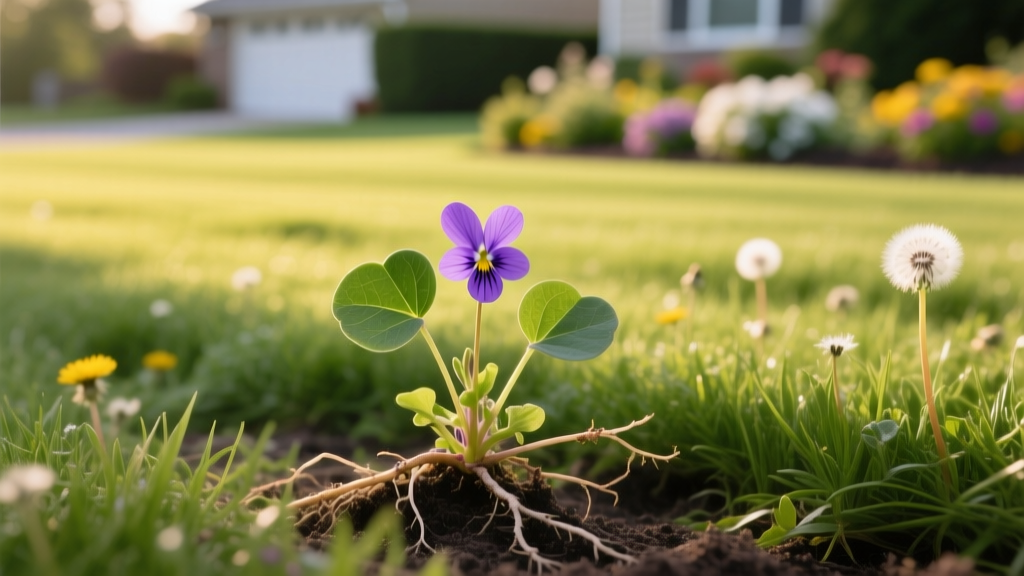
Wild Violet Lawn Weed: Identification and Spot-Treatment Guide
Botanical Profile: Identifying the Wild Violet Lawn Weed
The wild violet lawn weed (Viola sororia and Viola papilionacea) is a persistent perennial broadleaf weed that aggressively colonizes cool-season turfs like Kentucky bluegrass and tall fescue. While many homeowners recognize the conspicuous purple or white spring flowers, the plant's true survival mechanism lies beneath the surface and in its hidden reproductive structures.
Unlike annual weeds that die off after seeding, wild violets spread via a dense network of underground rhizomes. More insidiously, they produce cleistogamous flowers—small, self-pollinating, unopened flower buds hidden near the soil line that produce viable seeds without ever blooming. This means that even if you mow your lawn frequently and remove every visible purple blossom, the wild violet is still actively dropping seeds at the soil level. According to the Penn State Extension, this dual-reproduction strategy makes the wild violet one of the most difficult broadleaf weeds to eradicate from residential lawns.
Wild Violet vs. Creeping Charlie: A Quick Diagnostic
Homeowners frequently confuse wild violets with ground ivy (Creeping Charlie). Misidentification leads to incorrect herbicide selection. Use this diagnostic checklist:
- Leaf Structure: Wild violet leaves are distinctly heart-shaped with a pointed tip and upright posture. Creeping Charlie leaves are more rounded, heavily scalloped, and grow flat against the soil.
- Stem Anatomy: Violets have round, fleshy stems. Creeping Charlie features square stems characteristic of the mint family.
- Odor Test: Crush a leaf between your fingers. Creeping Charlie emits a strong, pungent minty odor. Wild violet leaves have virtually no scent when crushed.
The Waxy Cuticle Problem: Why Standard Sprays Fail
The most common failure mode in treating the wild violet lawn weed is the application of standard, off-the-shelf 2,4-D herbicides without a surfactant. Wild violet leaves possess a thick, waxy cuticle designed to repel water and protect the plant from environmental stress. When you spray a standard aqueous herbicide solution onto these leaves, the droplets simply bead up and roll off onto the soil, wasting the chemical and potentially harming the turf's root system.
⚠️ CRITICAL WARNING: Never apply systemic herbicides to wild violets during peak summer heat (above 85°F). The plant enters a state of summer dormancy to conserve moisture, shutting down the vascular system that transports the herbicide down to the rhizomes. Furthermore, applying ester-based formulations in high heat will volatilize the chemical, causing severe drift damage to nearby ornamental trees and garden beds.
Chemical Spot-Treatment Protocol
To successfully eradicate the wild violet lawn weed, you must use an herbicide containing Triclopyr or Quinclorac, paired with a high-quality non-ionic surfactant (NIS). Triclopyr is the undisputed industry standard for tough, waxy broadleaf weeds. Professional-grade concentrates like T-Zone SE (which combines Triclopyr, 2,4-D, Dicamba, and Sulfentrazone) or SpeedZone offer vastly superior results compared to consumer-grade ready-to-spray bottles.
Step-by-Step Mixing and Application
- Calculate Your Volume: For spot treatments, a 1-gallon or 2-gallon pump sprayer is ideal. It provides the precision needed to avoid overspraying desirable turf.
- Mix the Surfactant First: Fill the sprayer halfway with water. Add 1/2 teaspoon (roughly 0.25% v/v) of a non-ionic surfactant, such as Southern Ag Surfactant or a methylated seed oil (MSO). Agitate gently. The surfactant breaks the surface tension of the water, allowing the chemical to penetrate the violet's waxy cuticle.
- Add the Herbicide: Add 1.2 to 1.5 fluid ounces of T-Zone SE per gallon of water. This is the exact label rate for spot-treating stubborn perennial broadleaf weeds in cool-season grasses.
- Apply to the Point of Runoff: Spray the wild violet leaves until they are visibly wet and glistening, but stop before the liquid begins to drip off the leaf edges. Oversaturating the leaf provides no additional benefit and wastes product.
- Observe the Weather Window: Ensure no rain is forecast for at least 6 hours post-application, and avoid mowing the lawn for 48 hours before and 48 hours after spraying to maximize leaf surface area absorption.
Cost Analysis: A gallon of professional T-Zone SE costs approximately $130, but it treats up to 43,000 square feet. For a typical 5,000 sq. ft. lawn requiring spot treatment, your chemical cost is less than $1.50 per application. Consumer ready-to-use bottles cost $15 to $20 and often lack sufficient Triclopyr concentrations to kill the rhizome network, resulting in a false economy where the weed returns in three weeks.
Spot Treatment Decision Matrix
Not every wild violet infestation requires chemical intervention. Use this matrix to determine the most efficient eradication strategy based on your lawn's specific conditions.
| Infestation Scale | Soil Condition | Recommended Action | Expected Timeline |
|---|---|---|---|
| Isolated (1-5 plants) | Loose, well-aerated | Mechanical extraction using a 10-inch serrated stand-up weeder | Immediate |
| Moderate (Patches of 10-20) | Moderately compacted | Triclopyr + NIS spot spray in early fall (September) | 14-21 days for full necrosis |
| Severe (Widespread colonies) | Heavily compacted, clay | Fall broadcast application + Spring core aeration + Overseeding | 2 applications over 6 months |
Mechanical Removal: The Rhizome Extraction Challenge
If you prefer organic lawn care or are treating a small vegetable garden border, mechanical removal is an option, but hand-pulling is largely ineffective. When you pull a wild violet by the leaves, the brittle rhizome snaps cleanly at the crown. The remaining root mass simply generates a new rosette of leaves within 14 to 21 days.
To successfully extract the weed manually, you must use a stand-up weeder equipped with a deep, V-notched steel blade (such as the Radius Garden Ergo Weeder or Grampa's Weeder). Drive the blade at least 4 inches into the soil at a 45-degree angle directly beneath the plant's crown to sever the taproot and primary rhizomes. This method is highly effective for isolated weeds but is prohibitively labor-intensive for lawns with widespread colonies.
Post-Eradication Turf Recovery
Wild violets are indicator weeds. They thrive in environments where turfgrass struggles: specifically, in areas with heavy soil compaction, poor drainage, and low nitrogen levels. Eradicating the weed is only half the battle; if you do not alter the soil environment, the Missouri Botanical Garden notes that dormant violet seeds in the soil bank will quickly germinate to fill the void.
Pro-Tip for Lawn Recovery: After the wild violet foliage has completely browned and died back (usually 3 weeks post-spray), rake out the dead thatch. Immediately perform core aeration over the treated patches to relieve the soil compaction that invited the weeds in the first place. Top-dress the aerated holes with a 50/50 mix of fine compost and topsoil, then overseed with a shade-tolerant tall fescue blend to outcompete future violet seedlings.
By combining the correct Triclopyr-based chemistry with a non-ionic surfactant, applying during the optimal fall translocation window, and addressing the underlying soil compaction, you can permanently eliminate the wild violet lawn weed and restore a dense, uniform turf canopy.

