
Lawn Care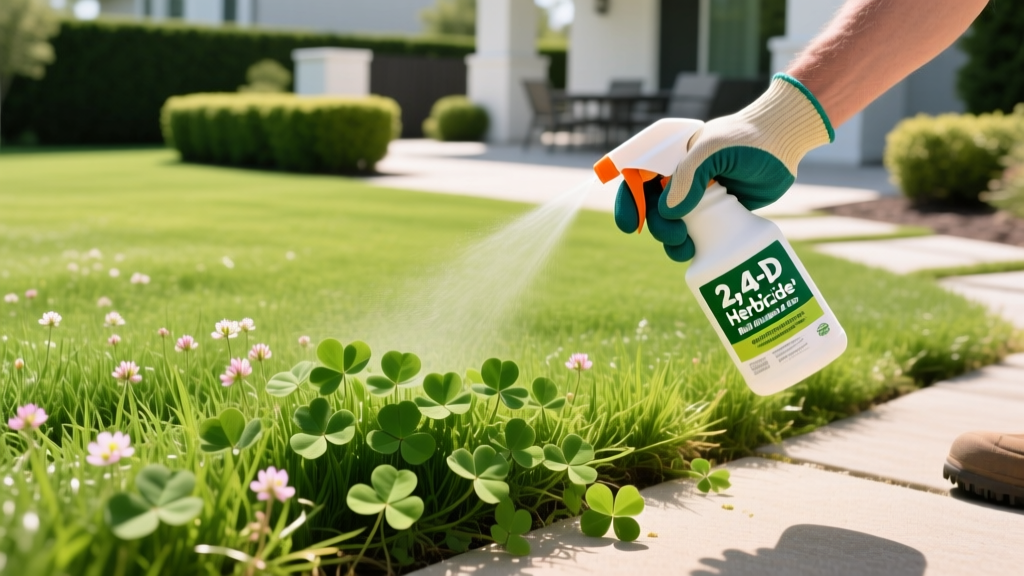
Will 2,4-D Kill Clover? Best Herbicide Mixes & Tips
The Short Answer: Will 2,4-D Kill Clover?
Yes, 2,4-D will kill clover, but straight 2,4-D is rarely effective on its own against mature white clover (Trifolium repens) or oxalis. While 2,4-D is a foundational broadleaf herbicide, clover’s waxy leaf cuticle and stoloniferous (creeping) growth habit allow it to survive single-active-ingredient applications. To achieve a complete kill, 2,4-D must be combined with secondary active ingredients like Dicamba, MCPP, or Triclopyr in a 'three-way' or 'four-way' herbicide formulation.
Key Takeaway: Do not buy straight 2,4-D amine for clover control. Purchase a three-way selective herbicide (such as Hi-Yield Trimec or Gordon's SpeedZone) that uses 2,4-D as the primary active ingredient alongside Dicamba and MCPP for systemic stolon eradication.
How 2,4-D Works on Clover (The Science)
2,4-Dichlorophenoxyacetic acid (2,4-D) is a synthetic auxin—a class of plant hormones that regulate growth. When clover absorbs 2,4-D through its foliage, the chemical mimics natural growth hormones but removes the plant's biological 'off-switch.' According to the United States Environmental Protection Agency (EPA), this causes uncontrolled, unsustainable cellular division. The clover's vascular tissue (phloem and xylem) rapidly clogs, leading to stem curling (epinasty), leaf cupping, and eventual necrosis within 14 to 21 days.
Why Straight 2,4-D Often Fails (And What to Use Instead)
Clover is a perennial broadleaf weed that spreads via above-ground stems called stolons. Straight 2,4-D often burns the top trifoliate leaves but fails to translocate down into the stolon nodes. Because clover can regenerate entirely from a single surviving node, the weed returns within three to four weeks. Furthermore, NC State Extension notes that white clover leaves possess a thick, waxy cuticle that causes water-based herbicide droplets to bead up and roll off onto the soil, where 2,4-D is rapidly degraded by microbes.
The Solution: Three-Way and Four-Way Herbicides
To overcome clover's biological defenses, turf professionals use multi-active-ingredient blends. Dicamba provides soil-residual activity and attacks the stolon nodes, while MCPP (Mecoprop) accelerates the translocation process. For highly resistant clover patches, a four-way mix adds Carfentrazone, which provides a rapid 'burn-down' effect that shreds the waxy cuticle, allowing the 2,4-D and Dicamba to penetrate deeply.
Top Herbicide Formulations for Clover Eradication
Selecting the right concentrate depends on your turf type and budget. Below is a comparison of the most effective 2,4-D-based clover killers available in 2026.
| Product Name | Active Ingredients | Efficacy on Clover | Avg. Price / Gallon | Safe Grass Types |
|---|---|---|---|---|
| PBI Gordon Trimec 992 | 2,4-D, Dicamba, MCPP | Excellent (Standard 3-way) | $35 - $45 | KBG, Fescue, Bermuda, Zoysia |
| Gordon's SpeedZone | Carfentrazone, 2,4-D, MCPP, Dicamba | Superior (Fast burn-down) | $110 - $130 | KBG, Fescue, Bermuda, Zoysia |
| Ortho WeedClear for Southern Lawns | 2,4-D (Amine), Quinclorac, Dicamba | Good (Slower systemic kill) | $20 - $25 (RTU) | St. Augustine, Centipede, Bahia |
| Hi-Yield Triclopyr Ester | Triclopyr, 2,4-D | Superior (Tough/Oxalis clover) | $50 - $65 | Bermuda, Zoysia (Cool-season only) |
Step-by-Step Application Guide for Maximum Kill
Applying a three-way 2,4-D herbicide requires precise timing and mixing to prevent turf damage and ensure the chemical reaches the clover's root system. Follow this protocol for optimal results.
- Mow 48 Hours Prior: Cut your lawn to its standard height two days before application. This removes excess turf canopy, exposing the clover leaves to the spray, and gives the clover time to push out new, highly absorbent foliage.
- Check the Weather Window: 2,4-D is highly volatile at high temperatures. Only spray when daytime temperatures are strictly between 60°F and 85°F. Spraying above 85°F causes the chemical to vaporize and drift, which can severely damage nearby ornamental shrubs, tomato plants, and grapevines.
- Mix with a Surfactant: Because clover repels water, you must add a Non-Ionic Surfactant (NIS). Mix 2.5 fluid ounces of Trimec (or label equivalent) with 1 gallon of water, then add 1/2 teaspoon of NIS. This breaks the surface tension, allowing the herbicide to coat the waxy clover leaves evenly.
- Spray to Dampness, Not Runoff: Use a pump sprayer with a fan-nozzle tip. Apply a fine mist directly to the clover patches until the leaves are visibly wet but not dripping. Over-spraying wastes chemical and increases soil runoff.
- Wait 24-48 Hours Before Watering: Do not irrigate the lawn or allow rain to wash the herbicide off the foliage for at least 24 hours. Systemic translocation into the stolons takes time.
Warning: Never use a hose-end sprayer for 2,4-D applications. Hose-end sprayers distribute chemical too heavily and unevenly, leading to localized turf burn and massive chemical waste. Always use a calibrated 1-gallon or 2-gallon hand-pump tank sprayer.
Grass Safety: Will 2,4-D Harm Your Turf?
While 2,4-D is a 'selective' herbicide—meaning it targets broadleaf weeds while sparing grasses—its safety profile varies drastically depending on your turf species and the chemical formulation (Amine vs. Ester).
- Cool-Season Grasses (Kentucky Bluegrass, Tall Fescue, Perennial Ryegrass): Highly tolerant to both Amine and Ester formulations of 2,4-D. Three-way mixes like Trimec are perfectly safe when applied at standard rates (2.5 oz per 1,000 sq ft).
- Warm-Season Grasses (Bermuda, Zoysia): Tolerant to 2,4-D, but applications should be avoided during the stressful peak heat of mid-summer (July/August). Apply in late spring or early fall when the grass is actively growing but temperatures are mild.
- St. Augustine & Centipede Grass: High Risk. These grasses are highly sensitive to 2,4-D, particularly Ester formulations, which will cause severe yellowing and stunting. If you have St. Augustine grass, you must use an Amine-based 2,4-D product specifically labeled for southern lawns (like Ortho WeedClear for Southern Lawns) at reduced rates, or switch entirely to an Atrazine-based herbicide.
According to University of Minnesota Extension, applying 2,4-D to newly seeded lawns is also dangerous. Wait until new turf has been mowed at least three times before applying any broadleaf herbicides, as young grass roots cannot metabolize the chemical safely.
Common Clover Misidentifications: Oxalis vs. True Clover
Many homeowners spray 2,4-D on what they believe is clover, only to find the weed survives. This is often due to misidentification. Oxalis (Yellow Wood Sorrel) is frequently confused with clover because it also features three-leaflet compound leaves. However, Oxalis has heart-shaped leaflets (true clover has oval/teardrop leaflets) and produces small yellow flowers (true white clover produces white/pink puffball flowers).
Oxalis is notoriously resistant to standard 2,4-D and Dicamba mixes. If you identify Oxalis in your lawn, you must upgrade to a herbicide containing Triclopyr or Fluroxypyr (such as Hi-Yield Triclopyr Ester or Spot Ultra), which are specifically formulated to penetrate the tough taproots and bulbils of wood sorrel.
Frequently Asked Questions
How long does it take for 2,4-D to kill clover?
You will notice the clover leaves twisting, curling, and yellowing within 3 to 5 days of application. Complete necrosis and stolon death typically take 14 to 21 days, depending on soil moisture and temperature.
Can I mix 2,4-D with fertilizer or grass seed?
Do not mix 2,4-D with liquid fertilizers in the same tank; the high salt content of fertilizers can cause the 2,4-D amine to precipitate out of the solution, clogging your sprayer and rendering the herbicide useless. Furthermore, never apply 2,4-D immediately before or after overseeding. Wait at least 4 weeks after seeding, or apply the herbicide 2 weeks before dropping new grass seed.
Does granular 2,4-D work on clover?
Granular 'weed and feed' products containing 2,4-D are highly inefficient for clover control. Clover leaves are small and waxy, making it difficult for granules to stick to the foliage long enough to absorb the chemical. Liquid applications with a surfactant are exponentially more effective and use a fraction of the active ingredient.

