
Lawn Care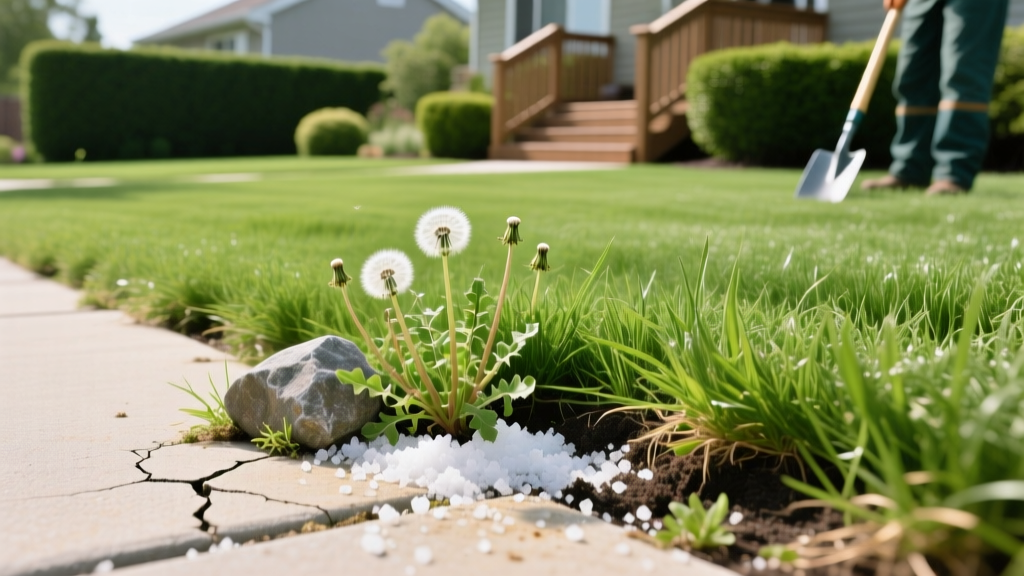
Will Rock Salt Kill Weeds? The Science, Soil Risks, and Alternatives
The Short Answer: Yes, But at a Severe Cost
If you are asking, 'will rock salt kill weeds?', the direct answer is yes. Sodium chloride (NaCl) is highly effective at desiccating plant tissue and destroying unwanted vegetation. However, using rock salt as a primary weed control method in or near your lawn is a scorched-earth tactic that causes long-term ecological damage to your soil. While it may seem like a cheap, accessible DIY herbicide, the residual sodium toxicity it leaves behind can sterilize soil, collapse soil structure, and make replanting nearly impossible for years.
This guide breaks down the exact biological mechanisms of salt-induced plant death, identifies the narrow scenarios where rock salt is actually appropriate, and provides professional-grade alternatives that eliminate weeds without destroying your soil's cation exchange capacity (CEC).
The Science: How Sodium Chloride Destroys Plant Tissue
Rock salt kills weeds through two primary mechanisms: osmotic stress and ion toxicity. Understanding these processes explains why salt is so lethal to both target weeds and desirable turfgrass.
1. Osmotic Stress (Plasmolysis)
Plant roots absorb water based on water potential gradients. When you introduce high concentrations of NaCl to the soil, the soil's water potential drops drastically below that of the plant's root cells. Instead of absorbing water, the weed's roots actually lose water to the surrounding soil. This causes the cell membranes to shrink away from the cell walls—a fatal biological process known as plasmolysis. The weed rapidly wilts, turns brown, and dies of dehydration, even if the soil is physically wet.
2. Ion Toxicity
As the weed attempts to take up water, it inevitably absorbs sodium (Na+) and chloride (Cl-) ions. Chloride accumulation in leaf tissue disrupts photosynthesis and causes severe necrosis (leaf burn). Sodium interferes with the uptake of essential macronutrients like potassium (K+) and calcium (Ca2+), leading to systemic metabolic failure.
Warning: The Sterilization Threshold
Applying just 1 tablespoon of rock salt per square foot is enough to permanently sterilize the soil in that micro-zone. The sodium binds tightly to soil particles and will not degrade or break down over time; it can only be physically leached out with massive volumes of water.
Applying just 1 tablespoon of rock salt per square foot is enough to permanently sterilize the soil in that micro-zone. The sodium binds tightly to soil particles and will not degrade or break down over time; it can only be physically leached out with massive volumes of water.
Where Rock Salt Actually Makes Sense (And Where It Doesn't)
Because of its residual toxicity, rock salt should never be used in garden beds, lawn borders, or areas where you plan to grow anything in the future. It is strictly reserved for hardscape and sterile zone maintenance.
| Application Zone | Suitability | Reasoning & Edge Cases |
|---|---|---|
| Driveway Cracks & Paver Joints | Approved | Keeps dandelions and crabgrass out of hardscape. Ensure runoff does not flow into adjacent lawn beds. |
| Gravel Paths & Alleys | Approved | Effective for maintaining sterile gravel zones. Apply sparingly (1/2 cup per 10 sq ft) to prevent groundwater contamination. |
| Lawn Edges & Borders | Never Use | Sodium will migrate laterally via capillary action, killing the roots of your bordering turfgrass and ornamentals. |
| Vegetable & Flower Beds | Never Use | Will cause immediate sodium toxicity, ruining the soil structure and poisoning future crops. |
The Hidden Costs: Soil Structure Collapse and Microbial Death
The most devastating impact of rock salt is not on the weed itself, but on the soil architecture. According to the USDA Natural Resources Conservation Service, high sodium levels fundamentally alter the physical properties of clay-heavy soils.
Healthy soil relies on calcium (Ca2+) and magnesium (Mg2+) to bind clay particles together into porous aggregates—a process called flocculation. Sodium ions (Na+), however, have a single positive charge and a large hydration radius. When sodium saturates the soil's Cation Exchange Capacity (CEC), it forces clay platelets to repel one another. This dispersion destroys soil pore spaces, resulting in a hardpan surface that is impermeable to water and oxygen.
Furthermore, the University of Minnesota Extension notes that high salinity creates an osmotic shock that decimates beneficial soil microbiology, including mycorrhizal fungi and nitrogen-fixing bacteria, effectively turning living topsoil into dead dirt.
How to Remediate Salt-Damaged Soil
If you or a previous homeowner used rock salt to kill weeds and the soil is now barren, compacted, and crusted, you must actively displace the sodium. You cannot simply wait for it to 'wash away.' Follow this exact remediation protocol:
- Test the Soil: Order a soil test to determine your Sodium Adsorption Ratio (SAR) and Electrical Conductivity (EC). If SAR is above 13, the soil is classified as sodic and requires chemical amendment.
- Apply Gypsum (Calcium Sulfate): Gypsum (CaSO4·2H2O) is the industry standard for sodic soil remediation. The calcium ions will displace the sodium ions on the soil's exchange sites. For moderate damage, apply 50 lbs of granular gypsum per 1,000 square feet. For severe sterilization, apply up to 100 lbs per 1,000 sq ft.
- Incorporate and Agitate: Use a core aerator or a rototiller to work the gypsum into the top 4 to 6 inches of the soil profile.
- Heavy Leaching: Once the calcium has displaced the sodium, the sodium pairs with the sulfate to form sodium sulfate, a highly soluble salt. You must then irrigate the area deeply with low-salt water (at least 2 inches of water per week for 4-6 weeks) to flush the sodium sulfate down below the root zone.
Pro Tip: Do not use limestone (calcium carbonate) to remediate salt damage unless your soil pH is highly acidic (below 6.0). Limestone dissolves too slowly to provide the immediate calcium flush required to displace sodium. Stick to agricultural gypsum.
Superior Alternatives for Targeted Weed Control
If your goal is to kill weeds without sterilizing the earth, modern agronomy offers several highly effective, low-residual alternatives. Below is a comparison matrix of professional-grade non-selective and organic herbicides.
| Active Ingredient | Type | Soil Residual | Cost Estimate | Best Use Case |
|---|---|---|---|---|
| 20% Acetic Acid (Horticultural Vinegar) | Non-Selective Contact | None (Degrades in 48 hrs) | $40 - $60 / Gallon | Driveway cracks, young annual weeds. Requires PPE (goggles/gloves) as it is highly corrosive. |
| Pelargonic Acid (e.g., Scythe) | Non-Selective Contact | None | $150 / Gallon | Rapid burn-down of tough perennial weeds. Strips the leaf cuticle causing immediate desiccation. |
| Iron HEDTA (e.g., Fiesta) | Selective Broadleaf | Minimal (Iron is a micronutrient) | $80 / Gallon | Killing dandelions and clover inside the lawn without harming surrounding turfgrass. |
| Boiling Water | Thermal | None | Free (Cost of energy) | Spot treatment for isolated weeds in paver joints. Kills the crown and taproot instantly. |
Why Iron HEDTA is the Gold Standard for Lawns
If you are dealing with broadleaf weeds in your actual turfgrass, Iron HEDTA (chelated iron) is the safest, most effective choice. Monocots (like Kentucky Bluegrass, Bermuda, and Fescue) naturally tolerate high iron levels and possess a metabolic mechanism to sequester it. Dicots (broadleaf weeds like dandelions, plantain, and clover) absorb the iron uncontrollably, leading to lethal oxidative stress and cellular necrosis within hours. It leaves no toxic soil residual and actually provides a slight greening effect to your grass.
Frequently Asked Questions
Will rock salt kill weeds permanently?
Rock salt will kill the existing weeds and prevent new seeds from germinating in that exact spot for several months to years. However, it is not a permanent physical barrier; eventually, heavy rainfall will dilute the sodium concentration enough for highly resilient pioneer weeds to take root again.
Does Epsom salt kill weeds like rock salt does?
No. Epsom salt is magnesium sulfate (MgSO4). While applying massive, concentrated doses of Epsom salt can cause osmotic stress and burn plant leaves, it does not cause the severe, long-term soil structural collapse associated with sodium chloride. In fact, magnesium is a secondary macronutrient required for plant chlorophyll production.
How long does it take for rock salt to kill a weed?
When applied directly to the base of a weed and watered in slightly, you will see wilting and desiccation within 24 to 48 hours. Complete necrosis of the root system typically takes 7 to 10 days, depending on the weed's taproot depth and the ambient temperature.
Final Recommendations
Rock salt is an effective desiccant, but its utility in modern lawn care is strictly limited to sterile hardscape zones like driveway expansion joints and gravel alleys. The risk of lateral sodium migration, soil structure dispersion, and long-term CEC damage far outweighs the benefit of a cheap DIY weed killer. For lawn beds and garden borders, transition to targeted contact herbicides like pelargonic acid or horticultural vinegar, and utilize Iron HEDTA for selective broadleaf control within your turf. Protect your soil's biology, and your lawn will naturally outcompete future weed invasions.

