
Lawn Care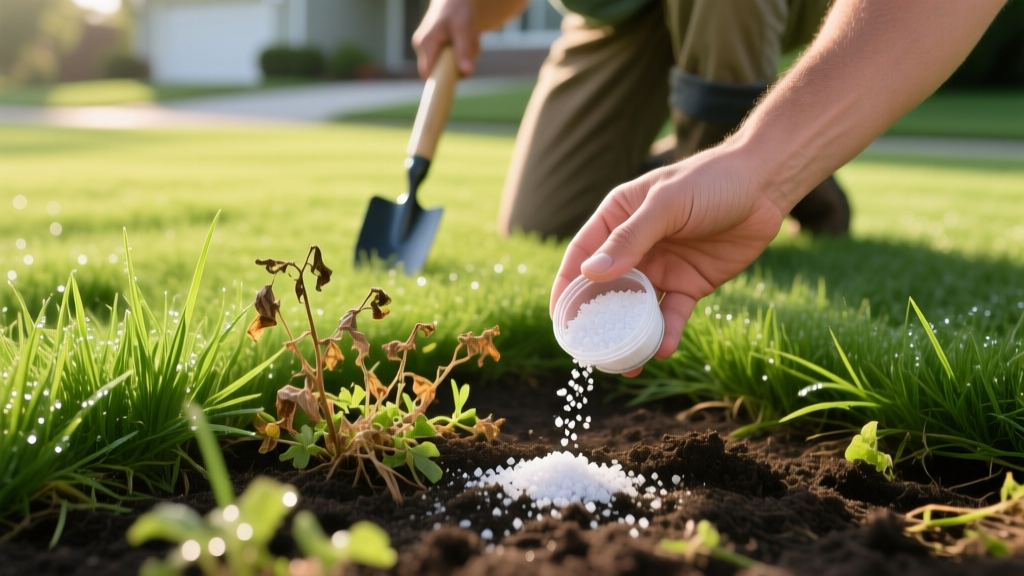
Will Salt Kill Weeds? The Truth About Sodium Herbicides and Soil Damage
The short answer to whether salt kills weeds is yes. Sodium chloride (NaCl) is a highly effective, non-selective desiccant that will rapidly destroy plant tissue. However, using salt as a DIY herbicide in or near your lawn is widely considered a catastrophic mistake by turfgrass scientists. While it provides immediate weed control, it simultaneously sterilizes the soil, destroys soil structure, and creates long-term toxicity that prevents future plant growth.
This guide breaks down the exact biological mechanisms of salt toxicity, the severe risks to your soil's cation exchange capacity, and the specific, lawn-safe organic alternatives you should use instead in 2026.
The Science of Salt as a Herbicide
Salt kills plants through two primary biological mechanisms: osmotic stress and ion toxicity. When high concentrations of sodium chloride are introduced to the soil, it drastically lowers the soil's water potential.
- Osmotic Desiccation: Plant roots absorb water through osmosis, moving water from an area of low solute concentration (the soil) to high solute concentration (the root cells). Salt reverses this gradient, literally pulling water out of the plant's roots and causing rapid cellular dehydration.
- Ion Toxicity: As the plant struggles to take up water, it absorbs toxic levels of chloride (Cl-) and sodium (Na+) ions. Chloride accumulates in the leaf margins, causing severe necrosis (tissue death), while sodium interferes with essential enzyme functions and photosynthesis.
⚠️ Warning: The 'Epsom Salt' Myth
Many DIY gardening blogs confuse rock salt (sodium chloride) with Epsom salt (magnesium sulfate). Epsom salt will not kill weeds. Magnesium and sulfur are essential secondary macronutrients. Applying Epsom salt to weeds will likely act as a fertilizer, promoting lusher, greener weed growth rather than killing it. Only sodium chloride or potassium chloride salts possess the necessary desiccant properties for weed control.
Why Salt is a Lawn Care Disaster
While salt effectively kills surface vegetation, its interaction with soil chemistry causes structural damage that can take years to reverse. According to turfgrass pathology research from Penn State Extension, excessive sodium fundamentally alters the physical properties of soil, particularly in clay-heavy lawns.
Soil Dispersion and Hardpan Formation
Healthy soil relies on calcium and magnesium to bind clay particles together into stable aggregates, creating pore spaces for air and water. Sodium ions, however, have a single positive charge and a large hydration shell. When sodium saturates the soil, it displaces calcium on the clay's cation exchange sites. This causes the clay particles to repel one another—a process called soil dispersion.
The result is a collapsed soil structure. The dispersed clay plugs soil pores, creating an impermeable hardpan crust that prevents water infiltration, gas exchange, and root penetration. Once this crust forms, your lawn cannot recover without mechanical and chemical intervention.
Groundwater Leaching and Salinity Spread
Salt does not break down or evaporate. When it rains, sodium chloride leaches downward into the water table or runs off into storm drains. The University of Minnesota Extension notes that runoff from salt-heavy DIY treatments can elevate the salinity of local watersheds, harming aquatic ecosystems and contaminating municipal groundwater supplies.
Where Salt Can Be Used Safely (With Extreme Caution)
There are specific, isolated hardscapes where salt can be used as a targeted weed killer without risking your lawn's soil biology. These areas must be completely disconnected from your turfgrass root zones and garden beds.
- Driveway Cracks: Weeds growing through isolated concrete or asphalt cracks.
- Gravel Paths: Unlined gravel walkways far from planting beds.
- Patio Paver Joints: The polymeric sand joints between stone pavers.
The Boiling Water and Salt Protocol
If you must use salt in these isolated zones, use this specific ratio to minimize residual soil toxicity:
- Boil 1 gallon of water.
- Dissolve exactly 1 cup of standard rock salt (do not exceed this ratio).
- Add 1 tablespoon of liquid dish soap (acts as a surfactant to break the water's surface tension).
- Pour directly into the crack or paver joint during the hottest part of the day.
Effective, Lawn-Safe Alternatives to Salt
If you need to kill weeds near your lawn, garden, or desirable plants, you must use herbicides that break down harmlessly in the soil. Below is a comparison matrix of the most effective non-selective and selective organic alternatives available in 2026.
| Active Ingredient | Mechanism of Action | Lawn Safety | Est. Cost (Per Gallon) |
|---|---|---|---|
| Acetic Acid (20-30%) | Cell membrane destruction via rapid desiccation. | Non-selective (kills grass) | $35 - $45 |
| Pelargonic Acid | Strips waxy leaf cuticle causing fatal water loss. | Non-selective (kills grass) | $40 - $55 |
| Iron HEDTA (FeHEDTA) | Induces oxidative stress and cellular necrosis in broadleaves. | Selective (safe for turfgrass) | $60 - $80 |
| Ammoniated Soap of Fatty Acids | Contact herbicide that dissolves plant cell membranes. | Non-selective (kills grass) | $25 - $35 |
Expert Recommendation: If you are trying to kill dandelions or clover inside your lawn without harming the surrounding grass, Iron HEDTA (found in products like Fiesta Turf Weeder or Natria Lawn Weed Control) is the only viable organic option. For driveway edges or garden bed clearing, horticultural 20% acetic acid (vinegar) is the most cost-effective salt replacement.
Remediation: How to Fix Salt-Damaged Soil
If you or a previous homeowner used salt on your property, the soil must be chemically remediated before reseeding. You cannot simply flush sodium away with water; it is tightly bound to the soil's cation exchange complex.
💡 The Gypsum Remediation Protocol
To displace sodium, you must introduce calcium. Granular Gypsum (Calcium Sulfate, CaSO4) is the industry standard for sodium remediation. The calcium ions will swap places with the sodium ions on the clay particles, allowing the sodium to be flushed out.
- Application Rate: Apply 50 lbs of granular gypsum per 1,000 square feet of affected area.
- Incorporation: Core aerate the soil to a depth of 3 inches to allow the gypsum to reach the root zone.
- Flushing: Water the area deeply (1 to 1.5 inches of water) immediately after application to push the displaced sodium below the root zone.
- Timeline: Repeat this process every 60 days until soil structure improves and turfgrass can successfully establish.
Frequently Asked Questions
Will pouring table salt on a weed kill it permanently?
Yes, table salt (sodium chloride) will kill the visible weed through osmotic dehydration. However, it does not destroy the deep root systems of perennial weeds like bindweed or bermudagrass, and the residual salt will sterilize the soil, preventing anything else from growing in that spot for months or years.
Can I use rock salt to kill weeds in my vegetable garden?
Absolutely not. Salt applied to a vegetable garden will ruin the soil structure, induce blossom end rot in tomatoes and peppers by blocking calcium uptake, and render the bed unusable for future crops. Use pelargonic acid or manual cultivation instead.
Does rain wash away salt weed killer?
Rain will dissolve the surface salt and push it deeper into the soil profile, but it does not neutralize it. As NC State Extension highlights, sodium remains in the soil ecosystem indefinitely unless actively displaced by calcium amendments like gypsum. Rain actually exacerbates the problem by spreading the sodium toxicity to adjacent plant root zones.

