
Lawn Care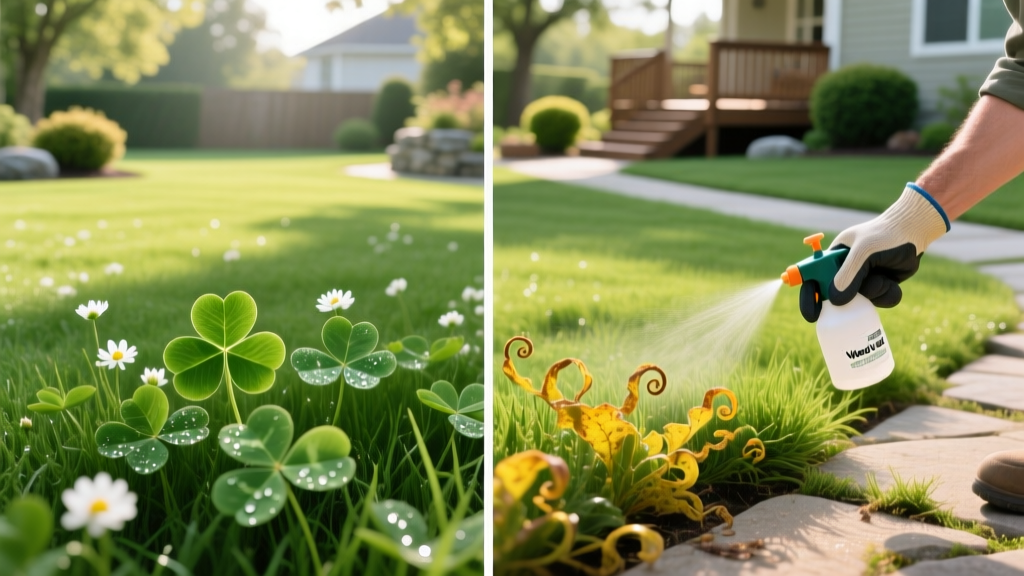
Will Weed and Feed Kill Clover? Identification and Control Guide
The Short Answer: Will Standard Weed and Feed Kill Clover?
If you are asking, 'will weed and feed kill clover?', the short answer is: standard granular weed and feed will rarely eliminate established clover. Most commercial granular 'weed and feed' products rely on a combination of 2,4-D and Mecoprop (MCPP). While these active ingredients are highly effective against broadleaf weeds like dandelions and plantain, they typically only burn the upper leaves of mature clover. Because clover spreads via resilient above-ground stolons and deep taproots, the plant quickly regenerates from the surviving nodes within two to three weeks of a granular application.
To permanently eradicate clover, you must abandon generic granular combinations and switch to targeted liquid selective herbicides containing Triclopyr or Dicamba, paired with a non-ionic surfactant to penetrate the plant's waxy cuticle. Below is a comprehensive breakdown of clover identification, the chemistry of why standard treatments fail, and the exact protocol required for total eradication.
Identifying Your Clover Invader
Before selecting an herbicide, you must accurately identify the specific clover species invading your turf. Clover belongs to the Trifolium genus and is characterized by its three-leaflet (trifoliate) leaves. According to turfgrass researchers at NC State University TurfFiles, clover thrives in nitrogen-deficient, compacted soils because it hosts Rhizobium bacteria in its root nodules, allowing it to fix its own atmospheric nitrogen.
| Clover Species | Scientific Name | Visual Identifiers | Growth Habit & Difficulty |
|---|---|---|---|
| White Clover | Trifolium repens | Smooth, hairless leaves often featuring a white 'V' watermark. Produces white or pinkish ball-shaped flowers. | Creeping stolons. Highly aggressive. Moderate difficulty to kill. |
| Red Clover | Trifolium pratense | Larger, hairy leaves with prominent veining. Produces larger, magenta-red flowers. | Upright, bushy growth with a deep taproot. Easier to pull manually but harder to spray thoroughly. |
| Microclover | Trifolium repens var. Pirouette | Extremely small leaves, rarely flowers, stays low to the ground. | Often intentionally seeded into eco-lawns. Very difficult to selectively remove without damaging surrounding turf. |
Why Standard Granular Weed and Feed Fails
The failure of standard weed and feed on clover comes down to plant morphology and application physics. Clover leaves possess a thick, waxy cuticle designed to repel water and retain moisture. When you apply granular weed and feed, the herbicide granules must stick to the wet leaf surface, dissolve, and be absorbed.
Warning: The Granular Bounce-Off Effect
Because clover leaves are angled upward and highly waxy, up to 70% of granular herbicide particles simply bounce off the leaf and fall into the thatch layer or soil, where they are rendered useless against a foliar-absorbing broadleaf weed. Furthermore, the 2,4-D concentration in granular mixes is heavily diluted by the fertilizer carrier, delivering a sub-lethal dose to the clover's vascular system.
Because clover leaves are angled upward and highly waxy, up to 70% of granular herbicide particles simply bounce off the leaf and fall into the thatch layer or soil, where they are rendered useless against a foliar-absorbing broadleaf weed. Furthermore, the 2,4-D concentration in granular mixes is heavily diluted by the fertilizer carrier, delivering a sub-lethal dose to the clover's vascular system.
To achieve a lethal dose, the herbicide must be applied as a liquid spray that coats the entire stolon network, and it must include a surfactant to break the surface tension of the waxy cuticle.
The Right Chemical Arsenal for Clover Eradication
When formulating a liquid spray, look for products where Triclopyr is the primary active ingredient. Triclopyr mimics plant growth hormones, causing the clover to undergo uncontrolled, lethal cellular division. The EPA's guidelines on lawn care pesticides emphasize using targeted selective herbicides to minimize environmental impact and protect non-target turfgrass species.
Top Selective Herbicides for Clover (2026 Market)
- Ortho WeedClear Lawn Weed Killer (Ready-to-Spray): Contains a proprietary blend of 2,4-D, Quinclorac, and Dicamba. The addition of Dicamba provides the necessary knockdown power for clover. Cost: ~$24 for 5,000 sq ft coverage.
- Bayer Advanced All-in-One Lawn Weed and Crabgrass Killer: Combines 2,4-D, Dicamba, and Quinclorac. Highly effective on white clover when applied in spring. Cost: ~$32 for 10,000 sq ft coverage.
- Hi-Yield Triclopyr Ester (Professional Grade): The gold standard for stubborn clover and ground ivy. Requires mixing with water and a surfactant. Cost: ~$45 for a 1-pint bottle (treats over an acre).
Expert Note on Grass Safety: Triclopyr and Dicamba are safe for most cool-season grasses (Kentucky Bluegrass, Fescue, Ryegrass) and warm-season grasses like Bermudagrass and Zoysia. However, they can severely damage or kill St. Augustinegrass and Centipedegrass. Always verify the product label against your specific turf type before application.
Step-by-Step Clover Treatment Protocol
Follow this exact sequence to ensure the herbicide reaches the clover's root system without causing chemical burn to your surrounding turf.
- Time the Application: Apply liquid herbicide when daytime temperatures are strictly between 65°F and 85°F. Applications above 85°F risk herbicide vapor drift, which can damage nearby ornamental shrubs and trees.
- Prep the Turf: Mow your lawn to a height of 2.5 inches two days before spraying. This removes excess grass blade competition, allowing the spray to reach the low-lying clover stolons.
- Mix the Surfactant: If using a concentrate like Hi-Yield Triclopyr, add 0.5 ounces of a non-ionic surfactant (or 1 teaspoon of liquid dish soap as a budget alternative) per gallon of water. This is non-negotiable for penetrating the clover's waxy leaves.
- Spray to Wilt, Not Drench: Using a pump sprayer, apply a fine mist over the clover patches until the leaves are visibly wet and glistening, but not dripping onto the soil. Dripping wastes chemical and increases soil residual risks.
- Wait 48 Hours: Do not water, irrigate, or mow the lawn for at least 48 hours post-application. The herbicide requires this time to translocate from the leaves down into the taproot and stolon nodes.
- Follow-Up Application: Clover is a perennial with deep energy reserves. A second application is almost always required 21 to 28 days after the first treatment to kill any late-germinating nodes or surviving root crowns.
Cultural Controls: Starving the Clover
Chemical eradication is only half the battle. If you do not alter the soil environment, clover seeds—which can remain viable in the soil seed bank for up to 12 years—will germinate the following season. Clover is an indicator weed; its presence screams that your soil is compacted and deficient in nitrogen.
The Nitrogen Advantage
Because clover fixes its own nitrogen, it outcompetes turfgrass in low-nitrogen soils. To reverse this, implement a heavy nitrogen fertilization program. Apply a high-nitrogen, low-phosphorus fertilizer (such as a 32-0-4 NPK ratio) at a rate of 1 lb of nitrogen per 1,000 square feet in early fall. This forces the turfgrass to grow thick and dense, shading out the soil surface and preventing clover seeds from receiving the sunlight required for germination.
Alleviating Soil Compaction
Clover thrives in hard, compacted clay where grass roots suffocate. Perform core aeration in the fall, pulling 3-inch plugs of soil to allow oxygen and water to reach the turfgrass root zone. Follow aeration immediately with topdressing and overseeding to fill in the bare patches where clover typically establishes.
Frequently Asked Questions
Can I just pull clover by hand?
Hand-pulling is only effective for isolated, young clover plants. If you attempt to pull mature white clover, the stolons will snap, leaving the nodes and root fragments in the soil. These fragments will sprout new plants within a week, effectively multiplying your clover problem.
Will vinegar or organic herbicides kill clover?
Horticultural vinegar (20% acetic acid) is a non-selective contact burn-down herbicide. It will scorch the top leaves of the clover, but it will also burn your surrounding grass to a crisp. Furthermore, it does not translocate to the roots, meaning the clover will return in less than two weeks. For selective control, synthetic systemic herbicides remain the only reliable option.
Is microclover actually bad for my lawn?
Microclover is increasingly being used in 'eco-lawns' as a beneficial companion plant. It stays low, requires less mowing, and naturally fertilizes the surrounding grass with fixed nitrogen. If you have intentionally seeded microclover, do not apply broadleaf herbicides. If it has invaded unintentionally, eradicating it requires the same Triclopyr-based protocol used for white clover.

