
Lawn Care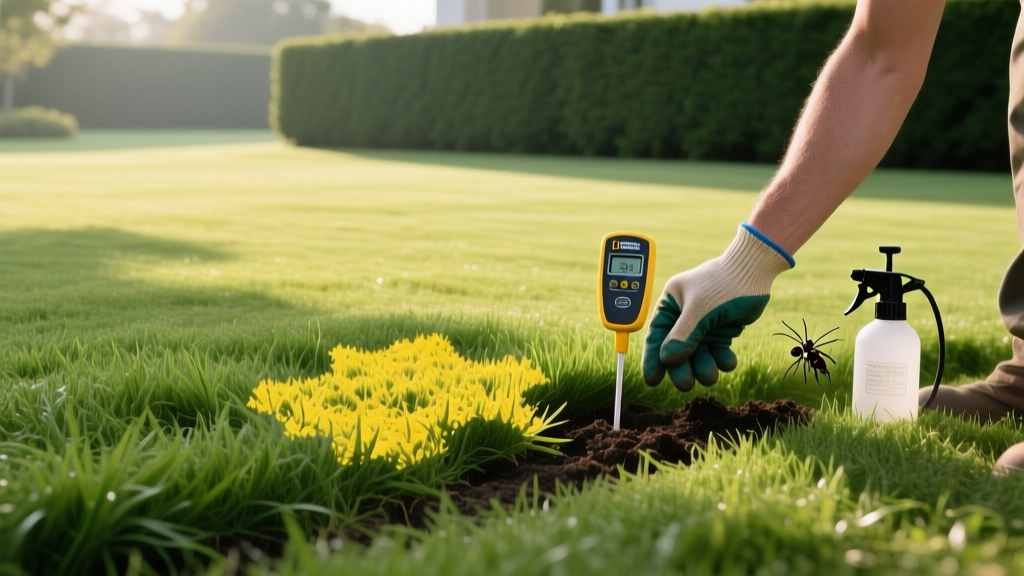
Yellow Spot on Lawn: 7 Causes and Exact Rescue Fixes
A yellow spot on your lawn is not a cosmetic flaw; it is an acute distress signal from your turfgrass. Throwing generic fertilizer at a localized yellow patch is the most common mistake homeowners make, often accelerating the damage if the root cause is fungal or chemical. Accurate diagnosis requires a systematic triage approach to differentiate between biotic pathogens, insect feeding, and abiotic environmental stressors.
The 60-Second Diagnostic Triage
Before purchasing any treatment, perform these three physical tests on the yellowing area and its immediate margins:
- The Tug Test: Grab a handful of the yellowing grass and pull upward. If the turf lifts easily with no root resistance and the roots look chewed or absent, you have an insect issue (grubs or chinch bugs).
- The Pattern Check: Look at the border where yellow grass meets green grass. A distinct, expanding circular ring with a dark 'smoke ring' indicates fungal disease. Irregular, splash-like patterns usually point to chemical burn or dog urine.
- The Soil Probe: Push a 6-inch soil probe or long screwdriver into the yellow spot and then into healthy grass. If the probe cannot penetrate the yellow area, you are dealing with severe soil compaction or localized dry spot (hydrophobic soil).
Biotic Pathogens: Fungal Diseases
Fungi thrive when specific moisture and temperature thresholds are met. The two most aggressive culprits causing localized yellowing are Brown Patch and Dollar Spot.
Brown Patch (Rhizoctonia solani)
Primarily affecting cool-season grasses like Tall Fescue and Kentucky Bluegrass during high-humidity summer nights (above 68°F), Brown Patch creates circular yellow-to-brown lesions ranging from 6 inches to several feet across. Examine individual grass blades for tan lesions with dark brown borders.
Rescue Fix: Apply a systemic fungicide containing Azoxystrobin (e.g., Heritage T&O) at a rate of 2 to 4 oz per 1,000 square feet, or Propiconazole (e.g., Banner MAXX) at 1 to 2 oz per 1,000 sq ft. Water the application into the soil immediately with 0.25 inches of irrigation. Halt all nitrogen fertilization until the disease is controlled.
Dollar Spot (Clarireedia jacksonii)
Manifesting as small, silver-dollar-sized yellow spots that can merge into larger blotches, this fungus strikes when daytime temperatures are warm but nights are cool, especially in nitrogen-deficient turf. Look for characteristic hourglass-shaped lesions on the leaf blades and cobweb-like mycelium in the morning dew.
Rescue Fix: Apply a contact fungicide like Chlorothalonil at 3 to 4 oz per 1,000 sq ft, combined with a light application of fast-release nitrogen (0.25 lbs N per 1,000 sq ft) to push the turf through the infection. According to NC State TurfFiles, rotating chemical classes (FRAC codes) is critical to prevent pathogen resistance.
Insect Pests: Root and Sap Feeders
When the yellow spot feels spongy underfoot and the turf rolls back like a carpet, insects are severing the root-soil interface.
White Grubs (Japanese Beetles, June Bugs)
Grubs feed on roots just below the soil surface. The damage threshold for rescue treatment is 8 to 10 grubs per square foot. Peel back a 1-foot square section of the yellowing turf to count the C-shaped white larvae. As noted by Penn State Extension, treating too early or too late renders insecticides ineffective because the grubs are either too deep or too small to absorb the chemical.
Rescue Fix: Use a fast-acting, short-residual insecticide like Trichlorfon (Dylox) applied at 1.15 lbs per 1,000 sq ft. This must be watered in heavily (at least 0.5 inches of water) immediately after application to move the active ingredient into the root zone where the grubs are feeding. Do not use preventative products like Imidacloprid for active rescue; they take too long to translocate.
Abiotic Stressors: Environmental and Chemical Damage
Not all yellowing is biological. Abiotic factors account for nearly 40% of localized turf decline and require entirely different remediation strategies.
Dog Urine and Animal Waste
Dog urine contains high concentrations of urea (nitrogen) and soluble salts. The center of the spot turns yellow or brown due to salt toxicity and nitrogen burn, often surrounded by a dark green 'halo' where the diluted nitrogen acts as a fertilizer.
Rescue Fix: Flush the area immediately with 2 to 3 gallons of water to dilute the salts below the root zone. Apply pelletized gypsum (calcium sulfate) at a rate of 50 lbs per 1,000 sq ft. The calcium in the gypsum displaces the toxic sodium in the soil, restoring soil structure and allowing roots to recover. Rake out dead debris and overseed with a matching turfgrass cultivar.
Fertilizer Burn (Salt Toxicity)
Spilling granular synthetic fertilizer or applying it to wet grass blades causes rapid osmotic stress, pulling water out of the plant tissue. The yellow spot will perfectly match the path of the spreader or the location of a spill.
Rescue Fix: Do not apply more chemicals. Run a sprinkler over the affected zone for 20 minutes daily for three consecutive days to leach the excess salts past the 6-inch root zone. If the grass crown is still white and firm, it will recover in 14 days.
Symptom-to-Rescue Decision Matrix
| Visual Symptom & Pattern | Primary Culprit | Immediate Rescue Action |
|---|---|---|
| Circular rings with dark margins; morning mycelium | Brown Patch / Dollar Spot | Azoxystrobin or Propiconazole fungicide; reduce evening watering |
| Spongy turf; pulls up without roots; visible C-shaped larvae | White Grubs | Trichlorfon (Dylox) watered in with 0.5 inches of irrigation |
| Yellow center with dark green halo; localized to pet areas | Dog Urine Burn | Flush with 3 gallons water; apply 50 lbs/1,000 sq ft pelletized gypsum |
| Irregular yellow streaks matching spreader overlap lines | Fertilizer Salt Burn | Leach salts with 20 mins daily irrigation for 3 days; no chemicals |
| Hard soil; water pools on surface; turf wilts despite rain | Localized Dry Spot / Compaction | Core aerate; apply yucca-extract soil surfactant to break surface tension |
Step-by-Step Recovery Protocol
Once you have identified the specific cause using the matrix above, follow this standardized recovery protocol to restore the turf canopy:
- Neutralize the Threat: Apply the targeted fungicide, insecticide, or leaching protocol outlined above. Wait 48 hours before proceeding to physical turf manipulation.
- Remove Necrotic Tissue: Use a thatching rake to aggressively pull out the dead, yellowed blades. Fungal spores and insect habitats thrive in decaying thatch. Removing it exposes the soil and living crowns to sunlight and treatment.
- Alleviate Compaction: If the soil is hard, use a manual core aerator to pull 3-inch plugs from the yellow spot and a 2-foot buffer zone around it. Leave the plugs on the surface to break down naturally.
- Overseed and Topdress: For cool-season lawns, apply 2 lbs of premium turf-type tall fescue seed per 1,000 sq ft directly into the aerated holes. Topdress with a 1/4-inch layer of screened compost to retain moisture and introduce beneficial soil microbes.
- Moisture Management: Keep the top 1 inch of soil consistently moist (but not saturated) for 14 to 21 days to ensure seed germination and existing crown recovery. Water lightly twice a day rather than one heavy soaking.
Expert Insight: Never apply pre-emergent herbicides (like Prodiamine or Dithiopyr) to a yellow spot you intend to overseed. These chemicals create a barrier in the soil that will prevent your rescue grass seed from germinating, leaving you with bare dirt. Always check the product label for the reseeding interval, which can be up to 4 months for some pre-emergents.
When to Abandon Rescue and Renovate
If the yellow spot exceeds 30% of your total lawn area, or if the soil profile is entirely comprised of hydrophobic sand or heavy clay with less than 2% organic matter, spot-treatment is a waste of resources. In these cases, schedule a full lawn renovation: kill the existing turf with a non-selective herbicide, rototill the top 4 inches, amend with 2 yards of compost per 1,000 sq ft, and lay new sod or hydroseed.

