
Lawn Care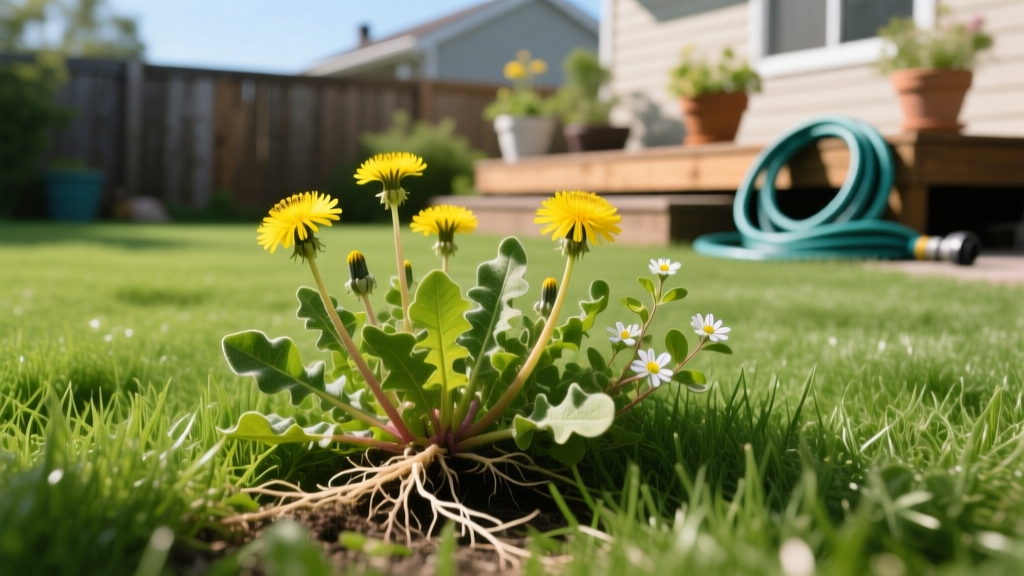
Yellow Weeds in Lawn: Exact Diagnosis and Rescue Fixes
The Diagnostic Matrix: True Yellow Weeds vs. Yellowing Turf
When homeowners spot yellow weeds in lawn settings, the first critical step is distinguishing between actual yellow-flowering weed species and turfgrass that is yellowing due to environmental stress. Misdiagnosis leads to wasted chemicals and further turf decline. True yellow weeds possess distinct botanical structures—such as heart-shaped leaflets, deep taproots, or explosive seed pods—that differentiate them from nutrient-deficient grass blades.
According to NC State University TurfFiles, accurate identification at the vegetative stage, before flowering, is the most effective window for post-emergent herbicide application. Below is a diagnostic framework to separate invasive weeds from turf disorders.
| Symptom Profile | Visual Characteristics | Root/Structure Type | Primary Cause |
|---|---|---|---|
| Yellow Woodsorrel (Oxalis) | Heart-shaped trifoliate leaves, small bright yellow 5-petal flowers | Shallow taproot with explosive seed pods | Invasive broadleaf weed |
| Dandelion | Jagged basal rosette leaves, large solitary yellow flowers | Deep, brittle taproot (up to 10 inches) | Invasive broadleaf weed |
| Black Medic | Teardrop-shaped trifoliate leaves, tight clusters of tiny yellow flowers | Shallow branching taproot | Invasive broadleaf weed (indicates low nitrogen) |
| Iron Chlorosis | Yellowing between leaf veins (interveinal), veins remain green | Normal turf root system | High soil pH locking out iron absorption |
| Dog Urine Spots | Yellow/brown dead center with a dark green ring of lush growth | Normal turf root system | Nitrogen and salt burn from canine urine |
Top 3 Yellow-Flowering Weeds and Targeted Rescue Fixes
If your diagnostic check confirms the presence of true yellow weeds in lawn areas, you must deploy targeted chemical and cultural rescue protocols. Broad-spectrum 'weed and feed' granular products often fail against mature specimens of these specific species due to poor foliar absorption and waxy leaf cuticles.
1. Yellow Woodsorrel (Oxalis stricta)
Yellow woodsorrel is notoriously difficult to eradicate because of its explosive seed pods, which can shoot seeds up to 10 feet away when disturbed. It thrives in thin, under-fertilized turf and can photosynthesize efficiently in partial shade.
Warning: Never mow immediately before spraying Oxalis. Mowing removes the leaf surface area required for herbicide absorption. Wait at least 3 days after mowing to allow new foliage to emerge before applying liquid treatments.
Rescue Fix: Apply a liquid mixture containing Triclopyr and 2,4-D. Triclopyr is highly effective against Oxalis species where 2,4-D alone fails. Use a professional-grade ester formulation for better cuticle penetration. Add a non-ionic surfactant (methylated seed oil) at a rate of 1/2 teaspoon per gallon of water to break the leaf's waxy barrier.
2. Dandelion (Taraxacum officinale)
Dandelions produce iconic yellow flowers before turning into wind-dispersed seed heads. The primary failure mode in dandelion control is 'top-killing' the weed without destroying the taproot. If the crown and upper taproot survive, the weed will regenerate within 14 days.
Rescue Fix: Spot-treat with a three-way herbicide containing 2,4-D, Dicamba, and MCPP (e.g., Trimec Classic). Apply when daytime temperatures are between 65°F and 80°F. The EPA's official guidance on 2,4-D notes that optimal translocation to the root system occurs when the plant is actively growing and not under drought stress. Water the lawn deeply 24 hours before application to ensure active sap flow.
3. Black Medic (Medicago lupulina)
Often mistaken for clover, black medic produces small yellow flower clusters and thrives in highly compacted soils with low nitrogen levels. Its presence is a biological indicator of poor soil health.
Rescue Fix: While Quinclorac or Triclopyr will kill existing black medic, chemical rescue must be paired with mechanical aeration. Core aerate the infested zones in the fall or spring to relieve compaction, followed immediately by an application of 1 lb of nitrogen per 1,000 sq ft to outcompete future medic germination.
Chemical Rescue Protocols: Active Ingredients and Mixing Rates
Consumer-grade ready-to-spray bottles are economically inefficient and often under-dosed for stubborn yellow weeds. Purchasing concentrated liquid herbicides and mixing them in a 1-gallon or 2-gallon pump sprayer provides superior coverage and costs a fraction of the price per square foot.
| Active Ingredient | Trade Name Example | Mix Rate (per 1,000 sq ft) | Target Weeds | Turf Safety |
|---|---|---|---|---|
| 2,4-D + Dicamba + MCPP | Trimec Classic | 1.5 fl oz in 1.5 gal water | Dandelion, Black Medic | Safe for most cool/warm grasses |
| Triclopyr + 2,4-D | Turflon Ester Ultra | 1.0 fl oz in 1.5 gal water | Yellow Woodsorrel (Oxalis) | Safe for cool-season; check warm-season labels |
| Quinclorac | Drive XLR8 | 0.5 fl oz in 1.5 gal water | Black Medic, Crabgrass | Safe for most turf except St. Augustine |
Backpack Sprayer Calibration Protocol
To ensure you are applying the exact dose required to kill yellow weeds in lawn environments without causing turf phytotoxicity, calibrate your sprayer using the 1/128th acre method:
- Mark off a 20 ft x 20 ft test area (400 sq ft) on your driveway.
- Fill your sprayer with plain water and spray the test area at your normal walking pace and pump pressure.
- Measure the exact ounces of water required to refill the sprayer back to the fill line.
- The ounces used equals the gallons per acre (GPA) your sprayer is delivering. Adjust your chemical mix rate based on this GPA output.
Cultural Rescue Fixes: Starving the Weeds
Chemical applications provide immediate relief, but cultural practices dictate long-term suppression. Yellow weeds exploit specific turf vulnerabilities. According to Penn State Extension, maintaining a dense turf canopy is the most effective pre-emergent barrier against broadleaf weed invasion.
- Mowing Height Calibration: Raise your mower deck to 3.5 or 4.0 inches for cool-season grasses (Tall Fescue, Kentucky Bluegrass). Yellow woodsorrel and black medic require sunlight to germinate and establish. Taller grass blades cast deeper shadows, dropping soil surface temperatures and inhibiting weed seed germination.
- Iron Supplementation: If your soil test reveals a pH above 7.0, your grass may be suffering from iron chlorosis, weakening it against weed invasion. Apply a chelated iron product (like Fe-EDDHA) at 2-3 oz per 1,000 sq ft. This darkens the turf canopy, improving photosynthesis without raising the soil pH further.
- Deep, Infrequent Irrigation: Yellow weeds like Oxalis have shallow root systems and thrive on frequent, light watering. Switch your irrigation schedule to deliver 1 to 1.5 inches of water in a single weekly session. This forces turfgrass roots to grow deep while shallow-rooted weeds desiccate and die off.
Pro-Tip: The Seed Bank Reality Check
If you successfully kill mature yellow woodsorrel but see a new flush of seedlings three weeks later, you are dealing with the soil seed bank. Oxalis seeds can remain viable in the soil for up to 5 years. To break this cycle, apply a pre-emergent herbicide containing Prodiamine (e.g., Barricade) in early spring when soil temperatures consistently reach 55°F at a 2-inch depth. This creates a chemical barrier in the top 1/2 inch of soil, preventing yellow weed seeds from establishing roots.
If you successfully kill mature yellow woodsorrel but see a new flush of seedlings three weeks later, you are dealing with the soil seed bank. Oxalis seeds can remain viable in the soil for up to 5 years. To break this cycle, apply a pre-emergent herbicide containing Prodiamine (e.g., Barricade) in early spring when soil temperatures consistently reach 55°F at a 2-inch depth. This creates a chemical barrier in the top 1/2 inch of soil, preventing yellow weed seeds from establishing roots.
Troubleshooting Edge Cases
Symptom: I sprayed the yellow weeds, the leaves curled and turned brown, but the weeds recovered and bloomed again in 30 days.
Diagnosis: You experienced 'top-kill' without root translocation. This occurs when herbicide is applied during extreme heat (above 85°F) or drought stress. The plant's stomata close to conserve water, halting the downward flow of the herbicide to the taproot.
Fix: Wait for a cool, overcast day or apply in the early evening when temperatures drop below 80°F. Ensure the soil is moist prior to application to guarantee active vascular flow within the weed.

