
Lawn Care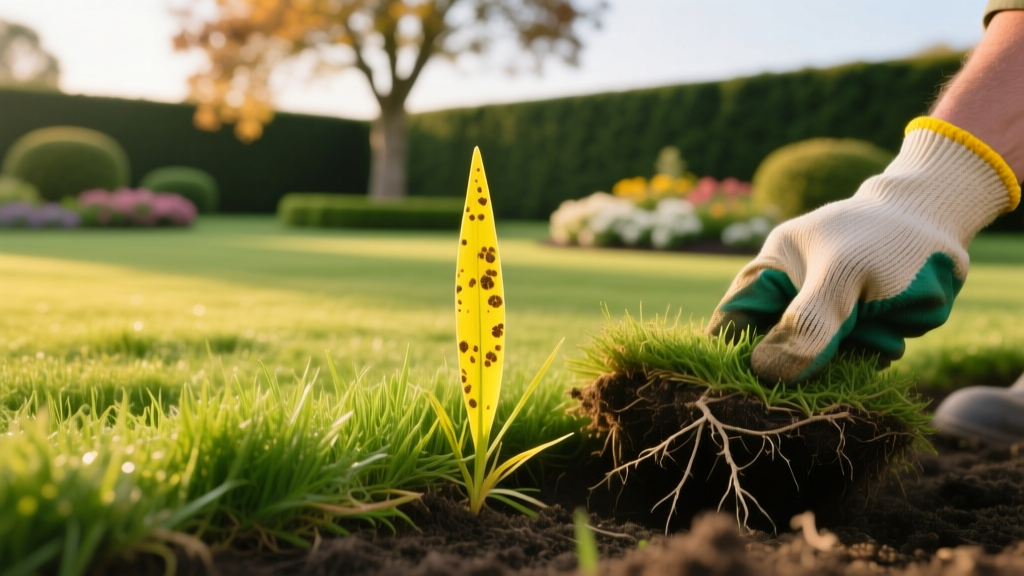
Why Your Grass Is Yellowing: Diagnosis and Rescue Fixes
The 3-Step Yellowing Triage Framework
When your grass is yellowing, it is communicating a specific physiological failure. Yellowing (chlorosis) is not a disease itself; it is a symptom of disrupted chlorophyll production. Before applying random fertilizers or fungicides, you must isolate the variable causing the breakdown. Professional turfgrass managers use a three-step triage framework to diagnose the root cause accurately.
- Pattern Recognition: Is the yellowing uniform across the entire lawn, localized in distinct circular patches, or following linear patterns (like wheel tracks or overlapping spreader rows)? Uniform yellowing points to systemic issues like nutrient deficiency or drought. Distinct patches indicate fungal pathogens or localized soil compaction.
- Leaf-Level Inspection: Pull a single grass plant and examine the leaves. Chlorosis on the newest, youngest leaves indicates immobile nutrient deficiencies (iron, manganese). Chlorosis on the oldest, lowest leaves indicates mobile nutrient deficiencies (nitrogen, magnesium).
- Environmental History Check: Review the last 14 days of weather, irrigation cycles, and chemical applications. A sudden temperature drop combined with heavy rain often triggers fungal outbreaks, while recent granular fertilizer applications without immediate watering can cause chemical burn.
Diagnostic Rule of Thumb: Never apply a nitrogen-heavy fertilizer to a yellowing lawn without first ruling out fungal disease. Excess nitrogen exacerbates Dollar Spot and Brown Patch, turning a minor yellowing issue into total turf loss.
Nutrient Deficiencies: Iron vs. Nitrogen Chlorosis
The two most common nutritional reasons your grass is yellowing are nitrogen starvation and iron chlorosis. Because they require entirely different chemical interventions, misdiagnosing them will waste money and delay recovery. According to the University of Minnesota Extension, understanding nutrient mobility within the plant is the key to visual diagnosis.
Nitrogen Deficiency (Mobile Nutrient)
Nitrogen is highly mobile within the plant. When soil levels drop, the grass translocates nitrogen from older leaves to support new growth. Consequently, nitrogen deficiency presents as a uniform, pale yellowing that starts at the base of the plant and moves upward. The lawn will also exhibit slowed vertical growth and reduced density.
Rescue Fix: Apply a fast-release nitrogen source like Urea (46-0-0) or Ammonium Sulfate (21-0-0) at a rate of 0.5 lbs of actual nitrogen per 1,000 square feet. Water immediately with 0.25 inches of irrigation to move the granules into the soil profile and prevent volatilization. You should see regreening within 48 to 72 hours.
Iron Chlorosis (Immobile Nutrient)
Iron cannot be translocated within the plant. When soil iron is unavailable—typically due to high soil pH (above 7.2) or excessive soil phosphorus locking it up—the newest leaves emerge yellow while the veins remain green (interveinal chlorosis). This is exceptionally common in cool-season grasses during the heat of mid-summer when rapid growth outpaces root uptake.
Rescue Fix: Soil applications of iron sulfate are ineffective in high-pH soils. Instead, apply a foliar spray of chelated iron. For soils with a pH above 7.0, you must use an EDDHA-chelated iron (such as Fe-EDDHA 6%), as DTPA and EDTA chelates break down in alkaline conditions. Apply at 2 to 4 ounces of product per 1,000 square feet. Avoid watering for 24 hours to allow maximum foliar absorption.
| Symptom Characteristic | Nitrogen Deficiency | Iron Chlorosis |
|---|---|---|
| Initial Leaf Affected | Oldest (lowest) leaves | Newest (highest) leaves |
| Yellowing Pattern | Uniform pale yellow | Interveinal (green veins, yellow tissue) |
| Soil Trigger | Low organic matter, heavy leaching | High pH (>7.2), excess phosphorus |
| Rescue Product | Urea (46-0-0) or Ammonium Sulfate | Foliar Fe-EDDHA chelated iron |
Fungal Pathogens: Dollar Spot and Brown Patch
If your grass is yellowing in distinct, expanding patches, you are likely dealing with a turfgrass disease. The NC State Extension TurfFiles database identifies Dollar Spot and Brown Patch as the most destructive summer pathogens for both cool- and warm-season lawns. Fungal rescue requires immediate curative fungicide applications, as cultural practices alone will not stop an active infection.
Dollar Spot (Clarireedia jacksonii)
Symptoms: Small, silver-dollar-sized sunken patches of bleached or yellowing grass. In the early morning dew, you may see white, cobweb-like mycelium spanning the leaves. Individual grass blades will have distinct hourglass-shaped lesions with purplish-brown borders.
Rescue Fix: Apply a curative rate of a Group 11 (QoI) or Group 3 (DMI) fungicide. Azoxystrobin (e.g., Heritage SC) applied at 0.4 to 0.8 fluid ounces per 1,000 square feet will halt the disease within 48 hours. Follow up with a light application of nitrogen (0.25 lbs/1,000 sq ft) to stimulate the plant to fill in the damaged spots.
Brown Patch (Rhizoctonia solani)
Symptoms: Large, irregular circular patches ranging from 6 inches to several feet in diameter. The turf within the patch is yellowing and thinning. On cool-season grasses, a dark 'smoke ring' may be visible at the outer edge of the patch during humid mornings.
Rescue Fix: Brown Patch requires a different chemical class to prevent resistance. Use a Group 3 DMI fungicide like Propiconazole (e.g., Banner MAXX) at 1.0 to 2.0 fluid ounces per 1,000 square feet. Crucially, you must alter your irrigation schedule. Water only in the early morning (between 4 AM and 6 AM) so the leaf surface dries before nightfall. Evening watering guarantees Brown Patch recurrence.
Environmental and Cultural Stressors
Sometimes the reason your grass is yellowing has nothing to do with nutrients or fungi, but rather physical soil limitations or localized chemical damage.
Soil Compaction and Hydrophobic Soil
If yellowing occurs in high-traffic areas or along sidewalks, the soil pores are likely crushed, preventing oxygen from reaching the roots. Conversely, in sandy soils, localized dry spot (hydrophobic soil) occurs when organic acids coat sand particles, repelling water. The grass yellows and dies of drought stress even when irrigated.
Rescue Fix: For compaction, perform core aeration using a stand-on or walk-behind aerator that pulls 3-inch plugs. For hydrophobic soil, apply a non-ionic soil wetting agent (such as Pelletized Cascade or Aqueduct) at the labeled rate to break the surface tension of the water, followed by deep, infrequent irrigation cycles.
Dog Urine Spotting
Dog urine contains high concentrations of urea and salts. The center of the spot burns and turns yellow or brown, while the outer ring receives a diluted nitrogen dose and turns dark green.
Rescue Fix: Do not apply gypsum or lime based on internet myths about 'acidic urine'; the damage is caused by nitrogen and salt toxicity, not pH. Immediately flush the spot with 2 gallons of water to dilute the urea below the root zone. For long-term soil remediation in heavily used areas, apply pelletized gypsum (calcium sulfate) at 50 lbs per 1,000 square feet in the spring to help displace excess sodium from the soil cation exchange sites.
Chemical Burn and Herbicide Carryover
Yellowing that appears in straight lines, geometric shapes, or perfectly circular dump spots 24 to 48 hours after a lawn treatment is a chemical burn. This happens when granular fertilizers are applied to wet grass and stick to the blades, or when a spreader is not calibrated correctly, resulting in overlapping double-doses.
Rescue Protocol: 1. Flush Immediately: Apply 1 inch of water daily for three consecutive days to leach the excess salts below the root zone. 2. Mow and Bag: Mow the lawn and collect the clippings to physically remove any fertilizer granules still clinging to the leaf tissue. 3. Overseed if Necessary: If the grass crowns are desiccated and pull up easily after 14 days, the tissue is dead. Rake the area to bare soil, apply a starter fertilizer (18-24-12), and overseed with a matching cultivar.
Quick-Reference Rescue Protocol Matrix
| Diagnosed Issue | Primary Symptom | Immediate Rescue Action | Expected Recovery Time |
|---|---|---|---|
| Nitrogen Deficiency | Uniform pale yellow, old leaves first | Apply 0.5 lbs N/1,000 sq ft (Urea) | 3 - 5 Days |
| Iron Chlorosis | Interveinal yellowing, new leaves first | Foliar spray Fe-EDDHA chelate | 48 - 72 Hours |
| Dollar Spot | Silver-dollar patches, hourglass lesions | Azoxystrobin at 0.4 - 0.8 oz/1,000 sq ft | 7 - 14 Days |
| Brown Patch | Large irregular patches, smoke rings | Propiconazole at 1.0 - 2.0 oz/1,000 sq ft | 10 - 21 Days |
| Chemical Burn | Geometric yellowing, spreader overlaps | Flush with 1 inch water daily for 3 days | 7 - 10 Days (if crowns survive) |
Frequently Asked Questions
Can overwatering cause grass to turn yellow?
Yes. Chronic overwatering saturates the soil profile, displacing oxygen. Without oxygen, roots cannot respire or uptake nutrients, leading to a condition called hypoxia. The grass will yellow uniformly and feel spongy underfoot. Reduce irrigation frequency and allow the top inch of soil to dry out between watering cycles.
Should I test my soil before treating yellow grass?
Absolutely. A standard soil test utilizing the Mehlich-3 extraction method will reveal your exact soil pH, phosphorus levels, and cation exchange capacity. Clemson HGIC recommends testing every two to three years to prevent the blind application of nutrients that may actually be locking up other essential elements in your soil.

