
Pest Control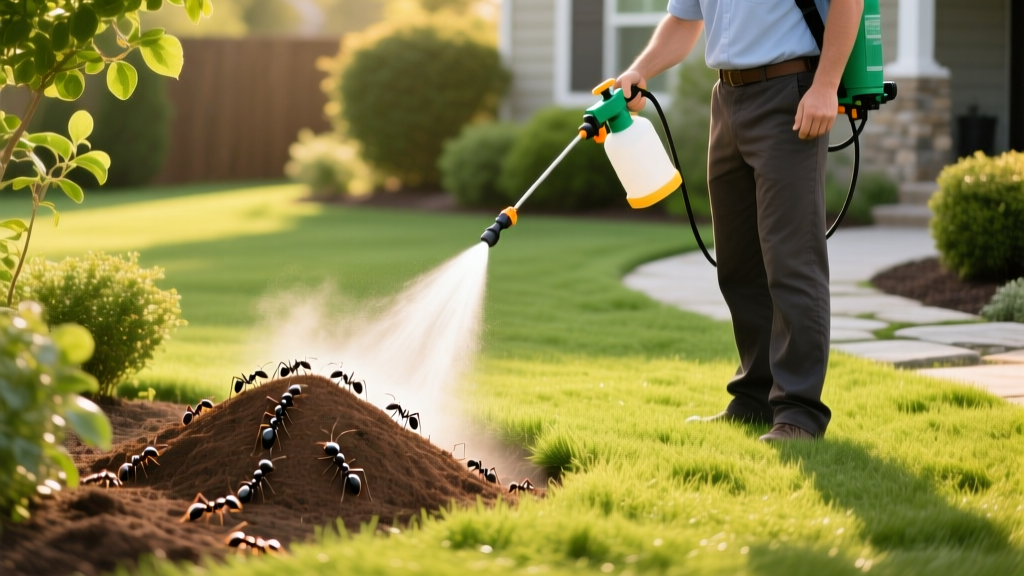
Strategic Ant Control Outdoors: Perimeter and Mound Defense
Effective ant control outdoors requires abandoning the reactive 'spray and pray' mentality. When you observe a trail of Argentine, pavement, or carpenter ants in your yard, you are only seeing 5% to 10% of the total colony. The remaining population—including the queens, alates, and brood—remains hidden deep underground or within structural voids. To achieve lasting yard defense, you must shift from contact killing to colony elimination using horizontal toxicity and strategic baiting.
According to the University of California Statewide IPM Program, outdoor ant management fails most often when homeowners use fast-acting repellent sprays that merely scatter the colony, causing 'budding' where a single colony splits into multiple satellite nests. This guide outlines a professional-grade, three-zone framework for eradicating outdoor ant populations without triggering colony fragmentation.
The 3-Zone Yard Defense Framework
Professional pest management operators (PMOs) treat the yard as a series of concentric defense zones. Each zone requires a specific active ingredient and application method based on ant foraging behavior.
Zone 1: The Foundation Perimeter
The perimeter is your primary barrier against ants migrating indoors. The goal here is to establish a continuous, non-repellent chemical barrier. Non-repellent insecticides (like Fipronil or Imidacloprid) are undetectable to ants. Workers walk through the treated zone, pick up the active ingredient on their tarsi and body hairs, and carry it back to the nest, transferring it to the queen and brood through trophallaxis (food sharing) and physical contact.
Zone 2: Hardscape & Turf Foraging Trails
Ants rely on pheromone trails to navigate between food sources and the nest. Zone 2 targets these visible highways along driveways, patios, and retaining walls. This zone relies heavily on slow-acting gel and granular baits that exploit the ants' natural foraging cycles.
Zone 3: Active Mounds & Nests
For mound-building species like fire ants or harvester ants, direct colony drenching is required. This involves flooding the subterranean gallery system with a liquid insecticide to ensure the queen is contacted and eliminated before she can relocate the colony.
Active Ingredient Breakdown for Outdoor Ants
Selecting the correct chemistry is critical. Using a repellent near a bait station will render the bait useless. Below is a comparison of the most effective active ingredients for outdoor ant defense in 2026.
| Active Ingredient | Product Example | Action Type | Approx. Cost | Best Application Zone |
|---|---|---|---|---|
| Fipronil (9.1%) | Taurus SC | Non-repellent liquid | $45 - $60 / 20oz | Zone 1 (Perimeter) & Zone 3 (Mounds) |
| Indoxacarb (0.05%) | Advion Ant Gel | Bioactive gel bait | $25 - $30 / 4 tubes | Zone 2 (Trails & Hardscapes) |
| Imidacloprid (2.15%) | Maxforce Fleet | Protein granular bait | $35 - $45 / 2lb | Zone 2 (Turf & Brood-rearing) |
| Bifenthrin (7.9%) | Talstar P | Repellent liquid | $30 - $40 / pint | Immediate knockdown only (Avoid near baits) |
CRITICAL WARNING: Never apply a repellent spray (like Bifenthrin or Deltamethrin) in the same area where you have placed gel or granular baits. The repellent will block the ants from reaching the bait, and the fast knockdown will prevent the transfer effect from occurring.
Execution Protocols: Baiting vs. Mound Drenching
The Texas A&M AgriLife Extension emphasizes that timing and technique dictate the success of outdoor ant treatments. Follow these precise protocols for maximum colony mortality.
Protocol A: Strategic Gel Baiting (Zone 2)
- Identify the Trail: Locate active foraging lines during peak activity hours (usually early morning or dusk).
- Placement: Apply Indoxacarb gel (Advion) in pea-sized drops directly adjacent to the trail, not on top of it. Placing it on the trail disrupts the pheromone path and causes confusion.
- Spacing: Space drops every 12 to 18 inches along the trail and near suspected entry points into the soil or foundation cracks.
- Moisture Protection: If rain is expected or sprinklers are active, place the gel inside tamper-resistant bait stations or under small pieces of cardboard to prevent wash-off.
Protocol B: Mound Drenching (Zone 3)
For large, visible mounds (particularly Red Imported Fire Ants), baiting can take 2 to 4 weeks. Mound drenching provides elimination in 24 to 48 hours.
- Mixing: Combine 0.8 fluid ounces of 9.1% Fipronil SC per gallon of water. Use a dedicated pump sprayer to ensure accurate agitation.
- Volume: Prepare 1 to 2 gallons of finished solution per standard-sized mound. Larger, established mounds may require up to 3 gallons.
- Application: Using a watering can or a sprayer with the nozzle removed to allow a heavy stream, pour the solution directly into the center of the mound to penetrate the deep royal chambers. Then, drench the outer perimeter of the mound to catch fleeing workers.
'The most common mistake in mound drenching is applying the liquid too slowly or with too little volume. If you do not flood the deepest galleries, the queen will simply move deeper into the soil profile and survive the treatment.' — Urban Entomology Field Manual, 2025 Edition
Biological & Organic Controls for Sensitive Yards
For homeowners managing organic lawns, pollinator gardens, or properties near waterways, synthetic insecticides may be restricted. In these scenarios, biological controls offer highly targeted alternatives.
Beneficial Nematodes (Steinernema feltiae)
Entomopathogenic nematodes are microscopic worms that actively seek out and infect ant larvae and pupae in the soil. They release symbiotic bacteria that kill the host within 48 hours.
Application Specs: Apply at a rate of 1 million nematodes per 2,000 square feet. Soil temperature must be between 60°F and 85°F. Apply at dusk and water the soil immediately to prevent UV degradation and desiccation.
Food-Grade Diatomaceous Earth (DE)
DE causes fatal desiccation by compromising the waxy outer layer of the ant's exoskeleton.
Limitation: DE is strictly a contact killer and loses efficacy when wet. It is best used as a dry dust inside outdoor electrical outlets, under deck stairs, and in dry crevices where liquid sprays cannot reach.
Troubleshooting: Common Failure Modes
Even with premium products, outdoor ant control can fail if you do not account for colony dietary cycling and environmental variables.
Issue: Ants Ignore Gel Bait
Cause: Dietary shift. Ant colonies cycle between craving carbohydrates (sugars) and proteins/lipids depending on the queen's egg-laying cycle and brood development stage.
Fix: If they ignore a sweet gel like Advion, immediately switch to a protein/lipid-based granular bait like Maxforce Fleet or Alpine Ant Bait.
Issue: Mound Reappears After Drench
Cause: Inadequate volume or polydomous nesting (multiple queens in separate subterranean chambers).
Fix: Increase drench volume to 3 gallons. For polydomous fire ant species, transition to a broadcast granular bait (like Amdro Pro) applied at 1.5 lbs per acre to target satellite queens.
Successful ant control outdoors is a marathon of observation and targeted chemistry, not a sprint of broad-spectrum spraying. By mapping your yard into distinct defense zones, utilizing non-repellent transfer chemistry, and adapting to the colony's dietary cycles, you can dismantle outdoor ant populations at their source and protect your property's perimeter year-round.

