
Pest Control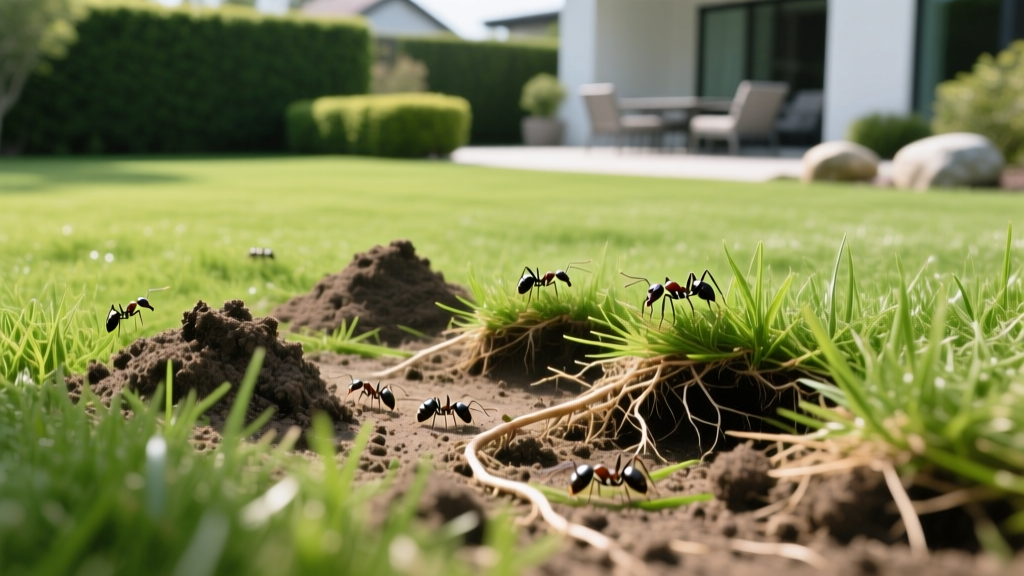
Are Ants Killing Grass? Identify Turf Damage and Eradicate Colonies
The Biological Reality: Do Ants Actually Eat Grass?
When homeowners notice expanding rings of dead, brown turf surrounding dirt mounds, the immediate assumption is that the insects are consuming the vegetation. However, the premise of ants killing grass by eating the blades or roots is largely a biological myth. With very few exceptions (such as leafcutter ants in the deep South), turf-dwelling ants do not feed on grass tissue. Instead, the grass dies from severe environmental stress caused by the colony's physical presence and secondary pest associations.
The necrosis you see in your lawn is the result of three distinct mechanisms:
- Root Desiccation: Extensive subterranean tunneling displaces soil particles, creating air pockets around the root zone. This prevents roots from making contact with moisture-holding soil, effectively drought-stressing the grass directly above the colony.
- Canopy Smothering: As colonies expand, they excavate thousands of cubic inches of soil, depositing it on the surface. This fanning mound physically buries the grass crown, blocking photosynthesis and suffocating the turf.
- The Sap-Sucker Syndicate: Many ant species act as agricultural protectors for honeydew-producing insects. They will actively farm root-feeding aphids and mealybugs, protecting them from predators in exchange for sugar secretions. It is often these secondary pests, not the ants themselves, that sever the grass's vascular tissue.
Warning: The Aphid Connection
If you observe ants aggressively swarming the base of your grass blades and notice a sticky residue (honeydew) or black sooty mold on the turf, you are dealing with a symbiotic infestation. Eradicating the ants will remove the aphids' bodyguards, but you must also treat the turf for the sap-sucking insects to halt the yellowing and dieback.
If you observe ants aggressively swarming the base of your grass blades and notice a sticky residue (honeydew) or black sooty mold on the turf, you are dealing with a symbiotic infestation. Eradicating the ants will remove the aphids' bodyguards, but you must also treat the turf for the sap-sucking insects to halt the yellowing and dieback.
Identifying the Culprit: Turf-Damaging Ant Species
Not all mounds are created equal. Accurate identification dictates your chemical and cultural response. According to entomological research from Texas A&M University's Fire Ant Project, misidentifying the species often leads to wasted treatments and continued turf degradation.
| Species | Mound Characteristics | Turf Impact Level | Primary Region |
|---|---|---|---|
| Red Imported Fire Ant (RIFA) | Flattened, dome-shaped; 12-24 inches wide; no surface opening visible. | Severe (Smothering + aggressive defense prevents mowing) | Southeast US, Texas, California |
| Allegheny Mound Ant | Massive, hard-packed mounds up to 3 feet high and 6 feet wide. | Extreme (Injects formic acid directly into plant tissue, killing roots) | Northeast US, Great Lakes |
| Harvester Ant | Large craters surrounded by completely cleared, bare dirt circles. | High (Actively clips grass blades to clear视野 around the nest) | Southwest US, Great Plains |
| Pavement Ant | Small, loose soil craters along hardscape edges and driveway seams. | Low (Mostly cosmetic soil displacement near edges) | Nationwide |
The Two-Step Eradication Protocol
Attempting to kill a mature colony by spraying the surface mound with over-the-counter contact killers (like bifenthrin or permethrin) is a critical mistake. Contact sprays only kill the foraging workers (about 10% of the colony). The queen simply relocates deeper into the soil profile, and the colony rebounds within 30 days, leaving behind a massive dead patch of grass. To permanently stop ants from killing your grass, you must employ the Two-Step Method endorsed by the Environmental Protection Agency (EPA) and university extension offices.
Phase 1: Broadcast Baiting (The Colony Killer)
Broadcast baiting targets the colony's nutritional supply chain. Worker ants carry the toxicant deep into the brood chambers and feed it to the queens. The active ingredient must be slow-acting to prevent the workers from dying before they can share it.
- Product Recommendation: Syngenta Advion Fire Ant Bait (Active ingredient: 0.04% Indoxacarb).
- Mode of Action: Indoxacarb is a pro-insecticide. It is biologically inactive until it is ingested by the ant and metabolized by its internal enzymes into a lethal sodium-channel blocker. This delayed action ensures maximum colony distribution.
- Application Rate: 1.5 pounds per acre, which translates to roughly 1/2 ounce (1 tablespoon) per 1,000 square feet of lawn.
- Cost: Approximately $35 to $45 for a 1.5-pound shaker bottle, treating up to 4 acres.
- Execution: Apply using a handheld rotary spreader on a dry afternoon when soil temperatures are between 70°F and 90°F. Do not water the lawn for 48 hours after application.
Phase 2: Targeted Mound Drenching (The Immediate Fix)
Three to seven days after broadcasting the bait, target the specific mounds that are actively smothering high-visibility turf areas. This step eliminates the remaining workers and prevents further soil excavation.
- Product Recommendation: BASF Alpine WSG (Active ingredient: 40% Dinotefuran).
- Mode of Action: Dinotefuran is a highly water-soluble neonicotinoid that provides rapid knockdown and acts as a non-repellent, meaning ants do not detect it and will not trigger a colony budding response.
- Application Rate: Dissolve one 10-gram packet in 1 gallon of water. Pour 1 to 2 gallons of the mixed solution directly into the center of the mound, using a dowel to pierce the crust first.
- Cost: Approximately $45 for a box of five 10-gram packets.
Organic Alternative Framework
For homeowners managing lawns near sensitive waterways or those adhering to strict organic landscaping standards, synthetic neonicotinoids and oxadiazines are not viable. In these scenarios, utilize Spinosad (e.g., Monterey Garden Insect Spray). Spinosad is derived from soil-dwelling bacteria (Saccharopolyspora spinosa) and is OMRI-listed. Apply as a drench at a rate of 4 tablespoons per gallon of water. Note that organic baits like Monterey Ant Control (spinosad bait) take 3 to 4 weeks to achieve full colony collapse, requiring patience while the mound continues to stress the surrounding grass.
Repairing Ant-Damaged Turf: Soil and Seed Recovery
Once the colony is confirmed dead (no worker activity for 14 days), the physical damage to the lawn remains. The dead grass ring and the hardened dirt mound will not recover on their own. Follow this exact remediation sequence to restore the turf canopy:
- Mound Dispersal: Use a steel landscaping rake to aggressively break apart the hardened, dead mound. Do not remove the soil entirely; instead, broadcast it thinly across the surrounding lawn as a natural topdressing.
- Core Aeration: The soil beneath the former mound is heavily compacted from the colony's excavation efforts. Run a manual or gas-powered core aerator over the dead patch, pulling 3-inch deep soil plugs to restore oxygen flow to the surviving adjacent roots.
- Topdressing and Leveling: Apply a 1/4-inch layer of finely screened compost over the bare soil. This introduces mycorrhizal fungi and microbial life that were displaced by the ant colony's acidic tunneling.
- Overseeding: Select a grass seed blend that matches your existing turf. For cool-season lawns (Tall Fescue or Kentucky Bluegrass), apply seed at a rate of 4 to 6 pounds per 1,000 square feet. For warm-season lawns (Bermuda or Centipede), apply at 1 to 2 pounds per 1,000 square feet. Keep the area consistently moist (watering 3 times daily for 5 minutes) until germination occurs, typically within 7 to 14 days.
Frequently Asked Questions
Do ants eat newly planted grass seed?
Harvester ants are notorious seed collectors and will actively strip a newly seeded lawn bare, carrying the grass seed back to their subterranean granaries. Fire ants and pavement ants generally ignore grass seed, preferring protein and sugar sources. If you live in the Southwest and are overseeding a winter ryegrass or Bermuda lawn, you must broadcast a harvester-specific bait (like Amdro Pro) two weeks prior to dropping your seed.
Why is my grass turning yellow instead of brown around the mound?
Yellowing (chlorosis) rather than total necrosis (browning) usually indicates the presence of root-feeding aphids or mealybugs being farmed by the ants. The ants are protecting these pests, which are sucking the chlorophyll-rich sap from the grass roots. Treating the ants with a fast-acting drench will expose the aphids to natural predators like ladybugs, but you may also need to apply a systemic insecticide like Imidacloprid (if legal in your state) to halt the sap-sucking damage immediately.
Can I just pour boiling water on the mound to save my grass?
While pouring 3 gallons of boiling water will kill roughly 60% of a fire ant colony, it will also instantly boil the root zone of your grass, sterilizing the soil and guaranteeing a dead patch that will require full sod replacement. The thermal damage to the soil microbiome takes months to recover. Chemical baits and targeted drenches are vastly superior for preserving the surrounding turf canopy.

