
Pest Control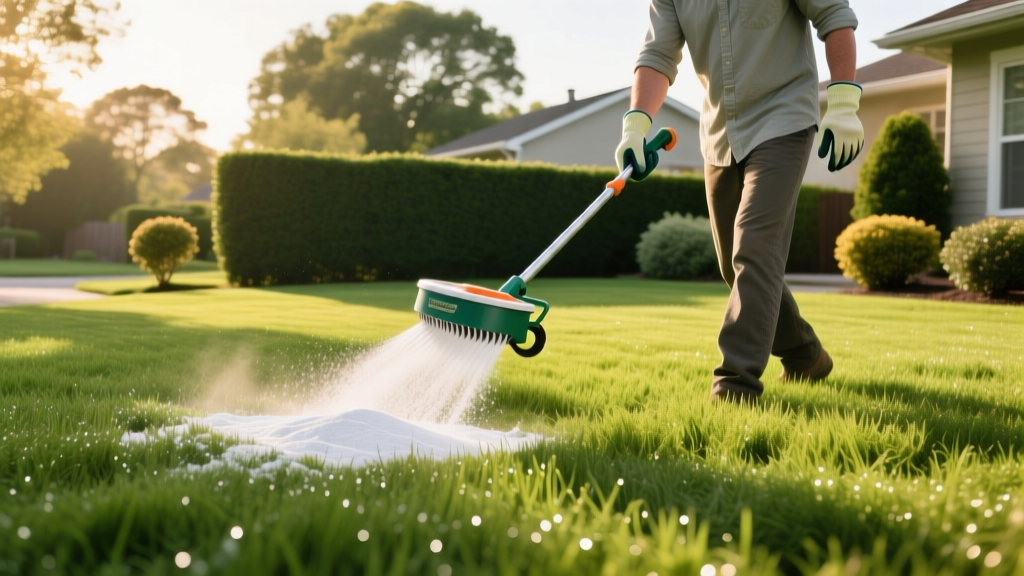
How to Spread Diatomaceous Earth for Fleas in Lawns
The Mechanics of Outdoor Desiccation
Flea populations in residential yards concentrate heavily in shaded, humid microclimates beneath decks, along fence lines, and in dense turf canopies. While chemical insecticides like permethrin offer rapid knockdown, they pose toxicity risks to pets and beneficial insects. Diatomaceous earth (DE) provides a mechanical, non-toxic alternative. According to the Environmental Protection Agency (EPA), DE consists of fossilized diatoms rich in silica. When fleas crawl across the powder, the microscopic, razor-sharp edges lacerate their waxy exoskeletons, leading to fatal dehydration within 24 to 48 hours.
However, learning how to spread diatomaceous earth for fleas outdoors requires overcoming environmental variables that do not exist indoors. Wind dispersion, soil moisture, and turf density can render a DE application completely ineffective if not managed correctly. The National Pesticide Information Center (NPIC) notes that DE loses its abrasive efficacy when saturated, meaning outdoor applications demand strict moisture management and precise calibration.
Selecting the Right Product and Gear
Not all diatomaceous earth is created equal. Applying the wrong grade to your lawn is not only ineffective but potentially hazardous.
Food Grade vs. Filter Grade
- Food Grade DE: This is the only type safe for yard use. It contains less than 1% crystalline silica and is generally OMRI-listed for organic use. Top brands include Harris Food Grade DE (approx. $18 for a 4lb bag) and Safer Brand Ant & Crawling Insect Killer (approx. $12 for 1.25lb).
- Filter/Pool Grade DE: Used for swimming pool filtration, this grade undergoes calcination (heat treatment), which converts the silica into crystalline form. Inhaling crystalline silica causes severe respiratory damage (silicosis). Never use pool-grade DE in your yard.
Application Equipment
Shaking DE from a cup results in uneven clumping and massive wind drift. For lawns exceeding 500 square feet, invest in a dedicated spreader:
- Rotary Hand Spreader: The Scotts Whirl Hand-Powered Spreader ($25) features a crank mechanism that broadcasts powder evenly in a 5-foot radius. Ideal for open turf.
- Bulb Duster: The Dustin-Mizer ($35) or standard rubber bulb dusters are mandatory for targeting the perimeter, underneath shrubs, and inside crawl spaces where fleas pupate.
CRITICAL SAFETY WARNING: Even food-grade DE is a severe respiratory irritant. The microscopic silica dust can cause lung inflammation. Always wear a properly fitted NIOSH-approved N95 respirator, safety goggles, and long sleeves during application. Keep pets and children indoors until the dust has fully settled into the turf canopy.
How to Spread Diatomaceous Earth for Fleas: A 4-Step Protocol
Executing a flawless outdoor application requires manipulating the lawn environment before the powder ever touches the grass.
Step 1: Canopy Preparation
Fleas avoid direct sunlight, residing in the lower thatch layer. Mow your lawn to a height of 1.5 to 2 inches—lower than your standard maintenance cut. Rake heavily to remove excess thatch and debris. This exposes the soil surface and the base of the grass blades, ensuring the DE reaches the exact zone where flea larvae and adults harbor.
Step 2: Calibration and Loading
The optimal application rate for outdoor flea control is 1.5 to 2.0 pounds of DE per 1,000 square feet. If using a rotary spreader, fill the hopper and set the dial to the lowest open setting (usually 1 or 2). DE is incredibly fine; a wider gate will dump the material too quickly and cause heavy clumping, which fleas will simply walk around.
Step 3: The Application Pattern
Walk at a steady pace of 3 miles per hour. Make two overlapping passes: one horizontally and one vertically (a crisscross pattern). Pay special attention to the 'hot zones':
- Underneath decks and porches.
- Along the shaded side of fences.
- Around dog houses and outdoor feeding stations.
- The perimeter of the home foundation (create a 2-foot continuous barrier).
Step 4: The Moisture Paradox
DE must be applied to completely dry grass. If the morning dew is still present, wait until mid-afternoon. However, once applied, a very light misting of water (using a hose-end sprayer set to a fine fog) can help 'lock' the powder into the thatch layer, preventing the next breeze from blowing it into your neighbor's yard. Do not soak the lawn; the grass should remain visibly dusty.
Environmental Timing Matrix
Weather dictates the success of your treatment. Use this matrix to schedule your application based on the local forecast.
| Forecast Condition | Action Required | Scientific Rationale |
|---|---|---|
| Rain expected within 48 hours | Delay application | Precipitation washes DE into the soil profile, rendering it useless against surface-dwelling fleas. |
| High winds (>10 mph) | Delay or use wet-application | Wind causes severe drift, wasting product and creating inhalation hazards. Mix with water to spray if urgent. |
| Humidity above 75% | Monitor and reapply | High ambient moisture causes DE particles to clump and lose their electrostatic charge and abrasive edge. |
| Dry, calm, 70°F - 85°F | Optimal application window | Fleas are highly active in these temperatures, increasing contact rates with the desiccant dust. |
Troubleshooting Common Application Failures
Even with food-grade DE, homeowners frequently report that the flea population rebounds within a week. According to integrated pest management guidelines from the University of Minnesota Extension, outdoor flea control requires breaking the reproductive cycle, which DE alone struggles to do if applied incorrectly. Here are the most common failure modes:
Failure Mode 1: The 'Snowstorm' Application
The Mistake: Applying DE so thickly that the grass looks like it is covered in snow.
The Reality: Fleas are not stupid. When faced with a massive, thick barrier of powder, they will simply tunnel underneath it or navigate around the pile. DE works best as a microscopically thin, barely visible dusting that the flea walks through unknowingly, picking up the particles on their legs and abdomen.
Failure Mode 2: Ignoring the Pupae Stage
The Mistake: Applying DE once, killing the adults, and stopping.
The Reality: Flea pupae are encased in a sticky, impenetrable cocoon that DE cannot penetrate. These pupae can remain dormant in your soil for up to 5 months. You must reapply a light dusting of DE every 14 to 21 days for at least two months to catch the newly emerged adults before they can lay new eggs.
Failure Mode 3: Treating Only the Open Lawn
The Mistake: Broadcasting DE across the sunny center of the yard.
The Reality: Flea larvae are phototactic-negative (they flee from light) and require 75%+ relative humidity to survive. The sunny center of your lawn is naturally hostile to them. Concentrate 80% of your DE application in the shaded, humid margins of your property where the fleas actually live.
Pro-Tip for Heavy Infestations: If your yard has a severe flea population, DE alone may take too long to achieve control. Consider a dual-approach: apply an outdoor IGR (Insect Growth Regulator) spray containing pyriproxyfen (like Archer IGR, approx. $35) to halt egg development, and use DE strictly as a dry perimeter barrier to catch wandering adults.
Mastering how to spread diatomaceous earth for fleas requires patience, precise calibration, and strict adherence to weather conditions. By targeting the shaded microclimates, maintaining a microscopically thin dust layer, and committing to a 60-day reapplication cycle, you can eradicate outdoor flea colonies without exposing your pets or local ecosystem to synthetic neurotoxins.

