
Pest Control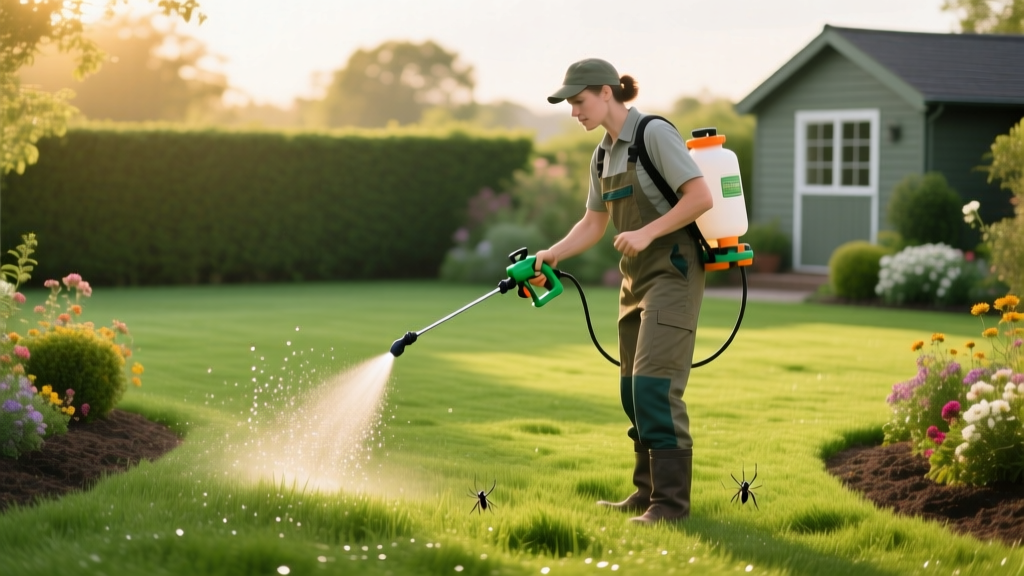
Step-by-Step Guide to Applying Insecticide for Lawns
Applying an insecticide for lawns is not as simple as broadcasting granules and walking away. Industry data indicates that nearly 70% of turf insecticide failures stem from improper equipment calibration, misidentified pest life stages, or ignoring soil thatch barriers. To achieve effective pest management, you must treat the application as a precise scientific procedure rather than a routine chore.
This guide outlines the exact step-by-step maintenance procedures for selecting, calibrating, and applying turf insecticides, ensuring maximum efficacy while minimizing environmental impact.
Phase 1: Identify the Threat and Select the Right Chemistry
Before purchasing any product, you must identify whether you are dealing with a soil-dwelling pest (like white grubs) or a surface-feeding pest (like chinch bugs or armyworms). Furthermore, you must decide between a preventative approach (targeting eggs and early instars) and a curative approach (targeting active, damaging adults or late-stage larvae).
| Target Pest | Application Timing | Active Ingredient | IRAC Group | Example Product | Est. Cost / 1,000 sq ft |
|---|---|---|---|---|---|
| White Grubs | Preventative (Late Spring/Early Summer) | Chlorantraniliprole | Group 28 | Scotts GrubEx1 / Syngenta Acelepryn | $0.12 - $0.15 |
| White Grubs | Curative (Late Summer/Fall) | Trichlorfon | Group 1B | BioAdvanced 24 Hour Grub Killer Plus | $0.08 - $0.10 |
| Chinch Bugs | Curative (Summer surface feeding) | Bifenthrin | Group 3A | Talstar P Professional / Ortho BugClear | $0.05 - $0.07 |
| Armyworms | Curative (Late Summer outbreaks) | Spinosad / Bt | Group 5 / 11A | Monterey Garden Insect Spray | $0.18 - $0.22 |
Expert Insight on IRAC Groups: The Insecticide Resistance Action Committee (IRAC) classifies chemicals by their mode of action. If you apply a Group 3A pyrethroid (like Bifenthrin) for surface pests in July, do not use another Group 3A product for a follow-up application in August. Rotate to a different group to prevent localized pest resistance.
Phase 2: Calibrating Your Spreader or Sprayer
The most critical step in applying an insecticide for lawns is calibrating your equipment. Guessing the dial setting on a rotary spreader often results in under-application (leading to pest survival) or over-application (causing turf phytotoxicity and chemical runoff).
The 1,000 Square Foot Calibration Method
- Measure a Test Area: Mark off exactly 1,000 square feet of your lawn or a paved driveway (e.g., a 20 ft x 50 ft rectangle).
- Weigh the Product: Weigh out the exact amount of granular insecticide required for 1,000 sq ft based on the manufacturer's label. For example, if the label dictates 2.8 lbs per 1,000 sq ft, weigh exactly 2.8 lbs.
- Set and Test: Set your spreader to a medium setting. Walk at your normal, steady application pace over the test area.
- Weigh the Remainder: Weigh the leftover product in the spreader. If you have product left, open the dial. If you run out before finishing the 1,000 sq ft, close the dial. Repeat until the 2.8 lbs is perfectly exhausted over the 1,000 sq ft area.
For liquid hose-end sprayers, calibration involves measuring the output of your specific hose nozzle over 60 seconds to calculate gallons per minute (GPM), then adjusting the sprayer's mixing dial to match the label's dilution rate. According to the Environmental Protection Agency (EPA), precise calibration is the primary defense against accidental environmental contamination.
Phase 3: Step-by-Step Application Protocol
Once your chemistry is selected and equipment calibrated, follow this strict field protocol to ensure the active ingredient reaches the target zone.
Step 1: Prep the Turf Canopy
Mow your lawn to a height of 2.5 inches. If you are targeting soil-dwelling pests like grubs, you must remove the clippings. Thick clippings and excessive thatch (greater than 0.5 inches) will intercept the granules or liquid spray, preventing the active ingredient from reaching the soil surface. If your thatch layer exceeds 0.75 inches, you must core aerate or dethatch before applying any soil-targeted insecticide.
Step 2: Broadcast the Insecticide
Apply the product during the coolest part of the day, ideally early morning. Avoid applications when wind speeds exceed 10 mph to prevent drift onto non-target areas, especially pollinator habitats or vegetable gardens. Use a perimeter shield on your rotary spreader when working near flower beds.
Step 3: Water-In (The Crucial Activation Step)
Granular insecticides targeting soil pests are completely ineffective if they remain on the surface. You must irrigate the lawn immediately after application to wash the chemical off the grass blades and into the root zone.
Place three empty tuna cans in different zones of the treated lawn. Turn on your sprinklers and let them run until the cans collect exactly 0.25 to 0.5 inches of water. This specific volume is required to move chemicals like Chlorantraniliprole into the top 2-3 inches of the soil profile where early-stage grubs feed. For surface pests like chinch bugs, do not water in the product; leave it on the surface where the insects reside.
Warning: Pollinator Protection
Never apply systemic insecticides (like neonicotinoids or certain anthranilic diamides) when your lawn or adjacent weeds (like clover or dandelions) are actively blooming. Mow the lawn and all adjacent weeds immediately prior to application to eliminate blooms and protect foraging bees, as recommended by Penn State Extension turfgrass management guidelines.
Never apply systemic insecticides (like neonicotinoids or certain anthranilic diamides) when your lawn or adjacent weeds (like clover or dandelions) are actively blooming. Mow the lawn and all adjacent weeds immediately prior to application to eliminate blooms and protect foraging bees, as recommended by Penn State Extension turfgrass management guidelines.
Phase 4: Post-Application and Resistance Management
After the application, restrict human and pet traffic on the lawn until the grass is completely dry (for liquids) or until the granules have been fully watered in and the surface is dry (for granules).
Record the date, product name, active ingredient, and IRAC group in a lawn care journal. If you experience a secondary pest outbreak later in the season, consult your journal to ensure you do not re-apply the same mode of action. Continuous use of pyrethroids (Group 3A), for instance, has led to documented bifenthrin-resistant chinch bug populations in several southern states.
Troubleshooting: Why Your Insecticide Failed
If you applied an insecticide for lawns and still see active damage, evaluate these three common failure modes:
- Thatch Binding: Pyrethroids (like Bifenthrin and Lambda-cyhalothrin) have a high organic carbon partition coefficient, meaning they bind tightly to organic matter. If your lawn has a thick thatch layer, the chemical will lock into the thatch and never reach the soil-dwelling pests. Fix: Dethatch before application or use a wetting agent to improve soil penetration.
- UV Degradation: Biological insecticides containing Spinosad or Bacillus thuringiensis (Bt) break down rapidly under direct ultraviolet light. If applied at noon on a cloudless day, the active ingredient may degrade before the target insect ingests it. Fix: Apply biologicals in the late evening.
- Wrong Life Stage Targeting: Applying a preventative product like Acelepryn in late August when grubs are already in their third instar (large and actively devouring roots) will yield poor results. Preventatives only work on eggs and first-instar larvae. Fix: Switch to a fast-acting curative like Trichlorfon (Dylox) for late-season outbreaks.
Mastering the application of an insecticide for lawns requires adherence to label rates, precise equipment calibration, and an understanding of turfgrass ecology. By following this step-by-step protocol, you ensure the health of your turf while maintaining strict environmental stewardship.

