
Pest Control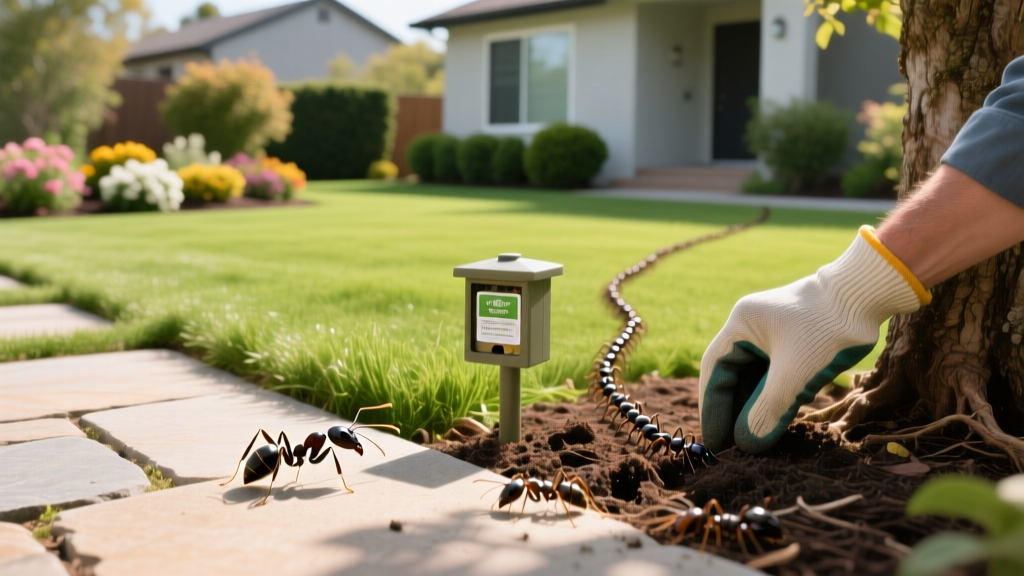
Argentine Ant Extermination: A Complete Yard Defense Guide
Argentine ants (Linepithema humile) are among the most structurally and ecologically disruptive pests in the southern and coastal United States. Unlike native ant species that maintain territorial boundaries, Argentine ants form massive, interconnected supercolonies spanning hundreds of yards. Standard hardware store sprays do not eliminate them; they exacerbate the infestation. Effective argentine ant extermination requires a targeted biological approach combining slow-acting baits with non-repellent liquid barriers.
The Supercolony Problem: Why Repellent Sprays Fail
The fundamental challenge of argentine ant extermination lies in their polygynous nature (multiple queens per nest) and unicolonial social structure. When a colony is stressed by fast-acting, repellent insecticides like bifenthrin or permethrin, the workers and queens trigger a survival mechanism known as 'budding'. The colony fractures into multiple satellite nests, effectively multiplying your infestation. According to the University of California Agriculture and Natural Resources (UC ANR), avoiding repellent contact sprays is the single most critical rule in managing this species.
Warning: Never use Ortho Home Defense, Raid, or any pyrethroid-based perimeter spray on active argentine ant trails. The immediate kill of foraging workers will signal the queens to bud, turning a single-nest problem into a multi-node supercolony within 72 hours.
The 3-Phase Extermination Protocol
To achieve total yard defense, you must execute a sequential three-phase protocol that exploits the ants' trophallaxis (food-sharing) behavior and their foraging pathways.
Phase 1: Diet Assessment and Pre-Baiting
Argentine ants shift their macronutrient preferences based on the season and colony needs. Before deploying expensive baits, conduct a 24-hour preference test. Place a small dab of honey (carbohydrate) and a dab of peanut butter (protein/fat) on index cards near active trails. Observe which food source attracts the highest volume of foragers. This dictates your active ingredient matrix for Phase 2.
Phase 2: Strategic Liquid and Gel Baiting
Once the dietary preference is established, deploy slow-acting baits. Liquid baits are generally superior because workers can ingest and regurgitate them more efficiently to the queens deep within the soil.
- Placement: Apply gel or liquid bait stations every 10 to 15 feet along visible trails and at the base of trees or shrubs where aphids are present (a primary food source).
- Volume: Use roughly 1 to 2 grams of gel per station. Do not over-apply; large pools of bait can dry out and become unpalatable, causing bait shyness.
- Patience: Expect ant activity to increase for the first 3 to 5 days as foragers recruit the colony. Do not disturb the trails during this period.
Phase 3: Non-Repellent Perimeter Trenching
After the baiting phase has reduced the internal colony population (typically 14 to 21 days), establish a non-repellent chemical barrier to prevent re-invasion from neighboring properties. Fipronil-based products are the industry standard because they are undetectable to the ants and feature a 'transfer effect'—ants walking through the treated soil carry the toxin back to the nest.
Trenching Calculation: To treat a 100-linear-foot foundation, dig a trench 6 inches wide and 6 inches deep. You will need 4 gallons of finished solution per 10 linear feet (40 gallons total). Mix Taurus SC at a rate of 0.8 fluid ounces per gallon of water. For 40 gallons, you will need exactly 32 fluid ounces of concentrate.
Professional-Grade Product Matrix
Consumer-grade baits often lack the concentration required to penetrate deep into a supercolony. The following professional products yield the highest success rates for argentine ant extermination.
| Product Name | Active Ingredient | Avg. Cost (2026) | Best Application |
|---|---|---|---|
| Maxforce Quantum | Imidacloprid (0.03%) | $45 - $55 / 275g | Sweet-feeding colonies; stays moist longer in dry climates. |
| Optigard Flex Liquid | Thiamethoxam (0.01%) | $60 - $75 / 20oz | Liquid barrier and spot-treatment; excellent transfer effect. |
| Taurus SC | Fipronil (9.1%) | $65 - $85 / 20oz | Exterior foundation trenching; long-term soil residual. |
| Advance 375A | Abamectin (0.011%) | $35 - $45 / 8oz | Protein/grease foraging shifts; granular broadcast. |
Seasonal Foraging Shifts: Sugar vs. Protein
A common reason for failed extermination attempts is deploying the wrong bait matrix during a seasonal dietary shift. Data from Texas A&M AgriLife Extension highlights that ant macronutrient requirements fluctuate heavily with the reproductive cycle.
Spring and Early Summer (Carbohydrate Load)
During the spring, the colony requires massive amounts of energy to fuel the queens' egg-laying and the workers' high-activity foraging. Carbohydrate-heavy baits (sugar, honey, syrup bases) like Maxforce Quantum are highly effective during this window. Additionally, Argentine ants heavily tend to aphids and scale insects on ornamental shrubs to harvest honeydew. Treating the host plants with horticultural oil disrupts this food source, forcing the ants to rely on your deployed baits.
Late Summer and Fall (Protein and Lipid Load)
As the colony prepares for winter dormancy and the development of reproductive alates (swarmers), the dietary demand shifts toward proteins and fats to sustain larval development. During this period, sweet baits may be completely ignored. Switch to protein-based granular baits like Advance 375A or gel baits formulated with fish oil and soybean protein matrices.
Critical Eradication Failure Modes
Even with professional-grade products, argentine ant extermination can fail if specific environmental and behavioral variables are ignored. Avoid these common pitfalls:
Failure Mode 1: Irrigation Washout. Applying granular baits or liquid barriers immediately before a heavy rainstorm or scheduled lawn irrigation will wash the active ingredients into the storm drain or dilute them below the lethal threshold. Always check the 48-hour weather forecast and ensure soil is moist, but not saturated, prior to trenching.
Failure Mode 2: Bait Spoilage and Shyness. Liquid and gel baits placed in direct, unshaded sunlight will dry out and ferment within 24 hours. If worker ants consume spoiled bait and suffer sub-lethal illness, the colony will associate the bait station with danger, resulting in permanent 'bait shyness'. Always place baits in shaded crevices, under mulch, or inside commercial plastic bait stations.
Failure Mode 3: Ignoring the Mulch Layer. Argentine ants prefer nesting in the moisture-retaining zone just beneath landscape mulch, leaf litter, and ground cover. If you apply a surface spray but fail to rake back the mulch to treat the underlying soil, the colony will simply forage beneath the barrier. Pull back mulch 12 inches from the foundation before applying your Taurus SC trench.
By respecting the biological imperatives of the supercolony and utilizing a phased, non-repellent strategy, you can achieve long-term yard defense against argentine ants. Consistent monitoring and seasonal bait rotation remain the cornerstones of sustainable pest management.

