
Pest Control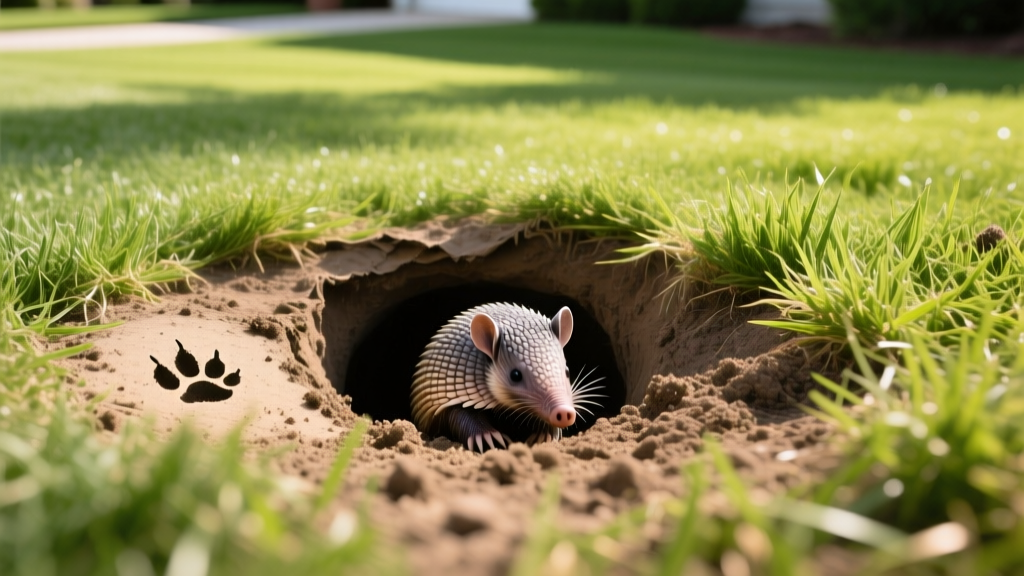
Armadillo Burrow Identification and Effective Lawn Deterrence
The Anatomy of an Armadillo Burrow
The nine-banded armadillo (Dasypus novemcinctus) is a prolific excavator that can cause severe structural damage to residential lawns, patios, and foundations. A single adult armadillo may maintain up to 12 distinct burrows across its territory, though it typically only uses one or two at a time for nesting. Understanding the exact dimensions and soil signatures of an armadillo burrow is the first step in effective mammal deterrence.
Key Identification Metrics
- Entrance Diameter: Typically 7 to 8 inches wide, large enough to easily fit a human fist.
- Tunnel Depth: Can extend up to 15 feet deep and 24 feet long, featuring multiple branching chambers for nesting and latrine use.
- Soil Mounding: Unlike moles that create tight volcano-shaped mounds, armadillos push loose, excavated dirt outward in a broad, conspicuous apron directly in front of the entrance.
- Scrape Marks: Look for deep, three-toed claw marks in the soil surrounding the hole and along nearby foraging paths.
Health & Safety Warning: Nine-banded armadillos are one of the few non-human mammals known to carry Mycobacterium leprae, the bacterium that causes leprosy. Never reach your bare hands into an active armadillo burrow. Always wear thick, puncture-resistant leather gloves and use long-handled tools when inspecting or filling tunnels.
Armadillo Burrow vs. Other Lawn Pests
Misidentifying the pest leads to wasted time and ineffective treatments. Use this comparison matrix to confirm you are dealing with an armadillo rather than other common subterranean mammals.
| Pest | Hole Diameter | Soil Evidence | Primary Lawn Damage |
|---|---|---|---|
| Armadillo | 7 - 8 inches | Broad, loose apron of dirt at entrance | Deep conical holes, uprooted turf from foraging |
| Groundhog | 10 - 12 inches | Flattened 'porch' of dirt, multiple exits | Massive soil displacement, chewed vegetation |
| Mole | 2 - 3 inches (rarely open) | Symmetrical volcano mounds, raised surface ridges | Severed grass roots, spongy lawn surface |
| Vole | 1 - 1.5 inches | No mounds, visible surface runways through grass | Gnawed bark at tree bases, eaten bulbs |
Step-by-Step Guide to Safely Filling an Active Burrow
Simply shoveling topsoil into an armadillo burrow will not deter the animal; they will easily re-excavate loose dirt within hours. You must use a structural fill method that creates an unappealing digging environment.
- Verify Abandonment (48-Hour Test): Lightly rake the soil apron smooth and place a thin layer of flour or fine sand over the entrance. Check after 48 hours. If the flour is undisturbed, the burrow is likely inactive. According to the Internet Center for Wildlife Damage Management, sealing an active burrow with an animal trapped inside is inhumane and will cause the armadillo to dig a desperate, highly destructive secondary exit.
- Mix a Deterrent Fill: Combine 60% native clay soil with 40% crushed gravel (3/4-inch angular stone). Armadillos have sensitive snouts and despise digging through sharp, unyielding substrates.
- Pack the Tunnel: Use a long tamping bar to push the gravel-soil mix as deep into the primary shaft as possible. Fill the final 12 inches with pure topsoil to allow for grass seed germination.
- Apply a Surface Deterrent: Saturate the filled area with a high-concentration castor oil repellent to mask the scent of the old burrow and discourage immediate re-digging.
Long-Term Deterrence: Exclusion and Habitat Modification
Filling a burrow is a reactive measure. To achieve long-term lawn protection, you must implement physical exclusion and eliminate the armadillo's primary food source: soil-dwelling insects.
Physical Exclusion: The 40-Degree Fence Rule
Standard vertical fencing is useless against armadillos, as they are powerful diggers, not climbers. The Humane Society of the United States recommends a specific subterranean fencing geometry. Use 1/2-inch galvanized hardware cloth. Dig a trench 18 inches deep around the perimeter of your lawn or garden bed. Bury the bottom 18 inches of the mesh, but critically, angle the buried portion outward away from the yard at a 40-degree angle. Leave 12 to 18 inches of mesh above ground. When the armadillo digs down and hits the wire, the outward angle directs its digging momentum away from your property.
Habitat Modification: Targeted Grub Eradication
Armadillos dig shallow, conical holes (often 1-3 inches deep and 3-5 inches wide) specifically to extract white grubs and earthworms. If your lawn has no grubs, armadillos will bypass it.
- Conventional Control: Apply products containing Chlorantraniliprole (e.g., Scotts GrubEX1) in late spring (May/June). This active ingredient targets early-instar grubs before they grow large enough to attract foraging armadillos. Cost: ~$25 per 5,000 sq ft.
- Organic Control: Apply Bacillus thuringiensis galleriae (Bt galleriae), sold under brands like grubGONE! G. This naturally occurring soil bacterium paralyzes the digestive system of beetle larvae without harming earthworms or beneficial soil microbes. Cost: ~$35 per 5,000 sq ft.
The Science of Castor Oil Repellents
Liquid castor oil repellents (such as Nature's Mace or Tomcat Mole & Gopher Repellent) do not poison the armadillo. Instead, the Ricinus communis oil acts as a powerful surfactant that coats soil particles and grubs. When the armadillo ingests the oil-coated prey, it causes mild, temporary gastrointestinal distress. The animal quickly associates your specific lawn with an upset stomach and relocates its foraging grounds. For maximum efficacy, apply castor oil solutions at a rate of 1 oz per 1,000 square feet, watering it deeply into the top 3 inches of soil immediately after application.
Cost Breakdown: DIY vs. Professional Wildlife Removal (2026)
When dealing with extensive tunnel networks under concrete slabs or near foundations, DIY methods may be insufficient. Below is a realistic cost comparison for armadillo management strategies.
| Management Strategy | Estimated Cost | Best Use Case |
|---|---|---|
| DIY Castor Oil Repellent | $25 - $45 per acre | Mild foraging damage, small suburban lawns |
| DIY Hardware Cloth Fencing | $3.50 - $6.00 per linear foot | Protecting specific garden beds or perimeter borders |
| DIY Live Trapping (Havahart 1085) | $60 - $90 (one-time trap cost) | Targeting a single, highly destructive nuisance animal |
| Professional Trapping & Relocation | $200 - $450 per visit | Multiple active burrows, foundation threats, or HOA restrictions |
Expert FAQ on Armadillo Management
Q: Will mothballs or ammonia-soaked rags keep armadillos out of their burrows?
A: No. Not only are these methods entirely ineffective against the deep, well-ventilated tunnel systems of an armadillo, but using mothballs (naphthalene) outdoors is a violation of federal EPA pesticide regulations and will toxicify your soil and local watershed.
Q: How do I trap an armadillo that is destroying my lawn?
A: Use a 32x12x12-inch single-door live trap (like the Havahart 1085). Place it directly over the primary burrow entrance or funnel it using wooden boards to create a narrow pathway. Bait the trap with overripe fruit, mealworms, or canned cat food. Check local wildlife regulations, as relocating trapped armadillos across county lines is illegal in many states to prevent the spread of zoonotic diseases.
Q: Do ultrasonic solar spikes work for armadillos?
A: Field tests consistently show that ultrasonic deterrents fail to deter armadillos. Their hearing range and subterranean lifestyle render above-ground high-frequency sound emitters useless. Stick to physical exclusion and food-source elimination.

