
Pest Control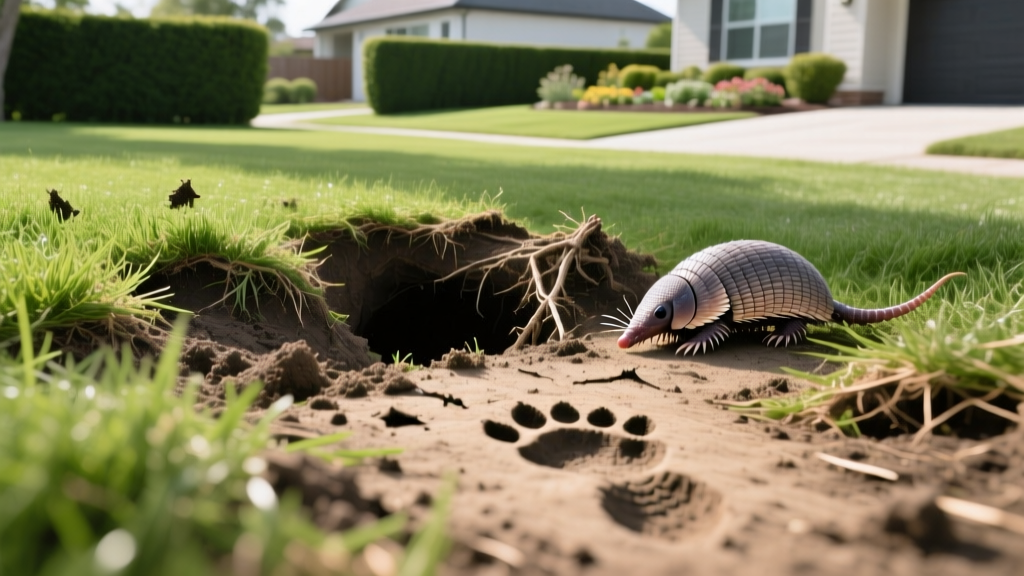
Armadillo Damage to Yard: Diagnosis and Rescue Fixes
Waking up to a lawn that looks like it has been peppered with shallow, conical craters is a frustrating reality for homeowners in the South and Southeast. While several pests dig in lawns, armadillo damage to yard turf is distinct, destructive, and requires a highly specific approach to repair and prevent. The nine-banded armadillo (Dasypus novemcinctus) is a nocturnal forager with a poor sense of sight but an exceptional sense of smell, zeroing in on soil-dwelling insects. Understanding the mechanics of their foraging behavior is the first step toward reclaiming your landscape.
The Anatomy of Armadillo Damage: What You Are Actually Seeing
Armadillos do not tunnel extensively beneath the surface like moles. Instead, they dig vertically into the topsoil to extract prey. Recognizing the specific symptoms of their foraging is critical for accurate diagnosis:
- Hole Dimensions: Typical foraging holes are 1 to 3 inches deep and 3 to 5 inches wide at the surface, tapering into a cone shape.
- Soil Displacement: Unlike molehills, which feature mounded volcanic soil, armadillo holes have loose dirt scattered haphazardly around the perimeter.
- Root Disruption: As they dig, armadillos frequently uproot shallow-rooted grasses and tear through rhizomes, leaving patches of torn, yellowing turf.
- Burrow Entrances: While foraging holes are shallow, their actual living burrows are much larger—typically 7 to 8 inches in diameter and up to 15 feet long, often located near foundations, stumps, or rock piles.
Armadillos vs. Moles vs. Skunks: The Digging Pest Matrix
Misidentifying the pest leads to wasted time and ineffective treatments. Use this diagnostic matrix to confirm the culprit before applying rescue fixes.
| Pest | Hole/Divot Shape | Depth | Soil Displacement | Primary Target |
|---|---|---|---|---|
| Armadillo | Conical, funnel-like | 1–3 inches | Scattered loosely around rim | Grubs, earthworms, beetles |
| Mole | Volcanic mound (molehill) or raised surface ridges | Surface to 12+ inches deep tunnels | Packed into distinct mounds | Earthworms, soil insects |
| Skunk | Wide, shallow divots (peeled-back sod) | 1–2 inches deep, 3-4 inches wide | Sod rolled back in flaps | Grubs, larvae |
| Vole | Small, clean-edged holes (golf ball size) | 1–2 inches, connected to surface runways | Minimal, hidden in grass | Plant roots, bulbs, bark |
The Root Cause: Why Armadillos Target Your Specific Soil
Armadillos are not digging for spite; they are following a food source. According to wildlife biologists at Texas Parks and Wildlife, insects make up over 90% of an armadillo's diet. If your yard is experiencing a boom in white grubs (Japanese beetle or June beetle larvae), armyworms, or earthworms, it will act as a beacon. Furthermore, armadillos prefer moist, loamy soil that is easy to dig. Overwatered lawns or yards with poor drainage inadvertently create the perfect foraging environment.
⚠️ Public Health Warning: The CDC notes that nine-banded armadillos are one of the only known animal reservoirs for Mycobacterium leprae, the bacteria that causes Hansen's disease (leprosy). Never handle an armadillo, its burrows, or fresh soil from its digging sites with bare hands. Always wear heavy-duty leather gloves, such as Wells Lamont HydraTuff, and wash thoroughly afterward. Read more on transmission risks via the CDC's Hansen's Disease guidelines.
Rescue Fixes: Restoring Turf After an Armadillo Raid
Once the immediate pest pressure is managed, you must repair the structural integrity of your lawn to prevent weed invasion and soil erosion.
Step 1: Soil Grading and Hole Filling
Do not simply kick loose dirt back into the holes. Armadillo digging aerates the soil but leaves voids that will sink and pool water after the next rainstorm.
- Mix a Custom Fill: Combine 70% screened topsoil with 30% coarse play sand. The sand prevents the fill from compacting into a hard clay plug, ensuring water penetrates to the grass roots.
- Fill and Tamp: Shovel the mixture into the conical holes until it mounds slightly above the surrounding grade. Use a manual steel hand tamper to compress the soil until it is flush with the existing lawn.
- Level the Surface: Drag a piece of chain-link fence or a leveling rake over the repaired areas to blend the fill seamlessly into the surrounding turf.
Step 2: Turf Reseeding and Sod Patching
For holes wider than 4 inches where the root structure is completely destroyed, spot-seeding or sod patching is required.
- Seed Selection: Match your existing turf. For warm-season lawns, use a vegetative Bermuda or Zoysia plug. For cool-season lawns, apply a high-quality Tall Fescue blend.
- Fertilization: Apply a starter fertilizer with a high phosphorus content (e.g., Scotts Turf Builder Starter Food 24-25-4) to accelerate root development in the patched zones.
- Hydration Protocol: Water the patched areas lightly three times a day for 5–10 minutes to keep the top inch of soil consistently moist until germination or root establishment occurs (typically 10–14 days).
Long-Term Exclusion and Deterrence Strategies
Repellent sprays and ultrasonic devices are largely ineffective against armadillos due to their deep foraging focus and poor hearing. True deterrence requires physical exclusion and food source elimination.
The Grub Control Timing Framework
Eliminating the food source is the most effective long-term deterrent. You must time your chemical applications to the grub lifecycle:
- Preventive Application (April - May): Apply Chlorantraniliprole (found in products like Acelepryn or Scotts GrubEx1). This active ingredient takes 60-90 days to reach peak efficacy in the soil profile, perfectly timing it to kill newly hatched grubs in mid-summer before they grow large enough to attract armadillos.
- Curative Application (August - September): If you missed the spring window and armadillos are actively tearing up your fall lawn, apply Imidacloprid (Merit) or Trichlorfon (Dylox). These act as fast-kill contact poisons that eliminate active, mature grubs within 24 to 48 hours, immediately removing the armadillo's food incentive.
Physical Exclusion Fencing
If your property borders wooded areas or creek beds, fencing is mandatory. Standard chain-link or privacy fences will not stop them. You must install a specialized wildlife barrier:
- Purchase 1/2-inch galvanized hardware cloth (minimum 24 inches tall).
- Dig a narrow trench 12 inches deep along the perimeter.
- Bury the bottom 12 inches of the hardware cloth in the trench, but bend the bottom 6 inches outward at a 90-degree angle (away from the yard) to form an "L" shape underground. Armadillos dig straight down when they hit a barrier; the outward lip will block their progress.
- Backfill the trench and secure the above-ground 12 inches to wooden stakes or existing fencing.
Trapping and Relocation Realities
If exclusion and grub control fail, live trapping is the final option. Use a large, single-door live trap like the Havahart 1045 (10 x 12 x 32 inches). Place the trap directly in front of an active burrow entrance. Construct a funnel using hardware cloth to guide the armadillo into the trap door. Bait with overripe bananas, fermented fruit, or live mealworms.
Legal Caveat: Relocation laws are strict and vary wildly by jurisdiction. In states like Florida, relocating wildlife that carries disease risks is often prohibited; you must release the animal on the exact capture site or arrange for humane euthanasia by a licensed nuisance wildlife trapper. In Texas, relocation on private property is permitted with the landowner's written consent. Always consult your local Department of Natural Resources before moving a trapped animal.

