
Pest Control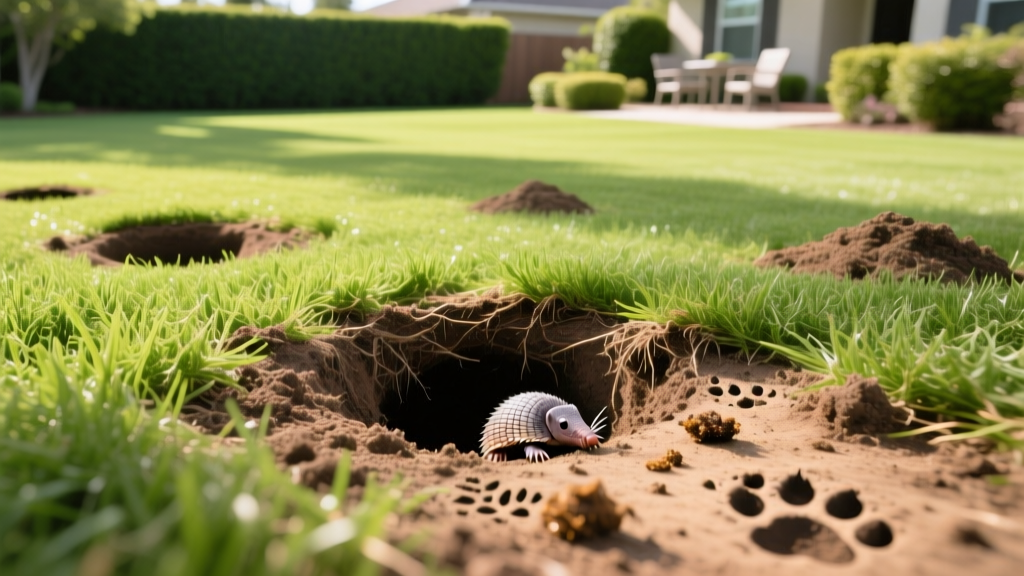
Armadillo Holes in Lawns: Identification, Filling, and Deterrence
The Anatomy of Armadillo Holes: Foraging vs. Burrowing
When dealing with lawn damage from the nine-banded armadillo (Dasypus novemcinctus), homeowners often misidentify the type of excavation they are looking at. Armadillos actually create two distinct types of holes, and understanding the difference is the first step in effective mammal deterrence.
1. Foraging Holes (The Rooting Damage)
Armadillos possess an acute sense of smell that allows them to detect subterranean insects through 2 to 3 inches of soil. When foraging, they root similarly to feral pigs, leaving behind shallow, scattered divots. These holes are typically 2 to 3 inches deep, 3 to 5 inches wide, and lack significant dirt mounds. They are a clear indicator of an active white grub or earthworm population beneath your turf.
2. Burrow Holes (The Nesting Entrances)
Burrow entrances are the structural holes most homeowners refer to when searching for armadillo hole solutions. These are deep, permanent excavations used for shelter and nesting. A standard armadillo burrow entrance measures 7 to 8 inches in diameter and can extend up to 15 feet horizontally, dropping 5 to 15 inches below the frost line. You will typically find these near structural foundations, large tree stumps, or dense brush piles, accompanied by a noticeable fan-shaped mound of excavated soil.
Hole Identification Matrix: Armadillo vs. Common Lawn Pests
| Pest Species | Hole Diameter | Depth / Structure | Dirt Mound Characteristics | Primary Location |
|---|---|---|---|---|
| Armadillo | 7-8 inches (Burrow) | Up to 15 ft long, angled down | Fan-shaped, loosely scattered | Near stumps, foundations, brush |
| Skunk | 2-3 inches | Shallow, precise cone shape | Minimal to no mound | Open lawn areas (foraging) |
| Groundhog | 10-12 inches | Deep, extensive tunnel network | Massive, crescent-shaped mound | Open fields, garden edges |
| Vole | 1-1.5 inches | Surface runways and shallow tunnels | Small, volcano-shaped piles | Under mulch, along borders |
Step-by-Step Guide to Filling Armadillo Burrows
Simplistically kicking loose dirt back into an armadillo hole guarantees the animal will re-excavate it within 48 hours. Armadillos are creatures of habit and possess excellent spatial memory regarding their den sites. To permanently reclaim the space, follow this engineered filling protocol.
- Verify Vacancy: Never seal an active burrow with an animal inside. Lightly sprinkle a thin layer of flour or fine sand across the entrance at dusk. If the powder is undisturbed after two consecutive nights, the burrow is likely abandoned.
- Clear the Tunnel Mouth: Use a garden trowel to remove the first 12 inches of loose, caved-in debris from the tunnel entrance to create a clean cavity.
- Mix the Deterrent Fill: Do not use pure topsoil. Armadillos prefer loose, easily excavated earth. Mix a composite fill of 70% compactable topsoil and 30% coarse masonry sand. The sand drastically improves drainage, preventing the hole from becoming a moist, attractive insect haven, while making the soil matrix harder to dig.
- Tamp in 3-Inch Lifts: Shovel the mixture into the hole and use a 4x4 wooden post or a hand tamper to compact the soil every 3 inches. This eliminates air pockets that would otherwise cause the ground to sink after heavy rainfall.
- Cap and Overseed: Mound the final 2 inches of fill slightly above the surrounding grade to account for natural settling. Broadcast turfgrass seed matching your existing lawn (e.g., Bermuda or Zoysia) and apply a light layer of straw mulch to retain moisture during germination.
Proven Deterrence Strategies: Starve, Block, and Repel
Filling holes is merely reactive. To stop armadillos from returning, you must alter the environmental incentives of your property. According to wildlife management guidelines from the University of Florida IFAS Extension, an integrated approach combining food source elimination and physical exclusion yields the highest long-term success rates.
Phase 1: Eradicate the Food Source (Grub Control)
If armadillos are digging shallow foraging holes across your lawn, your turf is harboring white grubs (the larval stage of June beetles, Japanese beetles, and European chafers). Eliminating this food source forces the armadillos to forage elsewhere.
- Preventative Chemical Control: Products containing Chlorantraniliprole (such as Scotts GrubEx or professional-grade Acelepryn) are highly effective and safe for pollinators once watered in. Apply between May and early June at a rate of roughly $45 to $60 per 10,000 square feet. This targets grubs before they reach the destructive third-instar stage.
- Curative Organic Control: For organic lawn care, apply Milky Spore (Paenibacillus popilliae) or beneficial nematodes (Heterorhabditis bacteriophora). Nematodes must be applied in the late evening when soil temperatures are between 60°F and 70°F, costing approximately $35 for a 10-million nematode concentrate covering 2,500 square feet. As noted by Penn State Extension, proper soil moisture is critical for nematode survival and efficacy.
Phase 2: Physical Exclusion Fencing
Armadillos are poor climbers but exceptional diggers. Standard chicken wire is entirely ineffective, as they will easily crush or dig beneath it. You must install a specialized exclusion barrier.
- Material: Use 19-gauge, 1/2-inch mesh galvanized hardware cloth. Purchase 36-inch wide rolls (averaging $1.50 to $2.50 per linear foot).
- Installation Depth: Dig a narrow trench 12 inches deep along the perimeter of the area you wish to protect. Bury the bottom 12 inches of the hardware cloth vertically.
- The 45-Degree Overhang: Leave 24 inches of the mesh above ground. Crucially, bend the top 6 to 8 inches outward, away from the protected area, at a 45-degree angle. When an armadillo encounters the fence, it will attempt to dig at the base (blocked by the buried section) or climb over (thwarted by the outward-angled overhang).
Phase 3: Castor Oil Repellents
For localized deterrence around specific garden beds or shed foundations, castor oil-based repellents (such as Nature's Mole & Armadillo Repellent) can disrupt the armadillo's olfactory foraging. Mix 2 ounces of castor oil concentrate with 1 gallon of water and apply to 1,000 square feet of soil. This coats the root zone and makes soil insects taste unpalatable. Reapplication is strictly required after any rainfall exceeding 0.5 inches or every 30 days, whichever comes first.
⚠️ Warning: Trapping and Relocation Laws
Do not attempt to live-trap and relocate armadillos without consulting local wildlife authorities. In many southern states (including Texas and Florida), relocating armadillos is strictly illegal due to their status as a known vector for Mycobacterium leprae (the bacterium that causes leprosy). Furthermore, relocating a territorial animal into an unfamiliar habitat usually results in starvation or fatal conflicts with resident wildlife. If exclusion and grub control fail, consult a licensed Nuisance Wildlife Control Operator (NWCO) for legal, humane removal.
Frequently Asked Questions
Will mothballs keep armadillos out of their holes?
No. Mothballs (naphthalene or paradichlorobenzene) are highly ineffective against armadillos and are illegal to use outdoors as a pesticide. The chemical dissipates rapidly in open soil, and armadillos will simply dig a new entrance a few feet away. Furthermore, mothballs leach toxic chemicals into your local groundwater.
How fast can an armadillo dig a new hole?
An adult nine-banded armadillo can excavate a standard 7-inch burrow entrance and a 5-foot tunnel in under an hour if the soil is adequately moist. This rapid excavation rate is why immediate filling and soil compaction are necessary once a burrow is confirmed vacant.
Do ultrasonic solar repellents work for armadillos?
Field tests consistently show that ultrasonic stakes and solar-powered vibrating spikes provide negligible deterrence against armadillos. Their hearing range and behavioral response to subterranean vibrations do not trigger a flight response strong enough to abandon a high-value food source like a grub-infested lawn. Invest your budget in targeted grub control and physical hardware cloth barriers instead.

