
Pest Control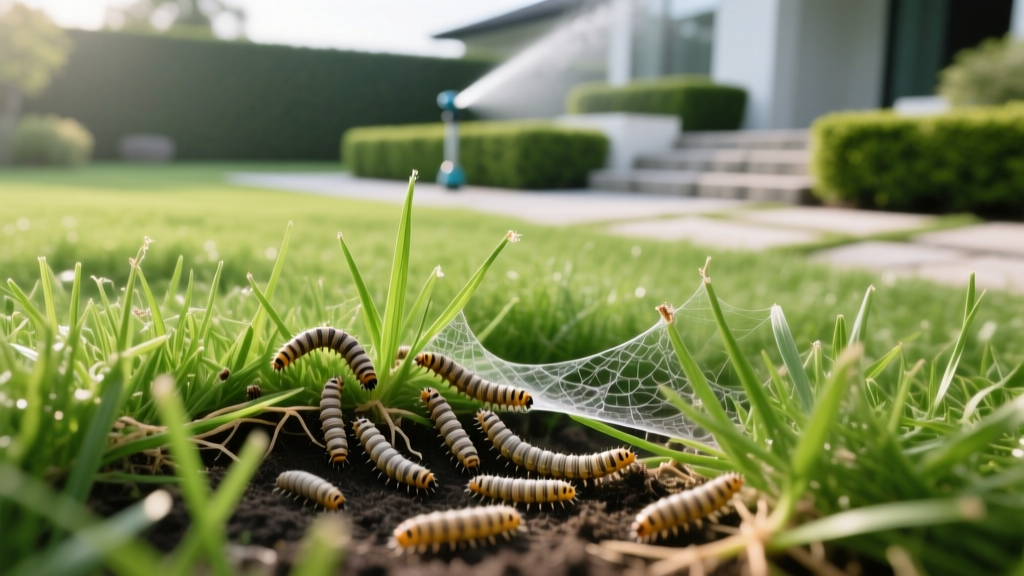
Army Worm Nest Myth: What You Are Actually Seeing and How to Treat It
The Biological Impossibility of an Army Worm Nest
If you are searching your yard for an 'army worm nest,' you are looking for a structure that does not exist. True armyworms (Mythimna unipuncta) and fall armyworms (Spodoptera frugiperda) are solitary, ground-dwelling larvae. Unlike tent caterpillars or fall webworms, armyworms lack the silk-spinning anatomy required to build tents, webs, or nests. They hatch, drop to the soil, and hide in the thatch layer during the day, emerging at night to devour turfgrass.
When homeowners report finding an army worm nest, they are almost always misidentifying one of three things: an armyworm egg mass, a sod webworm silk tunnel, or a fall webworm tent. Correctly identifying what you are actually looking at is the critical first step in saving your lawn from severe defoliation. Misapplying treatments based on a misidentified 'nest' will waste time and money while the larvae multiply.
Decoding the 'Nest': What Are You Actually Looking At?
Before purchasing insecticides, you must determine which pest is occupying your turf. The visual cues left behind by these insects are distinct, and confusing them leads to treatment failure.
| Pest Species | What Homeowners Call a 'Nest' | Actual Structure / Sign | Larvae Appearance |
|---|---|---|---|
| Fall Armyworm | Fuzzy patch on grass blade | Egg Mass (100-200 eggs covered in moth scale dust) | Green/brown with inverted Y on head, 1.5 inches max |
| Sod Webworm | Webbing on grass surface | Silk tunnels woven through the thatch layer | Gray/green with dark brown spots, 0.75 inches max |
| Fall Webworm | Large silk tent in trees/shrubs | Expansive silk webbing enclosing branch foliage | Pale yellow/green, heavily hairy, 1 inch max |
1. The Armyworm Egg Mass (The Real 'Nest')
The closest thing to an army worm nest is the egg mass laid by the adult female moth. She deposits 100 to 200 eggs in a single cluster, usually near the base of the grass or on nearby vertical structures like fence posts. To protect the eggs from predators and desiccation, she covers them with a layer of fuzzy, grayish-white scales rubbed from her own abdomen. From a distance, this looks like a small piece of cotton or a tiny, fuzzy nest stuck to a blade of grass. According to the University of Georgia Extension, these eggs hatch rapidly in summer heat—often within 48 to 72 hours—releasing hundreds of microscopic first-instar larvae onto your turf.
2. Sod Webworm Silk Tunnels
If you are seeing actual webbing on the surface of your lawn, you are likely dealing with sod webworms, not armyworms. Sod webworm larvae spin intricate silk tunnels through the thatch to hide from birds and sunlight. You will often notice small piles of green frass (caterpillar excrement) near the entrances of these silk tunnels. The Penn State Extension notes that sod webworm damage is often confused with drought stress, as the grass blades are chewed off at the soil line, leaving behind brown, scalped patches.
3. Fall Webworm Tents
If the 'nest' is a massive, ugly silk tent engulfing the branches of your pecan, persimmon, or ornamental trees, you have fall webworms. These are tree pests, not turfgrass pests, and require entirely different management strategies focused on canopy pruning or targeted horticultural oils rather than lawn sprays.
The Soapy Water Flush Test: Confirming the Infestation
Because armyworms hide deep in the thatch during daylight hours, visual inspection of the grass surface is insufficient. To confirm an active armyworm infestation, turf professionals rely on the soapy water flush test. This forces the larvae to the surface where they can be counted and sized.
Pro-Tip: The Flush Test Recipe
Mix 2 tablespoons of lemon-scented liquid dish soap (such as Dawn) into 2 gallons of water. Pour this solution evenly over a 1-square-yard area of damaged or suspected turf. Wait 3 to 5 minutes. The soap irritates the caterpillars' skin, forcing them to wriggle to the surface. If you see 3 or more armyworms per square foot, immediate chemical intervention is required.
Targeted Eradication: Matching the Chemical to the Instar
The most common reason armyworm treatments fail is that homeowners apply the wrong product for the caterpillar's developmental stage (instar). Armyworms go through six instars. Their susceptibility to biological controls drops to zero once they reach the fourth instar.
Stage 1: Early Instars (1st through 3rd) - Biological Control
If your flush test reveals tiny, greenish caterpillars less than 0.5 inches long, you are in the optimal window for Bacillus thuringiensis var. kurstaki (Bt). Bt is a naturally occurring soil bacterium that produces proteins toxic to the alkaline gut of young caterpillars.
- Recommended Product: Monterey B.t. Insect Spray or Bonide Thuricide.
- Application Rate: 2 oz per gallon of water, covering 1,000 square feet.
- Cost: Approximately $18 to $22 for a 16 oz bottle.
- Crucial Timing: Bt degrades rapidly in UV light. Apply in the late evening when the larvae are actively feeding on the grass blades. Do not irrigate for 24 hours post-application.
Stage 2: Late Instars (4th through 6th) - Synthetic Pyrethroids
If the flush test reveals large, dark brown or green caterpillars measuring 1 to 1.5 inches with the distinct inverted 'Y' on their head capsule, Bt will be entirely ineffective. Their gut lining has thickened, and they are consuming massive amounts of turf daily. You must escalate to a synthetic pyrethroid or carbamate.
- Recommended Product: Talstar P (Bifenthrin 7.9%) or Sevin Insect Killer (Carbaryl).
- Application Rate (Talstar P): 1 oz of concentrate per 1,000 square feet, diluted in enough water to ensure thorough coverage (usually 1.5 to 2 gallons).
- Cost: A 32 oz hose-end sprayer bottle of Bifenthrin costs roughly $35 to $45 and treats up to 20,000 square feet.
- Safety Note: Pyrethroids are highly toxic to aquatic life and bees. Avoid spraying near storm drains, ponds, or blooming weeds like clover and dandelions.
Cultural Defense: Eliminating the Thatch Bunker
Chemical treatments only address the current generation of larvae. To prevent future 'nests' (egg masses) from successfully hatching and establishing, you must alter the microenvironment of your lawn. Armyworms require a thick thatch layer to hide from the sun and avian predators during the day.
Warning: Irrigation Timing Matters
Watering your lawn in the late evening creates the perfect humid, cool environment for armyworm feeding and fungal diseases like Brown Patch. Always irrigate between 4:00 AM and 8:00 AM. This allows the grass blades to dry before the nocturnal armyworm emergence, making the turf less hospitable to egg-laying moths seeking moisture.
Implement these turf management tactics to break the pest cycle:
- Core Aeration and Dethatching: If your thatch layer exceeds 0.5 inches, rent a power dethatcher or core aerator in early spring. Removing this physical bunker exposes larvae to sunlight and ground beetles (natural predators).
- Mowing Height Adjustment: Maintain Tall Fescue at 3.0 to 3.5 inches and Bermuda grass at 1.5 to 2.0 inches. Cutting grass too short stresses the root system and removes the canopy shade that keeps soil temperatures cool, ironically making the lawn more susceptible to rapid armyworm defoliation.
- Nitrogen Management: Avoid heavy applications of quick-release nitrogen (like Urea 46-0-0) during late summer. The University of Florida IFAS warns that lush, rapid, dark-green growth acts as a powerful olfactory beacon for gravid female moths seeking egg-laying sites.
Expert FAQ: Armyworm Defense
Will dish soap kill armyworms?
No. While dish soap is an excellent irritant for flushing them out of the thatch for identification purposes, it does not possess the residual toxicity required to kill an established armyworm population. Relying on soap sprays will result in severe turf loss.
Do armyworms come back every year?
In USDA Zones 8 and above, fall armyworms can overwinter and cause annual damage. In northern zones, they do not survive freezing winter temperatures; instead, they migrate northward from the Gulf Coast each summer on weather fronts. Monitoring local university extension pest alerts in late July and August is the best way to anticipate their arrival.
Can I mow my lawn after applying Bifenthrin?
Wait at least 48 hours after a liquid pyrethroid application before mowing. This allows the active ingredient to bind to the plant tissue and thatch. Mowing too soon will physically remove the chemical barrier, rendering the treatment useless against the next wave of hatching larvae.

