
Pest Control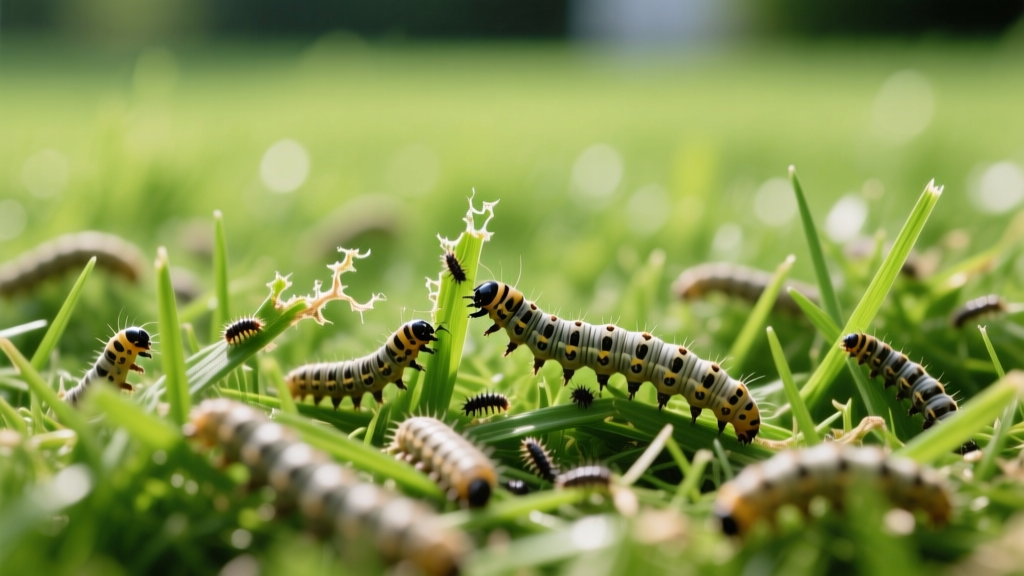
Army Worms Lawn Treatment: Stop the Invasion Before It Spreads
The 48-Hour Threat: Understanding Armyworm Behavior
When homeowners notice brown patches spreading across their turf, they often assume drought stress or fungal disease. However, if the damage expands visibly within a 48-hour window, you are likely facing a fall armyworm (Spodoptera frugiperda) invasion. Unlike grubs that feed on roots, armyworms are foliar feeders that chew grass blades down to the soil line. A heavy infestation can completely defoliate a 5,000-square-foot lawn in less than three days.
Armyworms are nocturnal feeders. During the heat of the day, they curl up in the thatch layer or at the base of the grass crown, making them nearly invisible. They emerge at dusk to feed aggressively. According to the University of Kentucky Department of Entomology, mature larvae can consume up to 80% of their total lifetime food intake during their final two developmental stages (instars). This biological fact dictates our treatment strategy: you must apply control measures late in the evening when the caterpillars are actively on the grass blades.
Field-Tested Identification Matrix
Before deploying an army worms lawn treatment, confirm the pest. Homeowners frequently misidentify cutworms or sod webworms, leading to incorrect chemical selection and wasted money. Use this diagnostic matrix to verify your target.
| Pest | Size at Maturity | Key Visual Identifier | Damage Pattern |
|---|---|---|---|
| Fall Armyworm | 1.25 to 1.5 inches | Prominent inverted white 'Y' on the head capsule; green/brown body with pale stripes. | Large, irregular brown patches; grass chewed to the crown. |
| Black Cutworm | 1.5 to 2.0 inches | Dark gray/black, greasy appearance; lacks the distinct 'Y' marking. | Clipped grass blades at soil level; small, localized dead spots. |
| Sod Webworm | 0.75 to 1.0 inch | Translucent gray/green with distinct dark brown spots along the back. | Notched grass blades; presence of silk webbing and green frass (droppings). |
The Insect & Rodent Yard Defense Protocol
Eradicating an active infestation requires a phased approach. Relying on a single broadcast spray without confirming the pest's location often results in treatment failure. Follow this exact sequence.
Step 1: The Lemon-Scented Soap Flush
Do not treat blindly. Confirm the infestation density using a soap flush. Mix 2 tablespoons of lemon-scented Dawn dish soap into 1 gallon of water. Pour this solution evenly over a 1-square-yard area of damaged turf at the border of the brown patch. The soap irritates the caterpillars' skin, forcing them to the surface within 3 to 5 minutes. If you count more than 3 to 5 armyworms per square yard, immediate chemical intervention is mandatory.
Step 2: Chemical Knockdown (Liquid Bifenthrin)
For rapid elimination of mid-to-late stage larvae, a pyrethroid insecticide is the industry standard. Bifenthrin (7.9% active ingredient) provides fast knockdown and up to 30 days of residual control.
- Product Recommendation: Bifen IT or Hi-Yield Bifenthrin 10%.
- Mixing Rate: 1 fluid ounce per gallon of water per 1,000 square feet.
- Application Timing: Apply between 6:00 PM and 8:00 PM.
- Crucial Technique: Do NOT water the lawn immediately after applying a liquid pyrethroid for caterpillars. The chemical must remain on the grass blades where the armyworms feed. Watering it into the soil renders it largely ineffective against foliar pests.
Step 3: Biological Control for Early Instars
If you catch the invasion early (caterpillars are less than 0.5 inches long), or if you prefer organic methods, Bacillus thuringiensis var. kurstaki (Bt) is highly effective. Bt is a naturally occurring soil bacterium that produces proteins toxic only to caterpillars.
- Product Recommendation: Thuricide Concentrate or Monterey Bt.
- Mixing Rate: 1.5 fluid ounces per 3 gallons of water per 1,000 square feet.
- Limitation: Bt must be ingested to work and is only lethal to early-stage larvae. It will not stop a massive invasion of 1.5-inch mature armyworms.
⚠️ Critical Mowing & Irrigation Warning:
Do not mow your lawn for at least 48 hours after applying any insecticide for armyworms. Mowing removes the treated foliage before the nocturnal feeders consume it. Additionally, avoid overhead irrigation for 24 hours post-application to prevent washing the active ingredient off the grass blades.
Cost Breakdown: DIY vs. Professional Extermination
Understanding the financial impact helps homeowners decide whether to tackle the army worms lawn invasion themselves or hire a licensed pest control operator. Below is a realistic cost analysis for a standard 5,000-square-foot residential lawn.
| Treatment Method | Estimated Cost (5,000 sq ft) | Efficacy on Mature Larvae | Time Investment |
|---|---|---|---|
| DIY Liquid Bifenthrin | $15 - $25 (Concentrate) | High (90%+ knockdown) | 1.5 hours (mixing & spraying) |
| DIY Granular Bifenthrin | $30 - $45 (Bagged) | Moderate (Requires heavy watering) | 1 hour (spreading & watering) |
| Professional Application | $85 - $150 (Per visit) | High (Commercial-grade chemistries) | Zero (Service handles all labor) |
According to Clemson University Home & Garden Information Center, professional services often utilize combination products (like Acelepryn or combinations of clothianidin and bifenthrin) that provide both immediate kill and long-term grub/caterpillar prevention, justifying the higher cost for recurring problem yards.
Post-Invasion Lawn Recovery Tactics
Once the armyworms are eradicated, your lawn will likely look scalped, resembling a bad haircut rather than a dead lawn. The roots are almost always intact. Recovery is highly probable if you execute the following agronomic steps within 72 hours of treatment:
- Apply a High-Nitrogen Fertilizer: Use a fast-release nitrogen source like Urea (46-0-0) at a rate of 1 lb of nitrogen per 1,000 square feet. This forces rapid blade regeneration. Avoid weed-and-feed products during recovery, as the herbicides can stress the compromised turf.
- Deep Irrigation Cycle: Apply 1 inch of water immediately after fertilizing. This pushes the nitrogen into the root zone and hydrates the crown for new shoot development.
- Delay Mowing: Allow the grass to grow to at least 3.5 inches before the first post-invasion mow. When you do mow, never remove more than the top 1/3 of the blade to prevent further shock to the plant's photosynthetic capacity.
By combining precise evening applications of liquid bifenthrin with aggressive post-treatment nitrogen feeding, you can halt an army worms lawn invasion and restore your turf's density within 14 to 21 days. Monitor the thatch layer weekly during late summer and early fall, as this is when migratory moth flights deposit the next generation of eggs.

