
Pest Control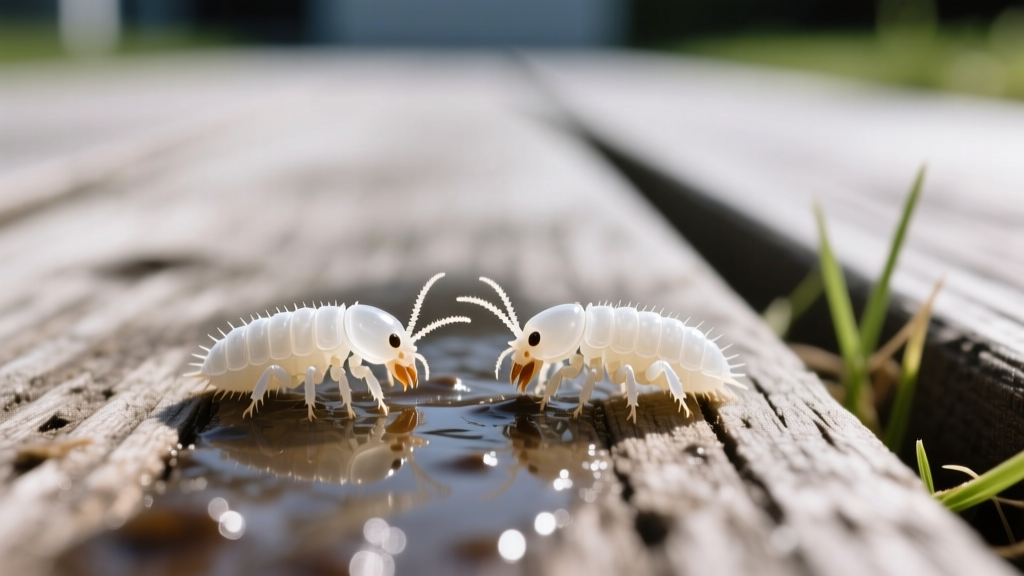
What Do Baby Termites Look Like? Complete ID Guide
Identifying Baby Termites: The Nymph Stage
When homeowners ask what baby termites look like, they are technically asking about termite nymphs. Unlike many insects that hatch as larvae and undergo complete metamorphosis, termites undergo incomplete metamorphosis. This means baby termites hatch looking like miniature, pale versions of the adults. Nymphs typically measure between 1 and 3 millimeters in length. Their bodies are soft, translucent, and range from creamy white to pale gray. Because they lack the hardened exoskeleton of mature soldiers or the dark pigmentation of swarmers, they are highly susceptible to desiccation and rarely venture into the open.
Finding these translucent juveniles inside your home is a critical red flag. Nymphs do not forage for food; they are nurtured deep within the colony's nesting galleries. If you are seeing them, it means the physical nest—or a massive satellite gallery—is located directly inside or immediately beneath your structure.
Anatomical Breakdown: How to Confirm a Termite Nymph
To accurately identify a baby termite, you must examine three distinct anatomical features under magnification or bright light. Misidentifying them as harmless beetle larvae or ant brood can cost thousands of dollars in delayed structural repairs.
- Antennae Structure: Termite nymphs possess moniliform (bead-like) antennae that extend straight out from the head. They look like a tiny string of pearls.
- Body Segmentation: The body is broadly joined. There is no distinct, pinched waist separating the thorax and the abdomen, giving them a uniform, pill-like thickness.
- Color and Texture: The exoskeleton is entirely soft and unpigmented. You can often see the dark contents of their digestive tract through their semi-transparent abdominal walls.
Expert Warning: Never use a flashlight to inspect active mud tubes by breaking them open completely. Exposing the nymphs and workers to dry ambient air will cause them to abandon the tube, forcing the colony to reroute through hidden, inaccessible wall voids where you cannot monitor their damage.
Baby Termites vs. Baby Ants: Comparison Matrix
The most common point of confusion is distinguishing termite nymphs from carpenter ant larvae or moisture ant brood. While both may be found in rotting wood, their physical traits and the implications of their presence are vastly different. According to the University of California IPM termite identification notes, proper morphological identification is the first step in selecting the correct pesticide class.
| Feature | Baby Termite (Nymph) | Carpenter Ant Larva |
|---|---|---|
| Body Shape | Uniform thickness, no waist | Slightly curved, grub-like, tapered ends |
| Antennae | Straight, bead-like (moniliform) | Absent in early instars, elbowed in late |
| Legs | Six distinct, jointed legs | Legless (maggot/grub-like) |
| Wood Damage | Consumes wood for nutrition | Only excavates wood for nesting |
What Nymphs Reveal About Colony Maturity
Spotting a baby termite is not a sign of a new, easily manageable problem. Subterranean termite queens begin as primary reproductives (swarmers) and spend the first two to three years exclusively building a worker force. The colony will not produce secondary reproductive nymphs or massive clusters of juvenile workers until the population reaches roughly 10,000 to 20,000 individuals.
If you find nymphs in your baseboards or sill plates, the colony beneath your foundation is likely at least three to five years old and contains upwards of 100,000 foraging workers. The EPA's termite control guidelines emphasize that by the time internal structural damage pushes nymphs and workers into visible living spaces, the load-bearing integrity of the wood has already been severely compromised.
High-Probability Inspection Zones
Because nymphs require near 100% humidity to survive, you will never find them crawling across a dry kitchen floor. Target your inspections on areas where wood contacts soil or where plumbing penetrates the slab.
- Sill Plates and Rim Joists: The wooden framing resting directly on the concrete foundation. Probe the wood with a flathead screwdriver; compromised wood will yield with a spongy, wet texture.
- Plumbing Penetrations: Where PVC or copper drain lines exit the concrete slab. The soil around these pipes is often backfilled loosely, creating a highway for subterranean tubes.
- Expansion Joints: The fiberboard gaps between concrete pours in your garage or patio. Termites use these thermal gaps to bypass physical and chemical barriers.
- Behind Vapor Barriers: In crawl spaces, pull back the 6-mil polyethylene sheeting near the piers. Nymph clusters often nest in the soil directly beneath the plastic.
Action Plan: Eradication Protocols for Active Nymph Colonies
DIY aerosol sprays and localized foam treatments are entirely ineffective against a colony producing visible nymphs. Killing the few hundred nymphs you see does nothing to the queen or the million workers foraging in your yard. Professional intervention utilizing non-repellent termiticides or chitin synthesis inhibitors is mandatory.
Liquid Soil Barriers (Fipronil 9.1%)
The industry standard for immediate colony elimination is a continuous trench-and-rod application using a non-repellent like Termidor SC. Technicians dig a trench 6 inches deep and 6 inches wide around the entire foundation perimeter. The application rate is strictly 4 gallons of finished solution per 10 linear feet. Fipronil works via the 'transfer effect'—workers pass through the treated soil, pick up a lethal dose, and transfer it to the nymphs and queen through trophallaxis (mouth-to-mouth feeding). As of 2026, a complete liquid barrier treatment for a standard 2,500 sq. ft. home averages between $1,400 and $2,200.
Baiting Systems (Noviflumuron)
For homes with well water, sensitive landscaping, or concrete slab foundations where trenching is impossible, bait stations like Sentricon Always Active are deployed. Stations are installed every 10 linear feet. The active ingredient, noviflumuron, is a chitin synthesis inhibitor. When workers feed the bait to the molting nymphs, the nymphs are unable to form new exoskeletons and die during their next growth cycle. This method takes 60 to 90 days to collapse the colony but provides continuous, long-term monitoring.
Frequently Asked Questions
Do baby termites eat wood?
Early-instar nymphs do not eat solid wood directly. They are fed a nutrient-rich liquid secretion regurgitated by the mature worker caste. However, late-instar nymphs will begin to ingest wood particles as their digestive tracts develop the necessary protozoa and bacteria to process cellulose.
Can I treat baby termites with DIY orange oil?
Orange oil (d-limonene) is only effective for isolated, localized drywood termite spots. It has zero soil residual and will not penetrate the deep subterranean galleries where baby termites are hatched. Relying on essential oils for a subterranean infestation guarantees continued structural degradation.
What should I do if I find nymphs in my mulch?
Finding termites in exterior mulch is common, as mulch retains the moisture they need. However, if you identify them as nymphs rather than foraging workers, the nest is likely situated directly under the mulch bed near your foundation. Remove all cellulose mulch within 12 inches of the foundation and schedule a soil treatment immediately.

