
Pest Control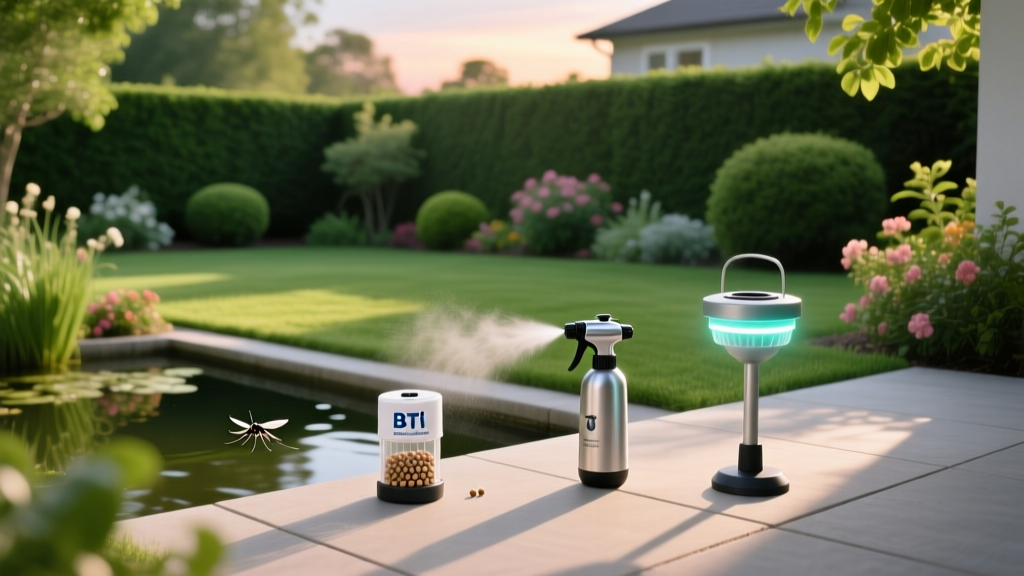
Effective Backyard Mosquito Control: BTI, Barrier Sprays & Traps
The 3-Tier Backyard Mosquito Control Framework
Effective backyard mosquito control requires interrupting the insect's life cycle at multiple stages. According to the Centers for Disease Control and Prevention, a mosquito can develop from an egg to a biting adult in as little as seven to ten days during peak summer temperatures. Relying solely on citronella candles or bug zappers addresses only the adult stage and fails to reduce the local population. A professional-grade yard defense strategy integrates three distinct tiers: source reduction (eliminating breeding sites), biological larviciding (killing larvae before they mature), and targeted adulticiding (managing flying adults with barrier sprays and spatial repellents).
Source Reduction: Eliminating Hidden Micro-Habitats
Mosquitoes require less than an ounce of stagnant water to lay a raft of 100 to 300 eggs. While homeowners routinely empty birdbaths and kiddie pools, the most prolific breeding grounds in a typical yard are hidden micro-habitats that hold water for just a few days after a rainstorm.
- Corrugated Downspout Extensions: The ridges in flexible black drain pipes trap water even when the pipe is angled downward. Replace these with smooth-walled PVC or solid aluminum extensions.
- French Drain Catch Basins: The grates over underground drainage systems often sit above a 2-inch sump that never fully drains. Drill a 1/4-inch weep hole at the absolute lowest point of the basin floor.
- Tarp Folds and Tire Swings: Landscape tarps left under decks and the drainage holes in toddler tire swings are notorious Aedes aegypti breeding sites. Store tarps tightly rolled and drill 3/8-inch holes in the bottom of tire swings.
- Tree Holes and Stumps: Water pooling in the crotch of a split tree trunk can produce thousands of mosquitoes. Fill these cavities with expanding polyurethane foam or mortar to prevent water accumulation.
Warning: The Capillary Action Trap Failure Mode
Many DIY guides suggest placing a shallow dish of soapy water near a light source to trap mosquitoes. This fails because mosquitoes are not strongly attracted to standard porch lights, and the surface tension of the water must be broken completely. If you use a dish trap, you must add at least three drops of liquid dish soap per cup of water and place it in deep shade, not near bright lights.
Many DIY guides suggest placing a shallow dish of soapy water near a light source to trap mosquitoes. This fails because mosquitoes are not strongly attracted to standard porch lights, and the surface tension of the water must be broken completely. If you use a dish trap, you must add at least three drops of liquid dish soap per cup of water and place it in deep shade, not near bright lights.
Biological Larviciding: BTI Product Matrix
When standing water cannot be drained—such as in rain barrels, pond edges, or low-lying swampy zones—biological larvicides are mandatory. Bacillus thuringiensis israelensis (BTI) is a naturally occurring soil bacterium that produces crystalline proteins. When mosquito larvae ingest BTI, the proteins bind to specific receptors in their alkaline midgut, causing cellular lysis and death within 24 to 48 hours. The Environmental Protection Agency classifies BTI as highly safe for humans, pets, birds, and beneficial insects like bees and butterflies.
| BTI Product Type | Active Release Time | Best Use Case | Approximate Cost |
|---|---|---|---|
| Mosquito Dunks (Solid Ring) | Slow release over 30 days | Rain barrels, permanent birdbaths, pond edges | $6.00 - $8.00 per dunk |
| Mosquito Bits (Granular) | Rapid release (24-48 hours) | Swampy lawn areas, potting soil (fungus gnats), temporary puddles | $15.00 - $20.00 per 30oz tub |
| Liquid BTI Concentrate | Immediate knockdown (12 hours) | Large municipal drainage areas, massive temporary floodwater pools | $40.00 - $60.00 per pint |
Adulticiding: Barrier Sprays and Spatial Repellents
While larviciding stops future generations, adulticiding manages the current biting population. Adult mosquitoes spend the heat of the day resting on the undersides of dense foliage, shrubs, and tall grasses. Targeting these resting sites is vastly more effective than broadcast fogging into the open air.
Bifenthrin Barrier Sprays
Bifenthrin is a synthetic pyrethroid that binds to soil and plant cuticles, providing a residual kill effect that lasts 3 to 4 weeks. For DIY application, purchase a concentrated liquid like Talstar P (7.9% bifenthrin) rather than pre-mixed hose-end sprays, which are heavily diluted and overpriced.
- Dilution Rate: Mix 1 ounce of Talstar P per gallon of water to achieve a 0.06% active ingredient solution.
- Application Technique: Use a pump sprayer to coat the underside of leaves on shrubs, hedges, and the perimeter tree line up to 6 feet high.
- Critical Restriction: Never apply bifenthrin to blooming flowers or near aquatic habitats. Pyrethroids are highly toxic to fish and foraging pollinators. Apply at dusk when bees are no longer active.
Spatial Repellents: Thermacell Radius vs. Liv
For immediate patio defense without spraying chemicals on your skin, heated spatial repellents create a 15-foot protection zone by vaporizing allethrin or metofluthrin. The Thermacell Radius Zone ($65 unit, $25 for 40-hour refills) uses a rechargeable battery to heat a metofluthrin mat, requiring 15 minutes to establish the invisible barrier. For permanent integration, the Thermacell Liv system ($300 for a 3-hub kit) wires directly into your landscape lighting or outdoor outlets, automatically activating via Bluetooth when you enter the yard.
The 'Spartan Mosquito' Trap Failure Mode
When researching backyard mosquito control, you may encounter the Spartan Mosquito Pro Tech or Eradicator tubes. These products claim to use a proprietary salt and yeast mixture inside a plastic tube hung in trees to attract and kill mosquitoes. Do not purchase these products.
In 2021, the Federal Trade Commission charged the makers of Spartan Mosquito with deceiving consumers. The FTC's formal complaint detailed that the tubes do not attract mosquitoes, do not kill them, and that the company's claims of reducing mosquito populations by 95% were entirely fabricated. Independent entomologists have repeatedly confirmed that hanging these tubes in your yard provides zero pest control value.
Seasonal Cost Breakdown: DIY vs. Professional
Deciding between a DIY approach and hiring a professional mosquito control service depends on your yard size, budget, and tolerance for chemical handling. Below is a realistic cost comparison for a standard 1/4-acre suburban lot for a full 6-month season (April through September).
| Method | Materials & Labor | Total Season Cost | Efficacy & Maintenance |
|---|---|---|---|
| DIY Source Reduction + BTI | $50 (BTI dunks/bits) | $50 - $75 | High efficacy for breeding sites; does not stop migrating adults from neighboring woods. |
| DIY Bifenthrin Barrier Spray | $120 (Concentrate + Pump Sprayer) | $120 - $150 | Excellent adult knockdown. Requires 45 minutes of manual spraying every 21-28 days. |
| Professional Yard Defense | $450 - $600 (6 scheduled visits) | $450 - $600 | Maximum convenience. Pros use commercial-grade backpack mist blowers for deeper foliage penetration. |
Frequently Asked Questions
How often should I replace BTI dunks in my rain barrel?
Standard solid BTI dunks are formulated to release active bacteria for exactly 30 days. Mark your calendar or set a recurring phone reminder for the 1st of every month from May through October. If the dunk physically disintegrates before 30 days due to high water turbulence, replace it immediately.
Can I spray bifenthrin on my vegetable garden to kill mosquitoes?
No. Bifenthrin is not labeled for use on edible crops or within the drip line of fruit-bearing trees. For mosquito control near vegetable gardens, rely exclusively on source reduction, BTI larvicides in nearby water features, and physical barriers like oscillating fans, which disrupt the weak flight patterns of adult mosquitoes.
Do ultrasonic mosquito repellent apps and plug-ins work?
No. Decades of peer-reviewed entomological studies confirm that mosquitoes do not possess the auditory receptors required to be deterred by high-frequency sound waves. Ultrasonic devices are entirely ineffective for backyard mosquito control and should be avoided.

