
Pest Control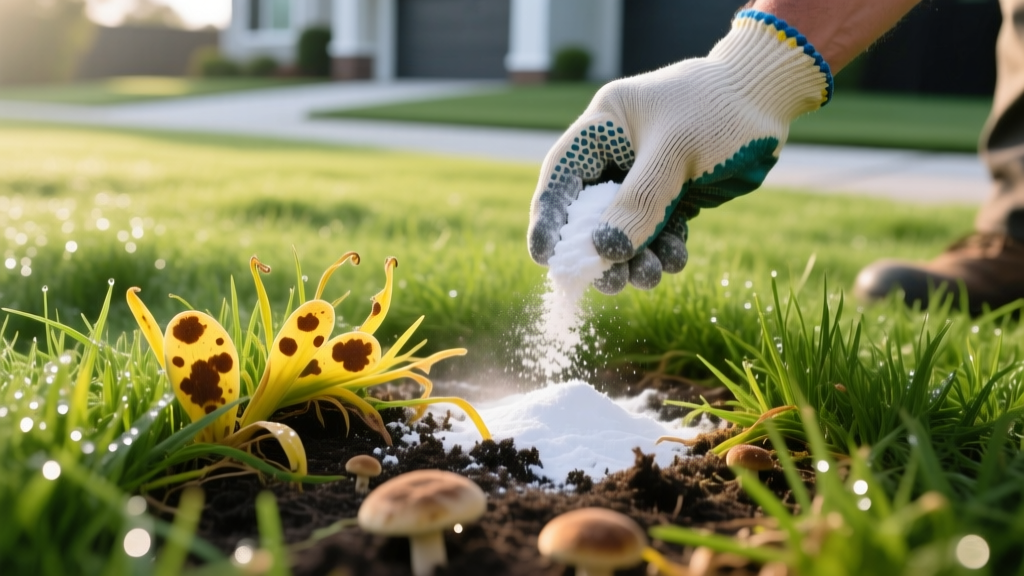
Baking Soda for Lawn Fungus: Diagnosis, Mixing, and Rescue Fixes
The Biochemical Reality of Sodium Bicarbonate on Turf
Homeowners frequently turn to pantry staples when turfgrass diseases strike, but applying baking soda (sodium bicarbonate) to lawn fungus requires a precise understanding of plant pathology and soil chemistry. Baking soda functions as a contact fungicide by altering the pH of the leaf surface. When dissolved in water and sprayed on grass blades, it raises the localized pH to approximately 8.0 or 8.5. This alkaline environment disrupts the cell walls of certain fungal spores, preventing germination and halting early-stage mycelial growth.
However, sodium bicarbonate possesses zero systemic activity. It cannot cure infections that have already penetrated the plant tissue or pathogens residing in the thatch layer and soil profile. Furthermore, the sodium (Na+) component poses a severe long-term risk to soil structure and turfgrass root health. According to turfgrass pathology research from NC State University, relying exclusively on sodium-based contact fungicides often leads to delayed systemic treatments, allowing aggressive pathogens like Rhizoctonia solani to destroy root systems unchecked.
Symptom Diagnosis: Target Pathogens vs. False Positives
Before mixing a DIY fungicide, you must accurately identify the pathogen. Baking soda is highly selective; it works on surface-level foliar diseases but fails completely against soil-borne or crown-rot diseases. Misdiagnosis leads to wasted time, sodium buildup, and dead grass.
| Pathogen / Disease | Visual Symptoms on Turf | Baking Soda Efficacy | Required Rescue Alternative |
|---|---|---|---|
| Powdery Mildew (Erysiphe graminis) | White, dusty fungal growth on leaf surfaces; common in shaded, cool areas. | High (Early stage only) | Neem oil or Potassium Bicarbonate |
| Dollar Spot (Clarireedia jacksonii) | Silver-dollar-sized bleached patches; hourglass lesions on individual blades. | Moderate (Preventative) | Boscalid or Fluoxastrobin |
| Brown Patch (Rhizoctonia solani) | Large circular brown patches with dark smoke rings; rotting leaf sheaths. | Zero | Azoxystrobin (e.g., Scotts DiseaseEx) |
| Pythium Blight | Greasy, dark, matted grass; rapid spread in hot, humid, wet conditions. | Zero | Cyazofamid or Propamocarb |
| Rust (Puccinia spp.) | Orange-yellow pustules on blades that rub off on shoes. | Low | Myclobutanil or Triadimefon |
The Exact Rescue Mix: Ratios, Surfactants, and Timing
If you have confirmed a surface-level fungal issue like powdery mildew or early dollar spot, the mixing ratio is critical. Exceeding the safe concentration threshold will cause immediate phytotoxicity (leaf burn). The University of California IPM program notes that sodium bicarbonate solutions must be carefully balanced with a surfactant to ensure the alkaline solution adheres to the waxy cuticle of the grass blade rather than beading off.
The 1-Gallon Diagnostic Protocol
- Base Solution: Mix exactly 1 tablespoon (approx. 15 grams) of standard Arm & Hammer baking soda into 1 gallon of water. Do not use 'heaping' tablespoons.
- Surfactant Addition: Add 1 teaspoon (5 ml) of liquid horticultural oil or pure liquid Castile soap. This breaks the surface tension, allowing the bicarbonate to coat the fungal spores evenly.
- Agitation: Shake the pump sprayer vigorously. Baking soda does not dissolve instantly in cold water; ensure no granular residue remains at the bottom of the tank, as spraying undissolved crystals will burn localized spots on the turf.
- Application Timing: Spray only during early morning (between 6:00 AM and 8:00 AM) when the grass is dry but temperatures are cool. Never apply in direct midday sun or when temperatures exceed 85°F (29°C), as the rapid evaporation concentrates the sodium on the leaf tip, causing severe necrosis.
WARNING: Phytotoxicity Risk
Applying baking soda more than once every 14 days will result in toxic sodium accumulation in the topsoil. Sodium displaces calcium and magnesium in the soil matrix, destroying soil aggregation and causing the turf to suffocate from lack of oxygen and water infiltration.
Applying baking soda more than once every 14 days will result in toxic sodium accumulation in the topsoil. Sodium displaces calcium and magnesium in the soil matrix, destroying soil aggregation and causing the turf to suffocate from lack of oxygen and water infiltration.
When the Cure Becomes the Poison: Fixing Baking Soda Burn
A common scenario in DIY lawn care is the 'rescue fix'—when a homeowner applies a baking soda mixture that is too strong, or applies it during a heat spike, resulting in chemical burn. The symptoms of sodium bicarbonate burn appear within 24 to 48 hours: grass tips turn stark white, then crisp brown, and the soil surface may develop a hard, crusty layer that repels water (hydrophobicity).
Step 1: Immediate Soil Flushing
If you observe leaf tip burn within 48 hours of application, your first step is to leach the sodium out of the root zone. Apply exactly 1.5 inches of water via your irrigation system over a 24-hour period. If your soil is heavy clay, split this into three 0.5-inch watering sessions spaced 4 hours apart to prevent surface runoff while allowing the water to push the sodium ions below the 6-inch root zone.
Step 2: Cation Exchange via Gypsum Application
Flushing alone is often insufficient because sodium ions bind tightly to negatively charged clay particles. To break this bond, you must introduce calcium. Apply pelletized agricultural gypsum (calcium sulfate dihydrate) at a rate of 40 to 50 lbs per 1,000 square feet. The calcium ions in the gypsum will perform a cation exchange, kicking the sodium off the soil particles and replacing it with calcium. The displaced sodium then pairs with the sulfate to form sodium sulfate, a highly soluble salt that can be easily flushed out of the soil profile with subsequent watering.
The Superior Alternative: Potassium Bicarbonate
For homeowners seeking an organic, bicarbonate-based contact fungicide without the severe soil-degradation risks of sodium, Potassium Bicarbonate (KHCO3) is the industry-standard upgrade. Products like MilStop or GreenCure utilize potassium bicarbonate, which provides the same pH-altering antifungal properties but replaces the toxic sodium with potassium—a primary macronutrient essential for turfgrass drought tolerance and disease resistance.
"While sodium bicarbonate has historical use in garden remedies, potassium bicarbonate is vastly superior for turfgrass applications. It delivers a contact fungicidal effect while simultaneously providing a foliar potassium boost, eliminating the risk of soil structural degradation associated with sodium buildup." — Turfgrass Pathology Guidelines, University Extension Research
As of 2026, commercial potassium bicarbonate products retail for approximately $45 to $60 per 5 lb container, which treats up to 20,000 square feet. While the upfront cost is higher than a $2 box of baking soda, the elimination of gypsum rescue treatments and the prevention of turf loss make it the economically sound choice for long-term lawn health.
Integrating Contact Fungicides into an IPM Strategy
Baking soda and potassium bicarbonate should never serve as the sole defense in a lawn care regimen. They are strictly preventative or early-intervention tools. A robust Integrated Pest Management (IPM) strategy requires addressing the environmental conditions that foster fungal growth. This includes core aeration to relieve soil compaction, dethatching when the organic layer exceeds 0.5 inches, and transitioning to deep, infrequent watering schedules (watering only 1-2 times per week at dawn) to minimize leaf wetness duration. By combining precise symptom diagnosis with targeted, chemically sound applications, homeowners can halt fungal outbreaks before they necessitate expensive, broad-spectrum chemical interventions.

