
Pest Control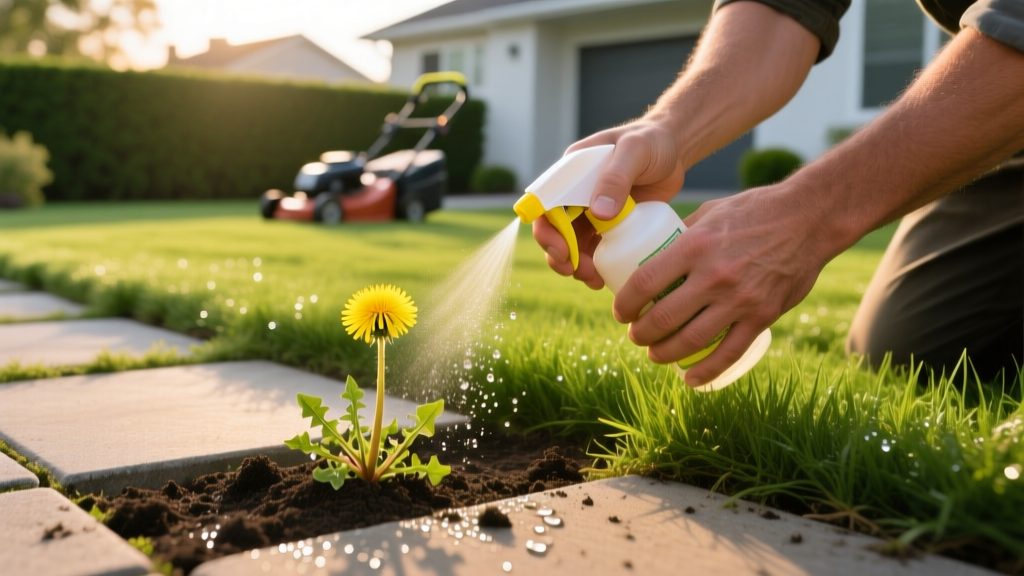
Best Grass and Weed Killer Formulas for Spot-Treating Stubborn Weeds
When homeowners search for the best grass and weed killer, they are typically looking for a selective herbicide—a chemical formulation designed to eradicate invasive weeds while leaving desirable turfgrass completely unharmed. Spot-treating is the most efficient, cost-effective, and environmentally responsible way to manage localized weed outbreaks. Rather than broadcasting chemicals across your entire property, targeted applications minimize chemical load, reduce runoff, and save you money.
However, the terminology can be confusing. Non-selective herbicides (like glyphosate) will kill both grass and weeds, making them suitable only for hardscape cracks or total lawn renovations. For turf preservation, you need selective active ingredients tailored to the specific weed species invading your lawn. This guide breaks down the exact chemical profiles, equipment calibration, and application timing required to spot-treat the most stubborn lawn weeds in 2026.
The Selective vs. Non-Selective Decision Matrix
Before mixing any chemicals, you must correctly identify your target weed and select the corresponding herbicide class. Using a non-selective product on a turf lawn will result in dead, brown patches that require reseeding or sodding.
| Weed Category | Target Species | Primary Active Ingredients | Brand Examples | Turf Safety | Avg. Cost per 1,000 sq ft |
|---|---|---|---|---|---|
| Broadleaf | Dandelion, Clover, Plantain | 2,4-D, Dicamba, MCPP | Ortho WeedClear, Bayer Advanced | Safe for most cool/warm grasses | $0.15 - $0.30 |
| Grassy Weeds | Crabgrass, Poa Annua | Quinclorac, Fenoxaprop-p-ethyl | Drive XLR8, Acclaim Extra | Safe for most, check St. Augustine limits | $0.40 - $0.80 |
| Sedges | Yellow Nutsedge, Purple Nutsedge | Sulfentrazone, Halosulfuron | Dismiss, SedgeHammer | Highly safe across all turf types | $0.60 - $1.10 |
| Total Vegetation | Driveway cracks, fence lines | Glyphosate, Glufosinate | Roundup, Finale | KILLS ALL GRASS | $0.10 - $0.20 |
Spot-Treating Broadleaf Weeds in Cool and Warm-Season Turf
Dandelions, Clover, and Plantain
Broadleaf weeds are the most common turf invaders. The industry standard for broadleaf control is a three-way herbicide blend containing 2,4-D, Dicamba, and MCPP (Mecoprop). This combination attacks the weeds through multiple modes of action, preventing resistance and ensuring a complete kill, including the deep taproots of mature dandelions.
For spot-treatments, purchase a concentrate rather than a ready-to-spray (RTS) hose-end bottle. RTS bottles are notoriously difficult to calibrate for small areas, often leading to over-application that can stunt your grass. A standard mixing ratio for a 2,4-D/Dicamba concentrate is 2.0 to 2.5 fluid ounces per gallon of water, which covers approximately 1,000 square feet.
Pro Tip: The Surfactant Secret
Weeds like broadleaf plantain and wild violet have thick, waxy cuticles that cause water-based herbicides to bead up and roll off. Always add a non-ionic surfactant (such as Hi-Yield Spreader Sticker, roughly $8 per pint) to your tank mix. Use 1/2 teaspoon of surfactant per gallon of mixed herbicide. This breaks the surface tension, allowing the chemical to spread evenly across the leaf and penetrate the plant's vascular system.
Eradicating Grassy Weeds Without Harming Your Lawn
Crabgrass and Poa Annua
Grassy weeds are significantly harder to spot-treat because they belong to the same botanical family as your lawn. You cannot use 2,4-D on crabgrass; it will have zero effect. Instead, you need Quinclorac (found in professional products like Drive XLR8 and consumer brands like BioAdvanced All-In-One Lawn Weed and Crabgrass Killer).
Quinclorac is highly effective on crabgrass, but it comes with a major caveat: it can cause severe yellowing and stunting in certain warm-season grasses, specifically St. Augustinegrass and Centipedegrass. If you have these turf types, you must use Atrazine (for dormant season) or Topramezone (Pylex) for safe post-emergent spot-treatment during the growing season.
Data Highlight: Soil Temperature Triggers
Spot-treating crabgrass is only effective if caught early. Crabgrass germinates when soil temperatures at a 2-inch depth consistently reach 55°F to 60°F for several consecutive days. Once the weed reaches the "tiller" stage (3 to 5 branches), standard consumer quinclorac doses will fail. You must increase the application rate by 30% and apply a second spot-treatment 14 days later to achieve control on mature tillered crabgrass.
Tackling Sedge: The Imposter Weed
Homeowners frequently mistake nutsedge for grass, but it is a sedge. You can identify it by rolling the stem between your fingers; if it feels triangular ("sedges have edges"), standard grass and weed killers will not touch it. The best spot-treatment for yellow and purple nutsedge is Halosulfuron-methyl (SedgeHammer) or Sulfentrazone (Dismiss).
SedgeHammer is highly economical for spot-treating. A single 1.33-ounce bottle costs around $25 and includes a built-in measuring cap. You only need 0.6 grams (one capful) per gallon of water to treat a 1,000-square-foot area. Sulfentrazone acts much faster, showing browning on the nutsedge within 24 to 48 hours, whereas Halosulfuron takes 7 to 14 days to translocate to the underground nutlets.
Pro-Level Spot-Treatment Equipment and Calibration
The best chemical in the world will fail—or kill your lawn—if applied through poor equipment. For precise spot-treatments, abandon hose-end sprayers. Invest in a 1-gallon or 2-gallon polyethylene pump sprayer (Chapin or Solo brands, $20 to $45).
More importantly, upgrade the nozzle. Factory sprayer nozzles produce a chaotic cone spray that drifts in the wind and causes overlapping burns on your turf. Purchase a TeeJet XR11002 flat fan nozzle (approx. $8). When calibrated to 40 PSI (achieved by pumping the tank handle 15 to 20 times), this nozzle delivers exactly 0.2 gallons per minute. By walking at a steady pace of 3 feet per second and holding the wand 18 inches above the turf, you guarantee a mathematically perfect application rate of 1 gallon per 1,000 square feet, eliminating the guesswork.
Common Spot-Treatment Failure Modes and Fixes
According to turf management extensions like NC State TurfFiles, herbicide failure is rarely due to a bad chemical; it is almost always an application error. Avoid these critical mistakes:
- Volatilization Drift: Herbicides containing Dicamba will vaporize and drift onto nearby ornamental shrubs if applied when air temperatures exceed 85°F. Always spot-treat in the early morning when temperatures are below 80°F.
- Mowing Stress: Never mow your lawn 2 days before or 2 days after a spot-treatment. The weed needs maximum leaf surface area to absorb the chemical, and the turf needs time to recover from the chemical exposure before mechanical stress.
- Ignoring the Label: The EPA mandates that the pesticide label is the law. Applying a product at double the recommended rate to "kill it faster" will actually cause the leaf tissue to burn and drop off before the chemical can translocate to the roots, resulting in a weed that simply grows back two weeks later.
- Washing it Away: Most modern selective herbicides require 2 to 4 hours to become rainfast. Check your local weather radar before mixing your tank. If it rains within 2 hours of application, the spot-treatment is entirely wasted.
Frequently Asked Questions
Can I mix pre-emergent and post-emergent herbicides in the same sprayer?
While chemically possible in some cases, it is highly discouraged for spot-treatments. Pre-emergents require heavy watering (0.5 inches) to activate in the soil, while post-emergents require the weed leaves to remain dry for 24 hours for absorption. Mixing them creates conflicting watering requirements.
Why did my weed turn yellow but not die?
This indicates the herbicide successfully entered the plant but failed to reach the root system. This usually happens if the weed was drought-stressed prior to application. Weeds shut down their vascular systems during droughts to conserve water, preventing the herbicide from moving downward. Always water your lawn deeply 48 hours before applying a spot-treatment to ensure the weeds are actively growing and translocating nutrients (and chemicals) to their roots.

