
Pest Control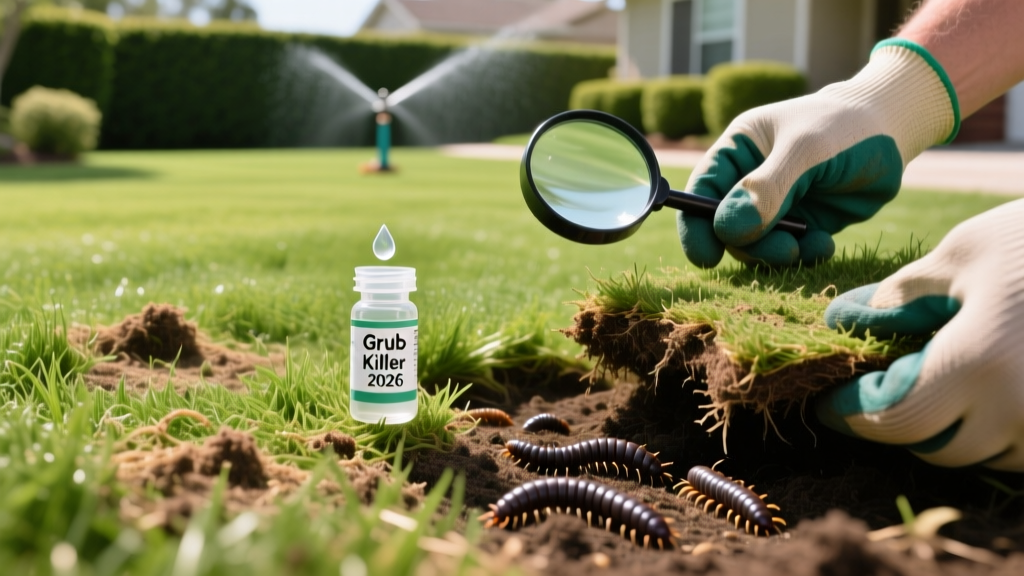
Best Grub Killer for Lawns 2026: Preventative vs Curative
The True Cost of White Grub Infestations
White grubs—the larval stage of Japanese beetles, European chafers, June bugs, and Asiatic garden beetles—are among the most destructive subsurface turf pests in North America. A severe infestation can consume the entire root system of a lawn in a matter of weeks, turning a lush Kentucky bluegrass or tall fescue yard into a spongy, brown, easily detachable carpet. Secondary damage from foraging skunks, raccoons, and crows tearing up the turf to eat the grubs often costs homeowners more in sod replacement than the initial insect damage.
Selecting the right grub killer for lawns is not a one-size-fits-all decision. The efficacy of a treatment depends entirely on matching the active ingredient to the grub’s current life cycle stage. Applying a slow-acting preventative in September when grubs are actively feeding is a waste of money, just as applying a fast-acting curative in May before eggs have hatched yields zero results. According to Penn State Extension, understanding the soil temperature triggers and instar stages is the single most critical factor in turfgrass pest management.
Preventative vs. Curative: The Active Ingredient Matrix
Before purchasing any product, you must determine whether your lawn requires a preventative shield or a curative rescue mission. The table below breaks down the primary chemical and biological agents used in modern grub control.
| Active Ingredient | Product Type | Target Window | Soil Temp Trigger | Best For |
|---|---|---|---|---|
| Chlorantraniliprole | Preventative | May – June | 60°F – 65°F | Bee-safe, long-residual prevention |
| Imidacloprid | Preventative | June – July | 65°F – 70°F | Early instar larvae (hatching eggs) |
| Trichlorfon (Dylox) | Curative | August – October | N/A (Active feeding) | Emergency rescue of dying turf |
| Heterorhabditis bacteriophora | Biological | Aug – Sept | >60°F | Organic curative control |
Top Preventative Grub Killers (Spring / Early Summer)
Preventatives work by creating a toxic barrier in the thatch and upper soil profile. When newly hatched first- and second-instar grubs begin feeding on roots in mid-to-late summer, they ingest the chemical and die. These products do not kill existing mature grubs.
1. Scotts GrubEx1 (Chlorantraniliprole)
Chlorantraniliprole (the active ingredient in GrubEx1) is widely considered the gold standard for preventative grub control in 2026. Unlike older neonicotinoids, it belongs to the anthranilic diamide class, meaning it is highly targeted toward lepidopteran and coleopteran larvae while remaining remarkably safe for pollinators and earthworms.
Pro Application Tip: Apply GrubEx1 between late May and mid-June. The product requires 60 to 90 days to fully translocate into the root zone. A 28.85 lb bag treats up to 10,000 square feet and typically retails for $45–$52. You must water it in with at least 0.25 inches of irrigation immediately after spreading to activate the granules.
2. BioAdvanced Season Long Grub Control (Imidacloprid)
Imidacloprid is a systemic neonicotinoid that has been a staple in turf management for decades. It is highly effective against young grubs but carries a higher toxicity risk for bees if applied to lawns where clover or dandelions are actively blooming. If you choose an Imidacloprid-based preventative, mow the lawn immediately before application to remove any flowering weed heads, and water the product into the soil immediately so it does not remain on the surface where foraging bees might contact it.
Top Curative Grub Killers (Late Summer / Fall)
If you missed the preventative window and your lawn is showing signs of damage in August or September—brown patches that roll back like loose carpet, or high bird activity—you need a curative contact killer. According to University of Kentucky Entomology, the threshold for curative treatment is finding more than 5 to 10 grubs per square foot during a turf peel-back test.
1. Bayer Advanced 24 Hour Grub Killer Plus (Trichlorfon / Dylox)
Trichlorfon, commonly known by its trade name Dylox, is the fastest-acting synthetic curative on the market. It does not provide long-term residual control; its half-life in the soil is only 3 to 5 days. However, it acts as a rapid contact and stomach poison for large, third-instar grubs that are aggressively feeding near the surface before winter.
- Cost: ~$22 for a 10 lb bag (treats ~3,000 sq ft).
- Watering Requirement: Dylox degrades rapidly in alkaline water (pH > 7.5). Water it in immediately with 0.5 inches of irrigation to push it past the thatch layer before it breaks down.
- Timing: Late August through September. Applying Dylox in spring is entirely ineffective, as the chemical will degrade long before summer eggs hatch.
Organic and Biological Defense: Beneficial Nematodes
For homeowners managing organic lawns or those with sensitive watersheds, synthetic chemicals are off the table. The most effective biological grub killer for lawns is the Heterorhabditis bacteriophora (Hb) nematode. These microscopic, unsegmented roundworms actively hunt grubs in the soil, entering their bodies and releasing a symbiotic bacteria that kills the host within 48 hours.
Critical Failure Point with Nematodes: Nematodes are living organisms. Buying them from a big-box store shelf where they have been sitting in a hot warehouse guarantees a 100% mortality rate before you even open the package. You must order Hb nematodes from specialized biological suppliers who ship them with cold packs. Apply them at dusk to avoid UV light degradation, and keep the soil continuously moist for 10 days post-application to allow them to mobilize through the soil water film.
The 5-Step Grub Eradication Protocol
To guarantee maximum efficacy, regardless of whether you are using Chlorantraniliprole, Dylox, or nematodes, follow this strict application sequence:
- The Tug Test & Peel-Back: Cut a 12x12 inch square of turf with a spade and peel it back. Count the grubs. If you see fewer than 5 per square foot, treatment is unnecessary; the turf can outgrow the minor root pruning.
- Mow Low: Drop your mower deck to 2 inches and bag the clippings. This removes thatch barriers and ensures granules reach the soil surface.
- Calibrate the Spreader: Do not guess your spreader setting. Weigh out the exact amount of product needed for a 10x10 ft test area (100 sq ft) and adjust your broadcast spreader gate until that exact amount is dispersed over the test zone.
- Apply and Water Immediately: Spread the product evenly. Within 30 minutes, run your irrigation system to deliver exactly 0.25 to 0.5 inches of water. Use a straight-sided tuna can placed on the lawn to measure the water volume.
- Restrict Access: Keep pets and children off the lawn until the grass blades are completely dry and the chemical has washed into the soil profile.
Frequently Asked Questions
Will a grub killer for lawns also get rid of moles?
No. While moles do eat grubs, their primary food source is earthworms. Applying a grub killer will eliminate one part of their diet, but moles will simply shift to hunting earthworms and remain in your yard. To manage moles, you must use targeted mole-specific baits (like Talpirid worm baits) or physical trapping.
Is Milky Spore an effective grub killer?
Milky Spore (Paenibacillus popilliae) is a biological bacteria that specifically targets Japanese beetle grubs. It will not kill European chafers, June bugs, or Asiatic garden beetles. Furthermore, UMass Extension notes that Milky Spore takes 2 to 5 years to build up sufficient spore counts in the soil to provide meaningful control, making it useless for immediate curative rescue.
Can I apply a preventative and a curative at the same time?
There is no agronomic benefit to mixing a slow-acting preventative (like GrubEx1) with a fast-acting curative (like Dylox). If you have an active infestation in September, use only the curative. If you are treating in June to prevent future damage, use only the preventative. Combining them wastes money and unnecessarily increases the chemical load in your soil ecosystem.

