
Pest Control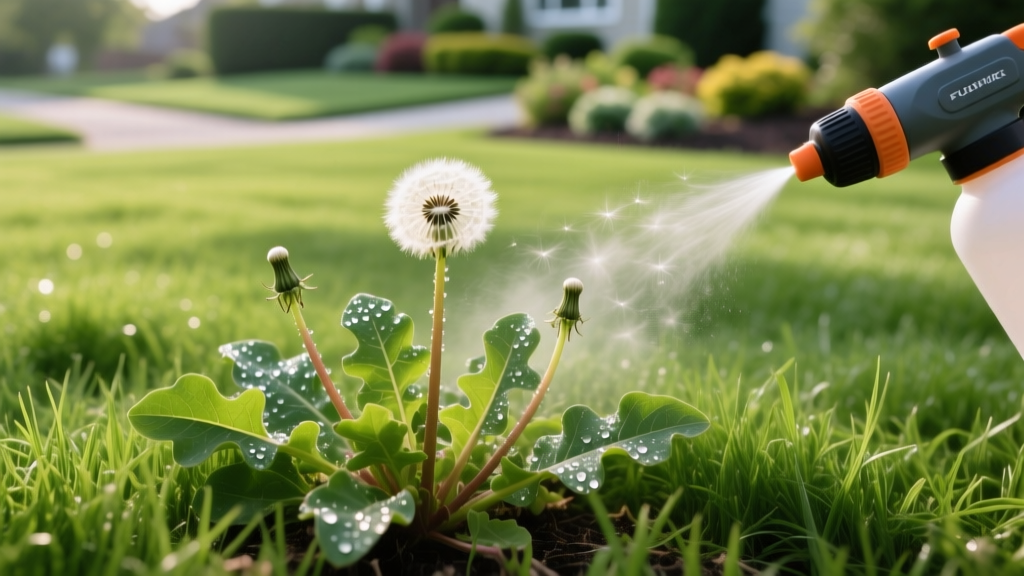
Best Herbicide for Dandelions: Top Spot-Treatments 2026
The Anatomy of a Dandelion: Why Most Sprays Fail
Dandelions (Taraxacum officinale) are notoriously resilient perennial broadleaf weeds. The primary reason homeowners fail to eradicate them is a fundamental misunderstanding of their root architecture. A mature dandelion possesses a brittle, fleshy taproot that can plunge 10 to 15 inches deep into compacted soil. If you use a contact-only herbicide or physically snap the weed at the crown, the root simply generates a new rosette of leaves within 14 to 21 days.
⚠️ The Taproot Rule: To permanently kill a dandelion, you must use a systemic herbicide. Systemic chemicals are absorbed through the foliage and translocated down the phloem into the deep taproot, destroying the meristematic tissue at the very bottom. Contact herbicides like horticultural vinegar (20% acetic acid) will only burn the top growth, guaranteeing a resurgence.
Finding the best herbicide for dandelions requires balancing rapid foliar burn with deep systemic translocation, all while remaining completely safe for your surrounding turfgrass. According to turfgrass researchers at the University of Minnesota Extension, selective broadleaf herbicides must mimic plant growth hormones (auxins) to cause fatal uncontrolled cellular division in broadleaf weeds without harming monocot grasses.
Evaluating the Best Herbicide for Dandelions by Active Ingredient
Not all active ingredients perform equally across different temperature ranges and grass types. Below is a matrix comparing the most effective systemic compounds available to homeowners and lawn care professionals in 2026.
| Active Ingredient | Speed of Kill | Temperature Limits | Best Use Case |
|---|---|---|---|
| 2,4-D (Amine) | 7-14 Days | Up to 85°F | Cool-season grasses, spring/fall |
| Carfentrazone-ethyl | 24-48 Hours (Burn) | Up to 90°F | Rapid visual results, tough weeds |
| Dicamba | 10-14 Days | Up to 85°F | Synergistic tank mixes |
| Iron HEDTA | 3-5 Days (Desiccation) | No strict upper limit | Organic lawns, near garden beds |
For a comprehensive breakdown of how the EPA regulates these compounds and their environmental half-lives, refer to the EPA's official 2,4-D registration guidelines.
Top Commercial Spot-Treatment Formulations (2026 Lineup)
Based on formulation stability, surfactant inclusion, and active ingredient synergy, these are the top-performing products for spot-treating dandelions this year.
1. SpeedZone Lawn Weed Killer Concentrate (Best Overall Broadleaf)
SpeedZone remains the gold standard for professional-grade spot treatments. It combines four active ingredients: 2,4-D, MCPP-p, Dicamba, and Carfentrazone-ethyl. The inclusion of Carfentrazone provides a rapid 'burn' effect, causing dandelion leaves to curl and blacken within 24 hours, while the other three ingredients travel down the taproot for a complete systemic kill.
- Mix Rate: 1.1 to 1.5 fl oz per gallon of water (covers 1,000 sq ft).
- Surfactant Requirement: Must add a non-ionic surfactant at 0.25% v/v (approx. 1 tsp per gallon) to break the surface tension of the waxy dandelion leaf.
- Cost: ~$130 per gallon (yields roughly 85 gallons of mixed solution, making the cost per spot-treatment negligible).
2. Ortho WeedClear Lawn Weed Killer (Best Ready-to-Spray)
For homeowners managing fewer than 20 dandelions, mixing concentrates is overkill. Ortho WeedClear RTU utilizes a specialized internal bladder bag system that prevents oxidation, keeping the 2,4-D and Quinclorac mixture potent for years. The built-in wand features a fan-spray nozzle calibrated to deliver exactly 4 gallons per acre, preventing the over-application that commonly damages turfgrass roots.
- Application: Spray until leaves are uniformly wet, but not dripping.
- Cost: ~$14 for a 32 oz bottle (treats up to 5,000 sq ft).
3. Fiesta Turf Weed Killer (Best Organic / Iron-Based)
If you maintain an organic lawn or need to spray near sensitive vegetable garden beds where synthetic auxin drift could cause catastrophic curling in tomatoes, Iron HEDTA (chelated iron) is the only viable option. As detailed by Michigan State University Extension, broadleaf weeds absorb excess iron, triggering the Fenton reaction—a process that creates lethal oxidative free radicals inside the plant cells. Grasses naturally repel excess iron, making this highly selective.
- Protocol: Requires two applications spaced 3 weeks apart for deep taproot eradication.
- Cost: ~$85 for 2.5 gallons.
🌡️ Temperature Warning: Never apply synthetic auxin herbicides (2,4-D or Dicamba) when ambient temperatures exceed 85°F. At high temperatures, these chemicals undergo volatilization—turning into a vapor that drifts onto neighboring trees, shrubs, and garden plants, causing severe epinasty (twisted, cupped growth).
Step-by-Step Spot-Treatment Protocol for Deep Taproots
To maximize systemic translocation and ensure the chemical reaches the bottom of the 15-inch taproot, follow this exact sequence:
- Delay Mowing: Do not mow for 48 hours prior to spraying. Dandelions need maximum leaf surface area to absorb the chemical. A freshly mowed weed has insufficient foliage to pull a lethal dose down to the root.
- Check Soil Moisture: Systemic translocation requires active plant growth. If the soil is bone dry, the dandelion is in survival mode and will not transport fluids to the root. Water the lawn deeply 24 hours before application.
- Calibrate the Sprayer: Use a 1-gallon or 2-gallon pump sprayer with a shield nozzle. The shield prevents the herbicide from bouncing off the waxy leaves and landing on the surrounding desirable grass.
- Apply the 'Mist and Dwell' Technique: Spray a fine mist over the rosette until it is visibly wet. Do not spray to the point of runoff. Let the droplets sit and absorb for 2 hours.
- Wait 48 Hours to Mow: After spraying, leave the lawn untouched. Mowing too soon physically removes the chemical before it has breached the plant's cuticle layer.
Post-Treatment Lawn Recovery and Prevention
Killing the dandelion is only 50% of the battle. Dandelion seeds (achenes) are wind-borne and can travel up to 5 miles from a single mature puffball. They specifically target bare, compacted patches in your turf. Furthermore, dandelions thrive in soil with a low pH and calcium deficiencies.
"A dense turf canopy is the ultimate pre-emergent herbicide. If your grass is mowed at 3.5 inches and fertilized with 3 lbs of nitrogen per 1,000 sq ft annually, dandelion seeds simply cannot reach the soil surface to germinate." — Dr. Aaron Patton, Turfgrass Extension Specialist
After the dandelions have desiccated and turned black (usually 14 days post-spray), use a hand trowel or a core aerator to relieve the soil compaction in the exact spots where the weeds grew. Top-dress these voids with a 50/50 mix of compost and screened topsoil, then overseed with a shade-tolerant or high-traffic grass seed blend matching your existing lawn. Applying a pre-emergent herbicide containing prodiamine in early spring (when soil temperatures hit 55°F) will create a chemical barrier at the soil surface, stopping any surviving dandelion seeds from germinating in the current season.

