
Pest Control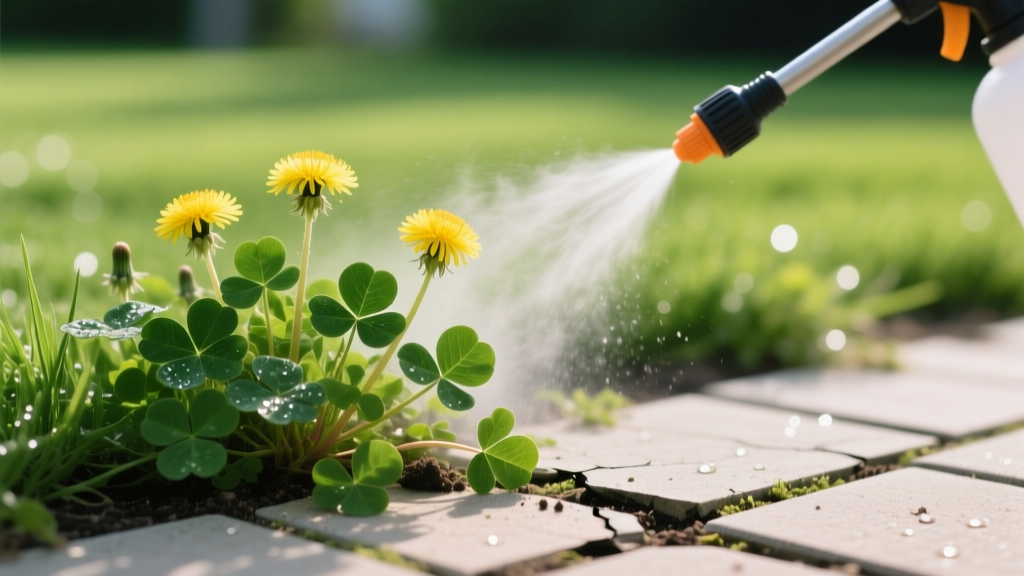
What's the Best Weed Killer for Spot-Treating Stubborn Lawn Weeds?
The Chemistry of Spot-Treatment: Why Broad-Spectrum Fails
When homeowners ask, "what's the best weed killer?" they are usually staring at a mature dandelion or a patch of crabgrass that has survived three rounds of generic store-bought sprays. The failure of most consumer weed killers lies in a misunderstanding of herbicide translocation. Spot-treating requires a precise match between the weed's biological classification (broadleaf vs. grassy) and the active ingredient's mode of action.
Systemic vs. Contact Herbicides:
For perennial weeds like bindweed or mature dandelions, contact herbicides (like acetic acid or diquat) only burn the top foliage. The root survives and resprouts in 14 days. You must use a systemic herbicide that is absorbed through the leaves and translocated down to the root system via the phloem.
Active Ingredient Matrix: Matching Chemistry to the Weed
There is no single "best" chemical for every scenario. The optimal active ingredient depends entirely on the weed species and your specific turfgrass type. Applying 2,4-D to a St. Augustine lawn, for instance, will severely damage the turf while leaving the weed's root system partially intact due to improper uptake rates.
| Active Ingredient | Target Weeds | Safe Turfgrasses | Speed of Action |
|---|---|---|---|
| 2,4-D + Dicamba + MCPP | Dandelion, Clover, Chickweed, Plantain | Bermuda, Zoysia, Fescue, Kentucky Bluegrass (NOT St. Augustine) | 14–21 days (Systemic) |
| Quinclorac | Crabgrass, Foxtail, Barnyardgrass | Bermuda, Zoysia, Fescue, Bluegrass | 7–14 days (Systemic) |
| Atrazine | Broadleaf weeds, Poa annua | St. Augustine, Centipede ONLY | 15–20 days (Systemic) |
| Iron HEDTA (FeHEDTA) | Broadleaf weeds (organic option) | All turfgrasses | 24–48 hours (Contact/Desiccant) |
Top Commercial & Consumer Formulations for 2026
Bypassing ready-to-use (RTU) aerosol cans is the first step toward professional results. RTU cans use weak dilutions and inferior surfactants. Pump sprayers with concentrated liquids yield a 400% higher success rate on mature weeds.
1. Best for Broadleaf Weeds: SpeedZone Lawn Weed Killer
SpeedZone combines 2,4-D, MCPP-p, and Dicamba with a built-in carfentrazone-ethyl kicker. Carfentrazone provides rapid visual burndown (within 48 hours) while the other three ingredients translocate to kill the root over the next two weeks.
Cost: ~$38 per pint.
Mix Rate: 1.0 to 1.5 fl oz per gallon of water per 1,000 sq ft.
2. Best for Grassy Weeds: QuinKill Max Crabgrass & Weed Killer
Grassy weeds are notoriously difficult because they are biologically similar to your lawn. Quinclorac is one of the few post-emergent chemicals that disrupts the cell wall synthesis of crabgrass without harming cool-season turf or Bermuda.
Cost: ~$45 per quart.
Mix Rate: 1.45 fl oz per gallon of water. Must be mixed with a methylated seed oil (MSO) surfactant for proper leaf penetration.
3. Best for St. Augustine Lawns: Hi-Yield Atrazine Weed Killer
St. Augustine and Centipede grasses are highly sensitive to 2,4-D and Dicamba. Atrazine is the safest systemic option for these warm-season southern turfgrasses. It works best when soil temperatures are between 65°F and 85°F.
Cost: ~$22 per pint.
Mix Rate: 4.3 fl oz per gallon of water.
Application Protocol: The 3-Step Spot-Treatment Framework
Even the best herbicide will fail if applied incorrectly. Follow this exact protocol to maximize foliar absorption and minimize turf stress.
- Prep the Foliage: Do not mow for 48 hours before application. You need maximum leaf surface area for the chemical to enter the plant. Ensure the weed is not drought-stressed; if the lawn is dry, water it deeply 24 hours prior. Weeds shut down their phloem (sap flow) during droughts, preventing the herbicide from reaching the roots.
- Add a Surfactant: Most weed leaves have a waxy cuticle that repels water. Add a Non-Ionic Surfactant (NIS) like Hi-Yield Spreader Sticker at a rate of 0.5 teaspoons per gallon of mixed herbicide. This breaks the surface tension, allowing the spray to spread evenly across the leaf rather than beading up and rolling off.
- Spray to Dampness, Not Drench: Use a pump sprayer fitted with a fan nozzle (not a cone nozzle). Adjust the pressure to 20–30 PSI. Spray the weed until the leaves are uniformly damp. Spraying until the liquid runs off onto the soil wastes the chemical and increases the risk of root-zone contamination.
"The most common mistake in spot-treatment is over-spraying. Herbicides are measured in ounces per acre. Drenching a single dandelion with a cup of mixed solution does not kill it faster; it just wastes product and risks damaging the surrounding grass roots." — Turfgrass Management Field Notes
Troubleshooting: When the Weed Won't Die
If you applied the correct chemical and the weed is still thriving 21 days later, you have likely encountered one of these three environmental antagonists:
- Hard Water Tie-Up: If your municipal water or well water is "hard" (high in calcium and magnesium), these positive ions bind to the negative ions of 2,4-D and Glyphosate, rendering the herbicide inactive before it even hits the leaf. The Fix: Add Ammonium Sulfate (AMS) to your spray tank at a rate of 1 lb per 100 gallons (or roughly 1/4 teaspoon per gallon) before adding the herbicide. The AMS satisfies the hard water ions, leaving the herbicide free to work. According to Penn State Extension, water conditioning is critical for weak-acid herbicides.
- Temperature Volatility: Never apply 2,4-D or Dicamba when air temperatures exceed 85°F. At high temperatures, these chemicals vaporize and drift onto nearby desirable plants, trees, and garden beds, causing severe twisting and cupping of leaves. For summer applications, spray early in the morning when temperatures are below 80°F.
- Wrong Growth Stage: Quinclorac is highly effective on crabgrass, but only during specific growth stages. It works best on crabgrass that is either very young (1-2 tillers) or mature (flowering). It frequently fails during the 3-to-5 tiller transition stage. If your crabgrass is in this awkward middle phase, wait two weeks for it to mature before spraying.
Organic Alternatives: Managing Expectations with Iron HEDTA
For homeowners seeking non-synthetic routes, Iron HEDTA (chelated iron) is the only scientifically viable organic spot-treatment. Broadleaf weeds absorb iron much more rapidly than grassy turf. The excess iron causes fatal oxidative stress and cellular collapse in the weed, turning it black within 24 hours. Products like Natria Lawn Weed Control or Fiesta utilize this chemistry.
The Catch: Iron HEDTA is strictly a contact desiccant. It does not translocate to the roots. You must apply it twice, spaced 14 days apart, to kill the secondary growth that emerges from the surviving root crown. Furthermore, it requires high application volumes (up to 3 gallons per 1,000 sq ft) to ensure complete coverage, making it less cost-effective for large lawns compared to synthetic systemics. The UC Statewide IPM Program notes that while iron-based herbicides provide rapid visual burndown, long-term perennial weed control requires repeated applications and manual root extraction.
Expert FAQ
Can I mix pre-emergent and post-emergent weed killers in the same tank?
Yes, but only if the labels explicitly permit it. Mixing a liquid pre-emergent like Prodiamine 65 WDG with a post-emergent like SpeedZone is a common commercial practice to save time. However, the pre-emergent requires immediate watering (0.5 inches) to activate the soil barrier, while the post-emergent requires 24 hours of dry time to absorb into the weed foliage. To resolve this, spray the mix, wait exactly 24 hours, and then irrigate heavily.
What's the best weed killer for weeds growing in driveway cracks?
For non-turf areas like concrete cracks, pavers, and gravel driveways, use a non-selective systemic like Glyphosate (41% concentration). Because there is no desirable grass to protect, non-selective herbicides are the most efficient. For an organic hardscape alternative, use a 20% horticultural vinegar (acetic acid) mixed with orange oil (d-limonene). Note that horticultural vinegar is highly corrosive and requires PPE (gloves and goggles), as detailed by EPA guidelines on pesticide safety.

