
Pest Control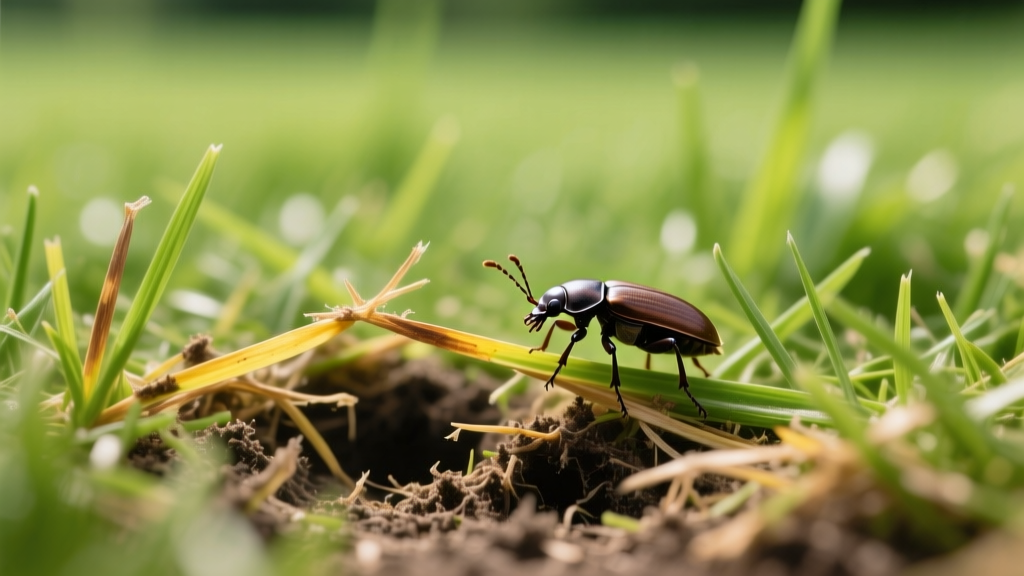
Billbug Lawn Damage: Identification and Treatment Guide
The Diagnostic Challenge: Billbugs vs. Drought vs. Grubs
Billbugs (Sphenophorus spp.) are destructive snout beetles that devastate turfgrass from the inside out. Unlike surface-feeding chinch bugs or root-munching white grubs, billbug larvae hollow out grass stems and sever roots at the crown, leading to rapid, localized turf death. Because the initial symptoms—wilting, browning, and thinning—perfectly mimic drought stress or fertilizer burn, homeowners frequently misdiagnose the problem and waste weeks watering a dying lawn.
Accurate identification requires looking at the micro-level damage rather than the macro-level lawn color. Below is a diagnostic matrix to help you separate billbugs from other common turf stressors.
| Symptom / Indicator | Billbug Damage | White Grub Damage | Drought / Heat Stress |
|---|---|---|---|
| Turf Tug Test | Stems break easily at the crown; hollowed out. | Entire turf rolls back like a carpet; roots severed. | Turf resists pulling; roots remain firmly anchored. |
| Soil Surface Debris | Fine, sawdust-like frass (excrement) at base of stems. | No frass; soil may be loose from animal digging. | Dry, cracked soil; no debris. |
| Damage Pattern | Irregular brown patches, often along sunny edges or sidewalks. | Large, uniform dead zones; high bird/skunk activity. | Uniform thinning across the whole lawn or high spots. |
| Root Inspection | Roots intact but detached from hollowed crown. | Roots completely chewed off by C-shaped larvae. | Roots intact but desiccated and brittle. |
The "Tug Test" and Frass Identification
The most reliable field test for billbugs is the "tug test" combined with a frass inspection. Walk to the periphery of a brown patch where the grass is just beginning to turn yellow or brown. Grasp a handful of grass and pull upward with moderate pressure.
⚠️ Critical Warning: Do not perform the tug test in the center of a completely dead, brown patch. By the time the grass is entirely brown, the structural integrity is gone, and you will not get a clean diagnostic break. Always test the transition zone between green and brown turf.
If billbugs are the culprit, the grass blades will snap cleanly at the soil line. Inspect the broken base of the stem. You will see a hollowed-out interior packed with a fine, white, powdery material that resembles sawdust. This is frass (insect excrement), the definitive calling card of billbug larvae feeding inside the stem. According to Penn State Extension, finding this sawdust-like frass at the base of the turf canopy confirms a billbug infestation with near 100% certainty.
Life Cycle and Treatment Timing Matrix
Treating billbugs requires precise timing based on their life cycle, which is best tracked using Growing Degree Days (GDD) rather than calendar dates. Calendar dates fail because spring temperatures fluctuate wildly year over year. GDD measures accumulated heat (base 50°F) and dictates when adults emerge, lay eggs, and when larvae move into the soil.
| Life Stage | GDD Threshold (Base 50°F) | Observable Activity | Recommended Action |
|---|---|---|---|
| Adult Emergence | 280 - 350 GDD | Adults migrate to turf, notch stems to lay eggs. | Apply preventative larvicide (e.g., Chlorantraniliprole). |
| Egg Hatch & Stem Feeding | 400 - 500 GDD | Larvae bore into stems; sawdust frass appears. | Monitor closely; curative options still viable. |
| Root Feeding (Crown) | 600 - 900 GDD | Larvae drop to soil, sever roots; turf dies rapidly. | Apply fast-acting curative (e.g., Trichlorfon). |
| Pupation & Overwintering | 1000+ GDD (Late Summer/Fall) | New adults emerge, feed briefly, seek overwintering sites. | No chemical control recommended; focus on fall recovery. |
Chemical Treatment Protocols: Active Ingredients and Costs
Effective billbug management relies on a bifurcated chemical strategy: preventative applications for long-term control and curative applications to stop active, destructive larvae.
1. Preventative Control (The Gold Standard)
Preventatives must be applied before eggs hatch and larvae bore deep into the stems. They require time to translocate through the plant tissue or soil profile.
- Active Ingredient: Chlorantraniliprole (Brand names: Acelepryn, Scotts GrubEx1).
- Mode of Action: Ryanodine receptor modulator (IRAC Group 28). Highly effective against early instar larvae with an excellent environmental and pollinator safety profile.
- Application Window: Early spring (280-350 GDD), typically late April to mid-May in northern zones.
- Cost Estimate: Consumer-grade Scotts GrubEx1 costs approximately $25-$30 per 5,000 sq. ft. bag. Professional-grade Acelepryn SC runs about $120-$140 per 32oz bottle (treating roughly 40,000 sq. ft.).
2. Curative Control (The Rescue Mission)
If you missed the preventative window and find active frass and hollowed stems in June or July, you need a fast-acting contact and stomach poison.
- Active Ingredient: Trichlorfon (Brand name: Bayer Advanced 24-Hour Grub Killer / Dylox).
- Mode of Action: Organophosphate (IRAC Group 1B). Degrades rapidly in soil (half-life of 3-7 days), meaning it must be watered in immediately and will not provide residual control.
- Application Window: Summer (600-900 GDD) when larvae are actively feeding near the crown.
- Cost Estimate: Approximately $35-$45 for a 10 lb bag covering 4,000 sq. ft.
💡 Pro-Tip for Curative Applications: Trichlorfon is highly sensitive to soil pH. In alkaline soils (pH > 7.5), it undergoes rapid chemical hydrolysis and becomes ineffective within hours. If your soil pH is high, substitute Trichlorfon with Clothianidin (e.g., Arena), which is more stable and offers both curative knockdown and longer residual activity.
Cultural Defense: Endophyte-Enhanced Turfgrasses
Chemical controls are only one pillar of defense. For long-term, sustainable lawn management, especially in high-pressure regions like the Midwest and Northeast, transitioning to endophyte-enhanced grasses provides biological resistance against billbugs.
Endophytes are beneficial fungi (such as Epichloë festucae) that live symbiotically within the tissues of certain cool-season grasses, primarily tall fescues and perennial ryegrasses. The fungus produces alkaloids that are highly toxic to stem-boring insects like billbugs and chinch bugs. According to research published by University of Kentucky Entomology, lawns seeded with endophyte-enhanced cultivars experience significantly lower billbug survival rates, as the larvae either starve or die shortly after ingesting the alkaloid-laced plant tissue.
Implementation Strategy: When overseeding a damaged lawn in the fall, avoid standard Kentucky Bluegrass (which lacks endophytes and is highly susceptible to billbugs). Instead, purchase certified seed blends containing "Endophyte-Enhanced" Tall Fescue or Perennial Ryegrass. Expect to pay a 15-20% premium on seed costs (roughly $8-$12 per pound for premium endophyte fescue vs. $5-$7 for standard), but the reduction in annual insecticide costs and turf loss easily justifies the investment.
Frequently Asked Questions
Will watering my lawn more save it from billbug damage?
No. While extra water might temporarily mask the wilting symptoms, it will not stop the larvae from hollowing the stems and severing the roots. Once the crown is destroyed, the plant cannot uptake water regardless of soil moisture. Overwatering a billbug-infested lawn often exacerbates the problem by promoting secondary fungal diseases like Pythium blight in the stressed turf.
Do nematodes work for billbug control?
Entomopathogenic nematodes, specifically the Heterorhabditis bacteriophora (Hb) strain, can be effective against billbug larvae once they drop to the soil to feed on roots (600+ GDD). However, they are largely ineffective against the early stem-boring stages. If using nematodes, apply them in the late evening when soil temperatures are between 60°F and 85°F, and irrigate immediately to wash them into the thatch and upper soil profile. Expect to spend $40-$60 to treat 5,000 sq. ft. with live nematode suspensions.
How long does it take for a lawn to recover after treatment?
Recovery depends on the extent of crown damage. If the treatment is applied during the stem-feeding stage (400-500 GDD) before the roots are severed, the surviving grass will recover in 2 to 3 weeks with proper fertilization and watering. If the larvae had already severed the roots, the dead patches will not recover and must be raked out, top-dressed with compost, and reseeded or sodded in the early fall.

