
Pest Control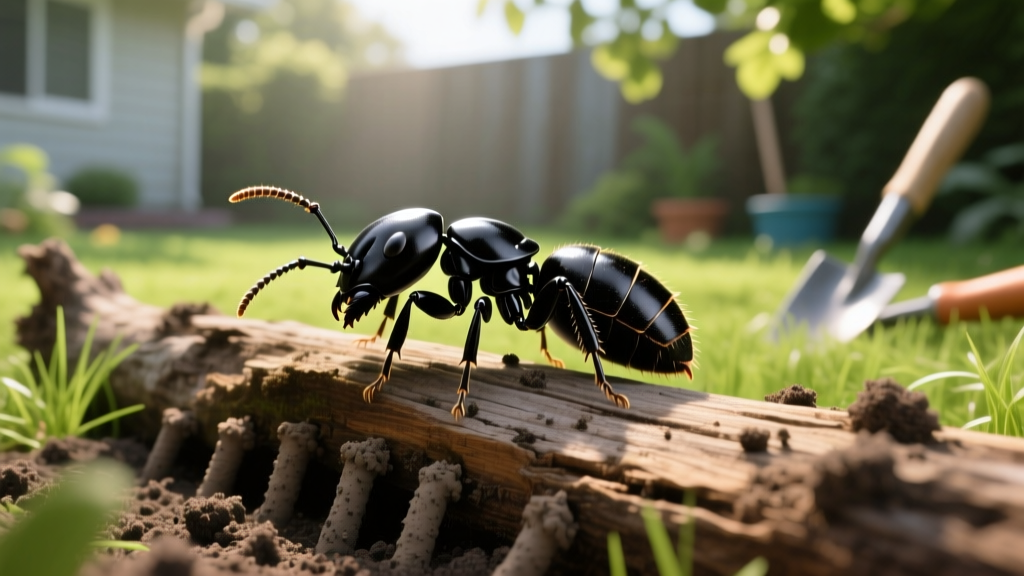
Black Termite Identification and Yard Defense Strategy Guide
The "Black Termite" Mystery: Swarmers vs. Carpenter Ants
Homeowners spotting black, winged insects near woodpiles, mulch beds, or foundations often search for "black termite" treatments. Biologically, solid black termites do not exist in the worker or soldier castes of common North American species. The insects you are observing are almost certainly either dark-winged subterranean termite alates (swarmers) or black carpenter ants (Camponotus pennsylvanicus). Misidentifying these pests leads to wasted money on ineffective treatments and leaves your property vulnerable to structural damage.
Subterranean termite swarmers (Reticulitermes spp.) emerge in spring to mate and establish new colonies. Their bodies are dark brown to black, and their wings are smoky gray. Black carpenter ants also swarm in spring, but their biology and the damage they inflict differ significantly. Carpenter ants excavate wood to build nests but do not consume it, whereas termites digest cellulose, causing catastrophic structural failure. Accurate identification is the first critical step in your yard defense strategy.
| Feature | Dark-Winged Termite Swarmer | Black Carpenter Ant Swarmer |
|---|---|---|
| Antennae | Straight, bead-like (moniliform) | Elbowed (geniculate) |
| Waist | Broad, uniform thickness | Pinched, narrow node (petiole) |
| Wings | Four equal-length wings, milky/smoky | Front wings longer than hind wings, clear |
| Diet | Consumes cellulose (wood) | Excavates wood; eats insects/sugars |
Why Wood-Destroying Insects Target Your Yard
Both termites and carpenter ants require specific environmental conditions to thrive in your yard. Subterranean termites require constant contact with soil moisture to prevent desiccation, while carpenter ants seek out moist, decaying wood to establish satellite colonies. Your landscaping practices often inadvertently create the perfect microclimate for these pests.
Warning: The Mulch Trap
Applying wood mulch deeper than 3 inches or allowing it to touch wooden siding creates a hidden highway for termites. Mulch retains soil moisture and provides a bridge over chemical soil treatments. Always maintain a 6-inch bare concrete or gravel gap between your mulch beds and your home's foundation.
Step-by-Step Yard Defense Protocol: Liquid Trenching
If you have confirmed the presence of subterranean termites, the most effective DIY yard defense is creating a continuous chemical barrier using a non-repellent termiticide. Non-repellents like Fipronil (9.1% Suspension Concentrate) do not kill on contact. Instead, they utilize the "transfer effect," allowing foraging termites to pass through the treated soil, return to the colony, and spread the active ingredient to the queen.
Required Materials and Dilution Math
Products like Taurus SC or Termidor SC are the industry standards. To achieve the required 0.06% finished solution, you must mix 0.8 fluid ounces of Fipronil 9.1% SC per 1 gallon of water. You will need 4 gallons of finished solution for every 10 linear feet of foundation.
- Dig the Trench: Using a trenching shovel, dig a trench 6 inches wide and 6 inches deep directly against the foundation wall. If you have a concrete slab, drill 1/2-inch holes through the slab every 12 inches to inject the solution beneath.
- Mix the Solution: In a 5-gallon pump sprayer, combine water and the precise Fipronil measurement. Agitate thoroughly to ensure the suspension concentrate does not settle.
- Apply the Termiticide: Pour the mixed solution into the trench at the rate of 4 gallons per 10 linear feet. For a standard 160-linear-foot home perimeter, you will need 64 gallons of finished solution (approx. 48 ounces of product).
- Backfill: Shovel the excavated soil back into the trench, mixing it with any remaining surface solution to ensure the backfill is also treated.
Alternative Defense: Termite Bait Station Deployment
If trenching is impossible due to hardscaping, well water proximity, or environmental concerns, termite bait systems offer a highly effective alternative. Systems like the Advance Termite Bait System utilize Hexaflumuron, a chitin synthesis inhibitor. When termites consume the bait, they are unable to molt, leading to colony collapse.
Install bait stations every 10 feet around the perimeter of the structure. Drive the station into the soil so the cap is flush with the ground. Inspect the wooden monitoring base every 90 days. Once termite activity is confirmed in a station, replace the monitoring wood with the Hexaflumuron bait cartridge. According to the Environmental Protection Agency (EPA), bait systems are highly effective but require strict adherence to inspection schedules to prevent colony rebound.
Cost Breakdown: DIY Trenching vs. Professional Treatment
Deciding between DIY application and hiring a licensed Pest Control Operator (PCO) depends on your budget, physical capability, and the severity of the infestation. The National Pest Management Association (NPMA) strongly recommends professional intervention for active structural infestations, as DIY methods only protect the exterior perimeter.
| Treatment Method | Estimated Cost (160ft Perimeter) | Time Investment | Effectiveness & Warranty |
|---|---|---|---|
| DIY Fipronil Trenching | $150 - $250 (Materials only) | 8 - 12 hours labor | High for perimeter; No warranty |
| DIY Bait Stations | $400 - $600 (16 stations + bait) | 2 hours install; quarterly checks | Moderate-High; Requires strict monitoring |
| Professional Liquid Treatment | $1,200 - $2,200 | 1 day (by crew) | Very High; Includes 1-5 year warranty |
| Professional Bait System | $1,500 - $2,500 | 1 day install; annual servicing | Very High; Includes ongoing monitoring |
Frequently Asked Questions
Can black termites survive in dry soil?
No. Subterranean termites require high moisture levels to survive. They build mud tubes to travel across dry surfaces between the soil and their food source. If you find termites in dry wood above ground, you are likely dealing with drywood termites, which are pale brown, not black, and require entirely different treatment protocols like structural fumigation.
Is Fipronil safe for yard use near vegetable gardens?
Fipronil is highly toxic to aquatic invertebrates and bees. While it binds tightly to soil and has low leaching potential, you should never apply termiticides within 5 feet of a well head, and you should avoid trenching near edible root crops. Always read the specific product label, as the label is the law. For garden-adjacent defenses, rely on physical barriers or targeted bait stations placed away from the root zones.
Why do I see swarmers but no mud tubes?
Swarmers emerge from hidden subterranean galleries or directly from mulch and woodpiles. The absence of visible mud tubes on your foundation does not mean your yard is termite-free. It often indicates the colony is nesting in a yard feature like a buried stump, a wooden retaining wall, or a thick mulch bed, rather than directly under the foundation. Treat the entire perimeter and remove all buried wood debris to eliminate satellite food sources.

