
Pest Control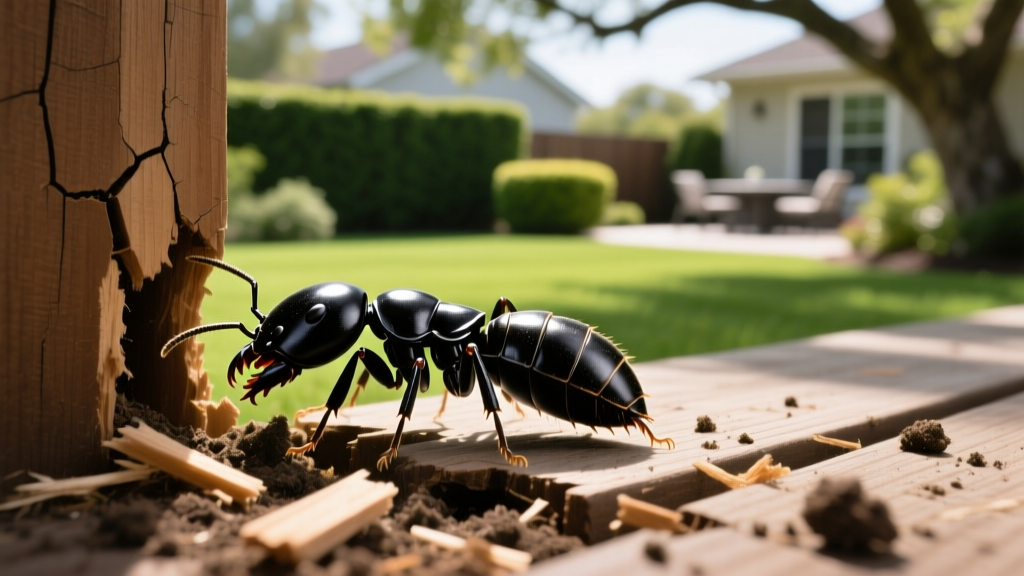
Black Termites Without Wings: Identification and Yard Defense
The Entomological Reality: Do Black Wingless Termites Exist?
Homeowners frequently contact pest control professionals reporting an infestation of "black termites without wings" crawling near their foundation, patio, or garden beds. From an entomological standpoint, true black, wingless termites do not exist in North American yards. Subterranean and drywood termite workers are translucent, creamy white, or pale brown. When a homeowner spots a pitch-black, wingless insect destroying wood or foraging in the soil, they are almost always dealing with a case of mistaken identity.
Misidentifying the pest leads to disastrous treatment failures. Applying a termite-specific wood injectant to a carpenter ant colony will waste hundreds of dollars and leave your structural timber vulnerable. To execute an effective yard defense strategy in 2026, you must first accurately identify the insect, understand its biology, and apply the correct chemical or mechanical intervention.
The Misidentification Matrix: What Are You Actually Seeing?
Before purchasing any pest control products, cross-reference your insect with the diagnostic matrix below. Pay close attention to the waist, antennae, and the debris (frass) left behind.
| Diagnostic Feature | Black Carpenter Ant | Shed-Wing Termite (Dealate) | Wood-Boring Beetle |
|---|---|---|---|
| Body Color | Uniform pitch black or dark brown | Dark brown to blackish (post-swarm) | Varies (black, brown, metallic) |
| Waist Shape | Pinched, narrow, distinct node | Broad, thick, no distinct waist | Hard shell, no visible waist |
| Antennae | Elbowed (bent in the middle) | Straight, bead-like (moniliform) | Short, clubbed, or thread-like |
| Wood Damage | Smooth, clean galleries | Rough, mud-lined galleries | Round exit holes, fine powder |
| Debris (Frass) | Sawdust-like shavings, insect parts | Fecal pellets or mud tubes | Fine, powdust dust (frass) |
Suspect #1: Black Carpenter Ants (Camponotus pennsylvanicus)
In 90% of cases, the "black termite without wings" is actually a worker black carpenter ant. Unlike termites, carpenter ants do not consume wood for nutrition. They excavate it to create sprawling, smooth galleries for their colony. They are attracted to your yard by moisture-damaged timber, decaying stumps, and thick layers of wood mulch.
Precision Treatment Protocol for Carpenter Ants
Spraying over-the-counter pyrethroid contact killers (like bifenthrin or permethrin) on foraging worker ants is a critical error. These repellent chemicals only kill the scouts, causing the colony to fracture and establish satellite nests deeper inside your home's walls. Instead, utilize the transfer effect.
- Non-Repellent Liquid Barrier: Apply a Fipronil 9.1% suspension (such as Termidor SC). Because Fipronil is undetectable to the ants, foragers walk through the treated soil, carry the active ingredient back to the nest, and transfer it to the queen through trophallaxis (food sharing). A 20-ounce bottle costs approximately $55 and treats 60 linear feet of foundation.
- Targeted Baiting: For nests located high in trees or inaccessible structural voids, deploy Advance Carpenter Ant Bait (Abamectin B1 0.011%). The dual-action carbohydrate and protein matrix adapts to the colony's shifting nutritional needs throughout the spring and summer seasons.
For a comprehensive biological breakdown of carpenter ant nesting behaviors, refer to the Penn State Extension Carpenter Ant Guide.
Suspect #2: Dealates (Termites That Shed Their Wings)
If you find dark, wingless insects near a pile of discarded, translucent wings on your windowsill or patio, you are looking at termite dealates. These are reproductive swarmers (alates) that have completed their nuptial flight, landed, and intentionally shed their wings to mate and establish a new subterranean colony. While they appear dark brown or blackish in certain lighting, they are not a separate "black termite" species.
⚠️ Critical Warning: Finding dealates in your yard indicates that a mature, 5-to-7-year-old termite colony is actively producing reproductives within 100 yards of your home. The wingless pairs you see are actively seeking soil contact to dig a new royal chamber. Immediate professional intervention is required.
Professional vs. DIY Termite Eradication
While DIY Fipronil trenching is effective for carpenter ants, subterranean termite colonies often contain 500,000 to 2 million individuals and forage across multiple properties. According to the EPA guidelines on termite control, soil-applied liquid termiticides and commercial bait matrices are highly regulated and often require a licensed applicator for safe, legal deployment.
- Professional Bait Systems: Systems like Sentricon Always Active utilize Noviflumuron, a chitin synthesis inhibitor. Worker termites feed on the bait matrix and share it with the colony, preventing molting and ultimately collapsing the entire population. Expect to pay between $1,200 and $2,500 for initial installation and annual monitoring.
- Liquid Trenching: Professionals will dig a 6-inch deep by 6-inch wide trench around your entire foundation, rodding the soil to inject 4 gallons of termiticide per 10 linear feet. This creates an unbroken chemical barrier that lasts 5 to 10 years.
The 6-Inch / 12-Inch Yard Defense Rule
Chemical treatments will fail if your yard's physical environment continues to invite wood-destroying organisms. Implement these strict architectural and landscaping boundaries to starve both carpenter ants and subterranean termites of their primary attractants: moisture and隐蔽 (concealment).
- The 6-Inch Siding Gap: Ensure there is a minimum 6-inch vertical clearance between the top of your soil/mulch line and the bottom of your wooden siding or brick weep holes. Termites use soil-to-wood contact to bypass chemical barriers, while carpenter ants use soil splashing during rainstorms to access structural voids.
- The 12-Inch Mulch Perimeter: Keep organic wood mulch at least 12 inches away from your foundation. In this 12-inch zone, use inorganic alternatives like crushed gravel, river rock, or rubber mulch. Gravel promotes rapid drainage and eliminates the damp, dark harborage sites that black carpenter ants require to establish satellite nests.
- Stump and Root Extraction: Do not leave decaying tree stumps in your yard. As the NC State Extension notes regarding subterranean termites, buried cellulose acts as a primary foraging beacon. Grind stumps at least 12 inches below grade and remove the resulting wood chips.
Decision Framework: When to Call a Licensed Exterminator
Use the following criteria to determine if your "black wingless termite" problem requires professional remediation or if it can be managed with DIY yard defense protocols.
| Scenario | Recommended Action | Estimated Cost (2026) |
|---|---|---|
| Black ants foraging in yard mulch, no structural damage. | DIY: Apply Fipronil 9.1% perimeter barrier and remove damp wood debris. | $55 - $85 |
| Black ants emerging from inside baseboards or window frames. | Professional: Interior wall void dusting and exterior colony tracking. | $250 - $450 |
| Dark insects with shed wings found on patio or near foundation. | Professional: Immediate comprehensive termite inspection and Sentricon/Termidor deployment. | $1,200 - $2,500+ |
| Mud tubes observed on foundation walls or crawl space piers. | Professional: Active subterranean termite infestation requires immediate licensed eradication. | $1,500 - $3,000+ |
Accurate identification is the cornerstone of effective pest management. By recognizing that "black termites without wings" are almost certainly carpenter ants or post-swarm termite dealates, you can bypass ineffective, generalized bug sprays and deploy targeted, colony-eliminating strategies that protect your home's structural integrity and your yard's ecological balance.

