
Pest Control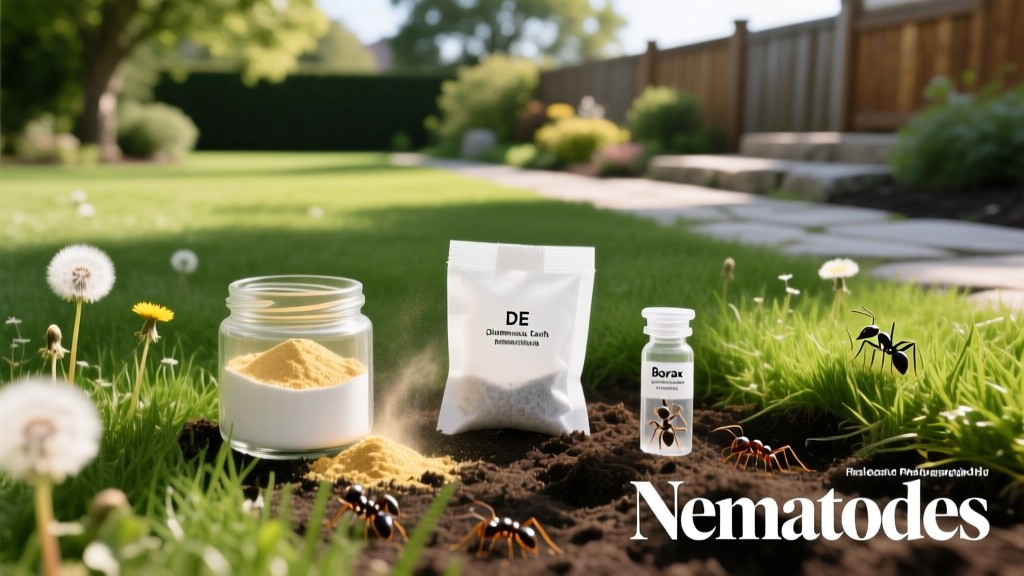
Effective Natural Ant Killers for Lawns: Borax, DE, and Nematodes
Managing ant populations in lawns and garden beds requires a strategic approach that balances efficacy with ecological safety. While synthetic pyrethroids and neurotoxic baits offer rapid knockdown, they pose significant risks to non-target pollinators, soil microbiomes, and household pets. For homeowners prioritizing organic lawn care, deploying targeted natural ant killers provides a sustainable solution that eradicates the colony rather than just the visible foragers.
This guide details the biochemical and mechanical mechanisms behind the three most effective organic ant treatments: sodium tetraborate (borax) baits, food-grade diatomaceous earth (DE), and entomopathogenic nematodes. We will cover exact mixing ratios, application timing, and the specific failure modes that cause most organic treatments to fail.
Diagnostic Matrix: Identify Your Target Species
Ant foraging behavior and nesting preferences dictate which natural treatment will succeed. Before purchasing materials, identify the primary pest species in your yard.
Quick Species Diagnostic
- Carpenter Ants (Camponotus spp.): Large (1/4 to 1/2 inch), nest in decaying wood or moist soil. Require protein-based baits in late summer. Borax baits are highly effective.
- Pavement Ants (Tetramorium caespitum): Small, dark brown, nest under driveways and patio stones. Create distinct soil mounds. Diatomaceous earth barriers work exceptionally well.
- Red Imported Fire Ants (Solenopsis invicta): Aggressive, build large dome mounds in sunny lawn areas. Require deep soil drenching or beneficial nematodes to reach the queen.
Comparison of Top-Tier Natural Ant Killers
Not all organic treatments function identically. Some rely on delayed toxicity, others on mechanical destruction, and some on biological parasitism. The matrix below breaks down the core characteristics of each method to help you allocate your pest control budget effectively.
| Treatment Type | Mechanism of Action | Best Target Species | Est. Cost (2026) | Primary Limitation |
|---|---|---|---|---|
| Borax (Sodium Tetraborate) | Disrupts digestive system and metabolism; delayed kill allows trophallaxis (food sharing) to reach the queen. | Sugar ants, Carpenter ants, Odorous house ants. | $5 - $8 per box | Requires precise dilution; too strong kills foragers before they return to the nest. |
| Food-Grade DE | Microscopic silica shards lacerate the waxy exoskeleton, causing fatal desiccation (dehydration). | Pavement ants, Field ants, crawling perimeter invaders. | $15 - $25 per 4lb bag | Completely inert when wet; must be reapplied after rain or heavy dew. |
| Beneficial Nematodes | Microscopic worms enter the ant host and release symbiotic bacteria that cause septicemia within 48 hours. | Fire ants, Subterranean mound-builders. | $35 - $50 per 10M count | Strict soil temperature (55°F-85°F) and moisture requirements for survival. |
| d-Limonene (Orange Oil) | Contact killer that dissolves the insect's respiratory wax coating, causing immediate suffocation. | Fire ant mound drenching, spot treatments. | $20 - $30 per gallon | No residual effect; will not eliminate the colony if the queen is deep underground. |
Formulating a Lethal Borax Bait Station
Borax is the cornerstone of organic ant colony eradication. However, the most common reason homeowners report failure is mixing the bait too strong. According to the UC Agriculture and Natural Resources integrated pest management guidelines, boric acid baits must be formulated at a concentration of 1% to 5% to ensure a delayed kill. If the concentration is too high, the forager dies on the way back to the nest, and the colony simply routes around the bait.
The Optimal Liquid Carbohydrate Recipe
This recipe targets sugar-feeding ants (like Argentine and Odorous house ants) active in the spring and early summer.
- Heat 1 cup of distilled water until warm (not boiling).
- Dissolve 1/2 cup of granulated white sugar completely.
- Stir in exactly 1.5 tablespoons of 20 Mule Team Borax (sodium tetraborate decahydrate).
- Allow the mixture to cool to ambient temperature.
Pro-Tip: Seasonal Dietary Shifts
In late summer and autumn, ant colonies shift their foraging focus from carbohydrates to proteins and fats to prepare overwintering brood. If your sugar bait is being ignored in August, switch the carrier to a mixture of 1 part Borax to 3 parts smooth peanut butter or bacon grease.
In late summer and autumn, ant colonies shift their foraging focus from carbohydrates to proteins and fats to prepare overwintering brood. If your sugar bait is being ignored in August, switch the carrier to a mixture of 1 part Borax to 3 parts smooth peanut butter or bacon grease.
Soak cotton balls in the cooled liquid and place them inside commercial plastic bait stations or modified pill bottles with 1/4-inch entry holes drilled in the sides. Place stations directly on active foraging trails, not randomly across the lawn. It typically takes 7 to 14 days for the trophallaxis (food sharing) cycle to deliver the borax to the queen and collapse the colony.
Diatomaceous Earth: Application Rules and Fatal Mistakes
Diatomaceous earth consists of fossilized diatoms. Under a microscope, these particles look like shards of glass. When ants crawl over DE, the shards scratch their lipid exoskeleton layer, causing them to leak moisture and die of dehydration within 24 to 48 hours. The Environmental Protection Agency (EPA) classifies food-grade DE as a minimum-risk pesticide, making it ideal for garden perimeters.
The Three Fatal Mistakes of DE Application
- Using Pool-Grade DE: Pool filter DE is calcined (heat-treated), which converts it into crystalline silica. This is highly toxic to human lungs when inhaled and largely ineffective against insects. You must purchase OMRI-listed Food-Grade DE, which is amorphous silica.
- Applying Too Thickly: Ants are not stupid. If they encounter a thick, visible mountain of white powder, they will simply walk around it. DE must be applied as a micro-fine, barely visible dusting. Use a bulb duster or a specialized bellows duster to achieve the correct particulate dispersion.
- Ignoring Moisture: DE relies on physical desiccation. When it gets wet from rain, irrigation, or heavy morning dew, the particles clump and lose their abrasive edge. You must reapply DE after any precipitation event. For long-term perimeter defense, apply DE inside hollow vinyl fence posts or under the lips of raised garden beds where it stays dry.
Biological Warfare: Beneficial Nematodes for Subterranean Colonies
For aggressive, deep-nesting species like the Red Imported Fire Ant, surface baits and dusts often fail to reach the primary queen chambers, which can extend three feet underground. In these scenarios, entomopathogenic nematodes provide a devastating biological strike.
Specifically, the species Steinernema feltiae and Heterorhabditis bacteriophora are highly effective against hymenopteran pests. These microscopic, unsegmented worms actively hunt insect larvae and workers in the soil matrix. Once they penetrate the ant's body cavity through natural openings, they release Photorhabdus or Xenorhabdus bacteria, which multiply rapidly and kill the host via septicemia.
'Nematodes are living organisms, not chemical compounds. Their efficacy is entirely dependent on soil ecology. Applying them to dry, compacted clay in the heat of the afternoon guarantees 100% mortality of the treatment itself before it ever contacts an ant.' — Soil Ecology Extension Guidelines
Nematode Application Protocol
- Timing: Apply only when soil temperatures are strictly between 55°F and 85°F. Early morning or dusk applications are mandatory to avoid UV radiation degradation.
- Hydration: Water the target lawn area deeply 2 hours before application. Nematodes require a film of water to swim through soil pores.
- Mixing: Submerge the nematode sponge (typically containing 10 million organisms) in a 5-gallon bucket of cool, distilled, or dechlorinated water. (Chlorine from municipal tap water will kill them). Stir gently.
- Deployment: Apply using a hose-end sprayer with the filter screen removed, or a watering can for targeted mound drenching.
- Post-Application: Keep the soil consistently moist (not waterlogged) for 7 to 10 days post-application to allow the nematodes to reproduce inside the dead hosts and seek new targets.
Troubleshooting: Why Your Natural Treatment Failed
When organic controls fail, it is rarely due to the active ingredient losing potency; it is almost always an error in behavioral timing or environmental mechanics.
Colony Budding (The Bait Aversion Trap)
If you use a fast-acting natural contact killer (like undiluted orange oil or vinegar) on a satellite mound of Argentine ants, the surviving colony members will detect the chemical stress and initiate 'budding.' This is a survival mechanism where the colony splits into multiple smaller colonies, each with its own fertile queen, effectively multiplying your pest problem. Always use slow-acting baits (Borax) for trailing ants, and reserve contact killers strictly for isolated, single-queen species like Fire ants.
Transitioning to natural ant killers requires patience and a fundamental understanding of insect biology. By matching the correct organic mechanism—whether delayed toxicity via borax, mechanical desiccation via DE, or biological parasitism via nematodes—to the specific nesting habits of your target species, you can achieve complete colony collapse without introducing persistent synthetic toxins into your lawn's ecosystem.

