
Pest Control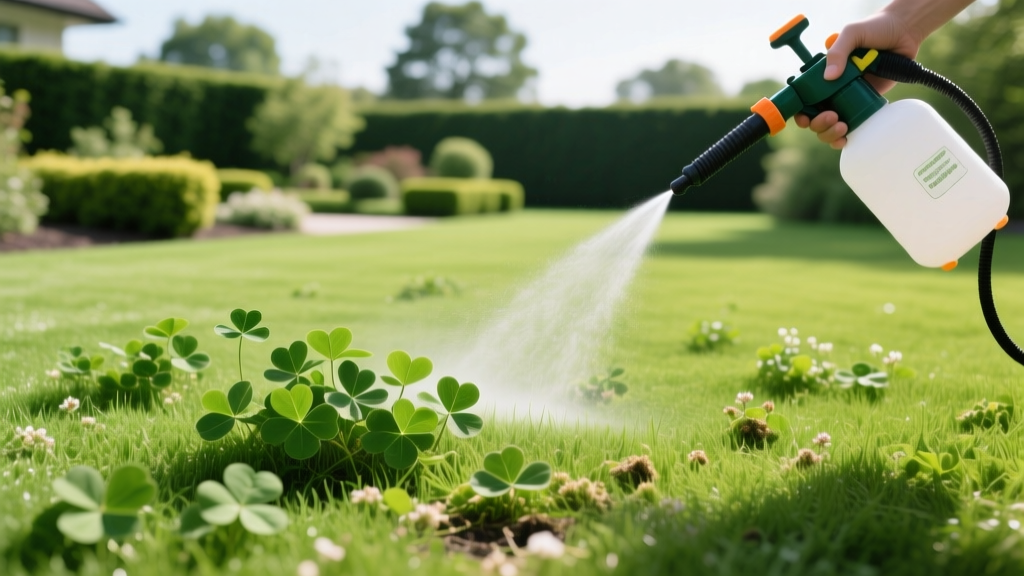
Broadleaf Herbicide Clover Control: Spot-Treatment Guide
The Nitrogen Connection: Why Clover Invades
Clover (Trifolium species) is a perennial legume that thrives in nitrogen-deficient soils. Unlike typical turfgrass weeds that exploit over-fertilized lawns, white clover (Trifolium repens) and red clover (Trifolium pratense) fix atmospheric nitrogen through symbiotic root bacteria. When your turfgrass lacks adequate soil nitrogen, clover gains a massive competitive advantage. According to the University of Minnesota Extension, simply pulling clover by hand is rarely effective because its stoloniferous growth habit allows it to root at every node. Eradication requires a targeted, systemic approach using a selective broadleaf herbicide that translocates down to the taproot and stolons.
Pro Tip: Before reaching for the sprayer, test your soil. If your soil test reveals nitrogen levels below 20 ppm, no herbicide program will provide long-term control. You must correct the nutrient deficiency to allow your turfgrass to outcompete returning clover seedlings.
Active Ingredients That Actually Work on Clover
Not all broadleaf herbicides are created equal. Clover's waxy leaf cuticle and complex root system require specific active ingredients (AIs) for complete kill. The NC State University Turfgrass Program recommends combination products over single-AI formulations to prevent resistance and ensure complete translocation.
- 2,4-D (Amine or Ester): The backbone of most broadleaf programs. It mimics plant hormones, causing uncontrolled growth and eventual death. Ester formulations penetrate the waxy clover leaf faster but carry higher volatilization risks in warm weather.
- Dicamba: Excellent for soil-residual control and highly effective on deep-rooted legumes. However, it has high soil mobility and can damage shallow-rooted ornamental trees (like maples and oaks) if applied within their drip lines.
- MCPP (Mecoprop-p): A slower-acting auxin herbicide that excels at controlling clovers and ground ivy when tank-mixed with 2,4-D and Dicamba.
- Carfentrazone-ethyl: A PPO-inhibitor that provides rapid contact burn-down. While it doesn't translocate well on its own, adding it to a 3-way auxin mix speeds up visible necrosis from 14 days down to 48 hours.
Formulation Comparison Matrix
| Formulation Type | Leaf Penetration | Volatilization Risk | Best Application Window |
|---|---|---|---|
| Amine (e.g., 2,4-D Amine) | Moderate | Low | Late Spring / Summer |
| Ester (e.g., 2,4-D Ester) | High (cuts through wax) | High (>85°F) | Early Spring / Late Fall |
Top Commercial & Consumer Broadleaf Herbicides for Clover
When executing a spot-treatment, you need a product with proven efficacy on legumes. Here are the top-performing broadleaf herbicides for clover on the 2026 market, categorized by user level.
1. Professional Grade: Trimec 992 Broadleaf Herbicide
Manufacturer: PBI Gordon | SKU: 89412-128 | Approx. Cost: $135 / Gallon
The Breakdown: Trimec 992 is the industry-standard 3-way herbicide (2,4-D, MCPP, Dicamba). It is highly effective on white and red clover. Because it is an amine formulation, it is safer for summer spot-treatments around sensitive ornamentals compared to ester-based products.
Mixing Rate: 1.5 fl oz per 1,000 sq ft in 1 to 2 gallons of water.
2. Fast-Acting Prosumer: SpeedZone Broadleaf Herbicide for Turf
Manufacturer: PBI Gordon | SKU: 81196 | Approx. Cost: $165 / Gallon
The Breakdown: SpeedZone adds Carfentrazone-ethyl to the standard 3-way mix. This addition causes clover leaves to show necrotic spotting within 24 to 48 hours, providing immediate visual confirmation of a lethal dose. It is particularly useful in cooler spring temperatures when standard auxins move too slowly through the plant.
3. Consumer Ready-to-Spray: Ortho WeedClear Lawn Weed Killer
Manufacturer: The Scotts Company | Approx. Cost: $18 / 32 oz Ready-to-Spray
The Breakdown: For small lawns under 5,000 sq ft where mixing concentrates is impractical, this consumer-grade 3-way (2,4-D, MCPP, Dicamba) is sufficient. However, the concentration is lower, meaning mature, thick-stemmed red clover may require a second application 21 days after the first.
The Spot-Treatment Protocol: Mixing and Application
Proper application technique is just as critical as the chemical itself. The EPA Safe Pest Control Guidelines emphasize minimizing off-target drift and ensuring proper personal protective equipment (PPE). Follow this exact protocol for clover spot-treatments:
- Prep the Canopy: Mow your lawn to 2.5 inches two days before application. This removes excess leaf tissue and forces the clover to push new, highly receptive growth.
- Calibrate the Nozzle: Swap the standard cone nozzle on your backpack sprayer for a flat fan nozzle, specifically the TeeJet XR8002. This delivers a uniform spray pattern at 20-30 PSI, preventing the heavy droplets that cause runoff.
- Mix the Solution: Fill your sprayer halfway with clean water. Add the required herbicide dose (e.g., 1.5 fl oz of Trimec 992 per 1,000 sq ft). Agitate gently.
- Add a Surfactant: Clover leaves are notoriously waxy. Add a non-ionic surfactant (NIS) at a 0.25% v/v rate (approximately 1/2 teaspoon per gallon of water). This breaks the surface tension, allowing the herbicide to spread evenly across the trifoliate leaves rather than beading up and rolling off.
- Target the Foliage: Spray the clover until the leaves are uniformly wet, but not dripping. Keep the wand 12 to 18 inches above the canopy.
Warning: Temperature Inversions and Volatilization
Never apply 2,4-D or Dicamba when daytime temperatures exceed 85°F, or during early morning temperature inversions. Under these conditions, the herbicide can vaporize and drift into neighboring gardens, causing severe epinasty (twisting and curling) in sensitive broadleaf plants like tomatoes and hydrangeas.
Never apply 2,4-D or Dicamba when daytime temperatures exceed 85°F, or during early morning temperature inversions. Under these conditions, the herbicide can vaporize and drift into neighboring gardens, causing severe epinasty (twisting and curling) in sensitive broadleaf plants like tomatoes and hydrangeas.
Post-Treatment Lawn Recovery
Once the clover is dead, you are left with bare patches in your turf. Do not overseed immediately. Auxin herbicides like 2,4-D and Dicamba leave a brief soil residual that can inhibit the germination of cool-season turfgrass seeds (like Kentucky Bluegrass and Tall Fescue). Wait a minimum of 14 to 21 days after application before dropping seed. In the meantime, apply a fast-release nitrogen fertilizer (such as 46-0-0 Urea) at a rate of 0.5 lbs of actual nitrogen per 1,000 sq ft. This will stimulate your existing turfgrass to spread laterally and fill in the voids left by the dying clover stolons.
Frequently Asked Questions
Will broadleaf herbicide kill my grass?
Selective broadleaf herbicides (like 2,4-D, MCPP, and Dicamba) are designed to target the physiological pathways of dicot plants (broadleaves like clover) while leaving monocots (turfgrasses) unharmed. However, applying these chemicals during summer drought stress or exceeding the labeled application rates can cause temporary yellowing or stunting in sensitive grasses like St. Augustine and Centipede.
How long does it take for the clover to die after spraying?
With a standard 3-way amine herbicide, you will see leaf curling and epinasty within 3 to 5 days. Complete browning and root death typically take 14 to 21 days. If you use a product containing Carfentrazone-ethyl (like SpeedZone), visual burn-down occurs in 24 to 48 hours, though total root kill still takes up to two weeks.
Can I use vinegar to kill clover?
Horticultural vinegar (20-30% acetic acid) is a non-selective contact burn-down agent. While it will scorch the top leaves of the clover, it does not translocate to the roots. The clover will regenerate from its taproot and stolons within a week. Furthermore, high-concentration vinegar is highly corrosive, dangerous to handle without specialized PPE, and will indiscriminately kill any turfgrass it touches. Selective systemic herbicides are vastly superior for clover management.

