
Pest Control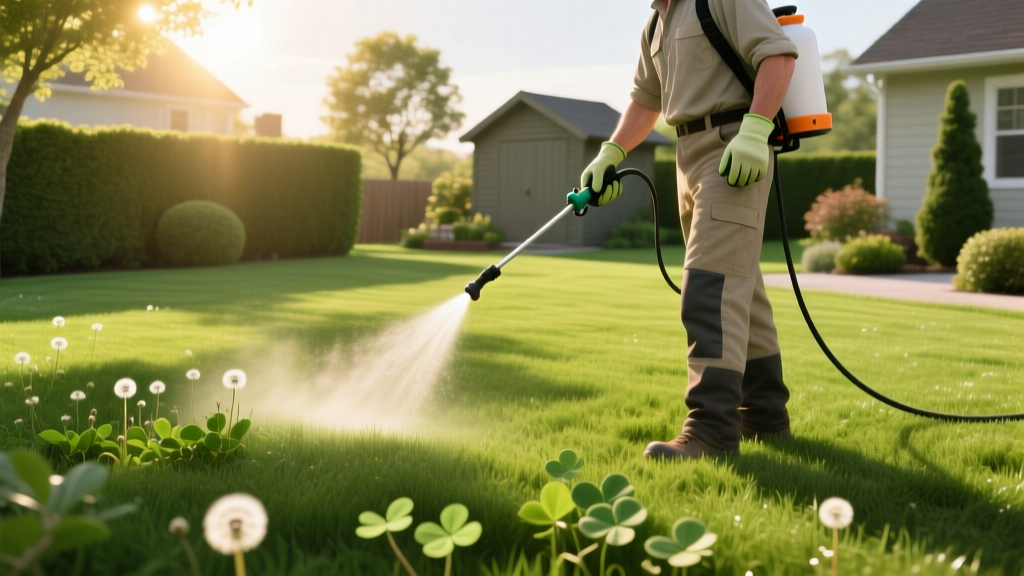
Applying Broadleaf Herbicide for Lawns: Fertilizer Timing Guide
The Physiological Clash: Nitrogen Uptake vs. Herbicide Translocation
Applying a broadleaf herbicide for lawns simultaneously with a high-nitrogen fertilizer is one of the most common turf management errors. The underlying science dictates a physiological conflict: auxin-type herbicides (like 2,4-D, Dicamba, and MCPP) rely on active plant growth and phloem translocation to move the active ingredient from the leaf tissue down to the weed's root system. When you apply a fast-release nitrogen fertilizer (such as a 24-0-6 urea blend) on the same day, the turfgrass experiences a rapid metabolic spike. This forces the broadleaf weeds to prioritize localized cellular expansion over systemic translocation, effectively trapping the herbicide in the leaf tissue. The result is superficial leaf curling (epinasty) without root death, leading to weed regrowth within three weeks.
Furthermore, granular 'weed-and-feed' products suffer from an inherent application paradox. The herbicide component requires moisture (dew or post-irrigation) to stick to the waxy cuticle of the broadleaf weed, while the fertilizer component requires dry grass blades to prevent localized nitrogen burn. According to turfgrass researchers at the University of Minnesota Extension, separating these applications is critical for both efficacy and turf safety.
⚠️ Volatilization Warning: Never apply ester-based broadleaf herbicides when ambient temperatures exceed 85°F. The chemicals will vaporize and drift onto non-target ornamental shrubs, causing severe cupping and stunting. Use amine-based formulations during warmer months.
Soil pH and Cation Exchange Capacity (CEC)
Before scheduling any herbicide or fertilizer application, verify your soil pH. Broadleaf weeds like plantain and dandelion thrive in compacted, acidic soils where turfgrass struggles. More importantly, soil pH directly impacts herbicide efficacy. In highly acidic soils (pH below 5.5), the Cation Exchange Capacity (CEC) shifts, causing herbicide molecules like Dicamba to bind tightly to soil organic matter rather than remaining available for root uptake. Conversely, in alkaline soils (pH above 7.5), certain herbicides degrade rapidly via alkaline hydrolysis before they can translocate.
- Target pH Range: 6.2 to 6.8 for optimal nutrient availability and herbicide performance.
- Correction Cost: Applying pelletized lime costs approximately $6 to $8 per 1,000 sq. ft. to raise pH, while elemental sulfur costs about $10 per 1,000 sq. ft. to lower it.
- Testing Protocol: Submit a core sample to a university extension lab (typically $20-$30) rather than relying on analog home probes, which often have a margin of error exceeding ±0.5 pH units.
Standalone Liquid Herbicides vs. Granular Weed-and-Feed
Professional turf managers almost exclusively use standalone liquid herbicides paired with separate fertilizer schedules. Below is a functional comparison of the two methodologies based on 2026 retail formulations and pricing.
| Feature | Standalone Liquid (e.g., SpeedZone Southern) | Granular Weed-and-Feed (e.g., Scotts Turf Builder) |
|---|---|---|
| Active Ingredients | 2,4-D, MCPP, Dicamba, Carfentrazone | 2,4-D, Mecoprop, Dicamba |
| Cost per 1,000 sq. ft. | $0.12 - $0.18 | $0.35 - $0.45 |
| Application Requirement | Dry foliage, no rain for 24 hrs | Wet foliage (for herbicide adherence) |
| Speed of Kill | Visible burn in 24-48 hours | 14-21 days for visible necrosis |
| Fertilizer Flexibility | High (choose any N-P-K ratio separately) | Locked into manufacturer's N-P-K ratio |
The 14-Day Sequencing Protocol
To maximize both weed eradication and turf nutrition, implement a strict 14-day separation window. This allows the auxin herbicide to fully translocate to the weed's taproot before the introduction of high-nitrogen fertilizers stimulates competitive lateral growth.
- Day 1 (Preparation): Mow the lawn to 2.5 inches. Do not water. Broadleaf weeds should have maximum leaf surface area exposed for chemical absorption.
- Day 2 (Herbicide Application): Apply a liquid broadleaf herbicide for lawns such as PBI/Gordon SpeedZone Southern (Item # 87582, approx. $58/gallon). Mix at a rate of 1.5 fl. oz. per 1,000 sq. ft. in 1.5 gallons of water. Ensure the inclusion of a non-ionic surfactant if using a concentrate like Trimec Classic.
- Days 3-13 (Translocation Phase): Avoid mowing for 48 hours post-application. Do not apply any soil amendments. The herbicide is actively moving through the phloem to destroy the root meristems.
- Day 14 (Fertilizer Application): Apply your chosen granular fertilizer. For late spring, a 24-0-6 slow-release methylene urea blend (e.g., Lesco Professional, approx. $48/50lb bag) provides sustained feeding without the rapid flush that weakens root-to-shoot ratios.
Nutrient Deficiencies That Invite Broadleaf Weeds
Weeds are opportunistic indicators of soil imbalance. Rather than relying solely on chemical eradication, correcting specific macronutrient and micronutrient deficiencies will naturally suppress broadleaf germination.
White Clover Invasion
Cause: Nitrogen deficiency. Clover fixes its own atmospheric nitrogen, allowing it to outcompete starving turfgrass.
Fix: Apply 1 lb of nitrogen per 1,000 sq. ft. using a slow-release source like Milorganite (6-4-0).
Buckhorn Plantain
Cause: Severe soil compaction and low calcium availability. Plantain roots can penetrate hardpan soil that grass roots cannot.
Fix: Core aerate in the fall and apply gypsum (calcium sulfate) at 40 lbs per 1,000 sq. ft. to improve soil flocculation.
Creeping Charlie (Ground Ivy)
Cause: Low boron levels and excessive shade/moisture.
Fix: Apply Solubor (20.5% boron) at a strict rate of 1 teaspoon per 1,000 sq. ft. dissolved in water. Caution: Exceeding this rate will cause severe turfgrass toxicity.
Troubleshooting Herbicide Burn on Fertilized Lawns
Even with proper timing, environmental variables can cause phytotoxicity. If your turfgrass exhibits tip-burn or yellowing after a combined or closely timed herbicide and fertilizer application, diagnose the issue using the following framework:
- Symptom: Uniform yellowing across the entire blade.
Diagnosis: Iron chlorosis induced by high soil pH locking out micronutrients, exacerbated by a fast-release nitrogen push.
Action: Apply liquid chelated iron (Fe-EDTA) at 2 oz per 1,000 sq. ft. to restore green color within 48 hours. - Symptom: Brown, crispy leaf tips with a distinct line of demarcation.
Diagnosis: Fertilizer burn (salt desiccation) combined with herbicide stress.
Action: Irrigate heavily (1 inch of water) to leach excess soluble salts below the root zone. Suspend all chemical applications for 21 days. - Symptom: Twisted, cupped grass blades (epinasty) mimicking weed damage.
Diagnosis: Herbicide drift or application during high heat (>85°F).
Action: Apply a seaweed extract (kelp) biostimulant containing cytokinins to help the turfgrass metabolize the chemical stress and recover cellular division.
For comprehensive safety guidelines and environmental protection measures regarding turf chemicals, always consult the EPA's Safe Pest Control resources before purchasing or mixing active ingredients. Proper calibration of your sprayer and strict adherence to the 14-day sequencing rule will ensure your lawn receives the nutrition it needs while systematically eliminating broadleaf competitors.

