
Pest Control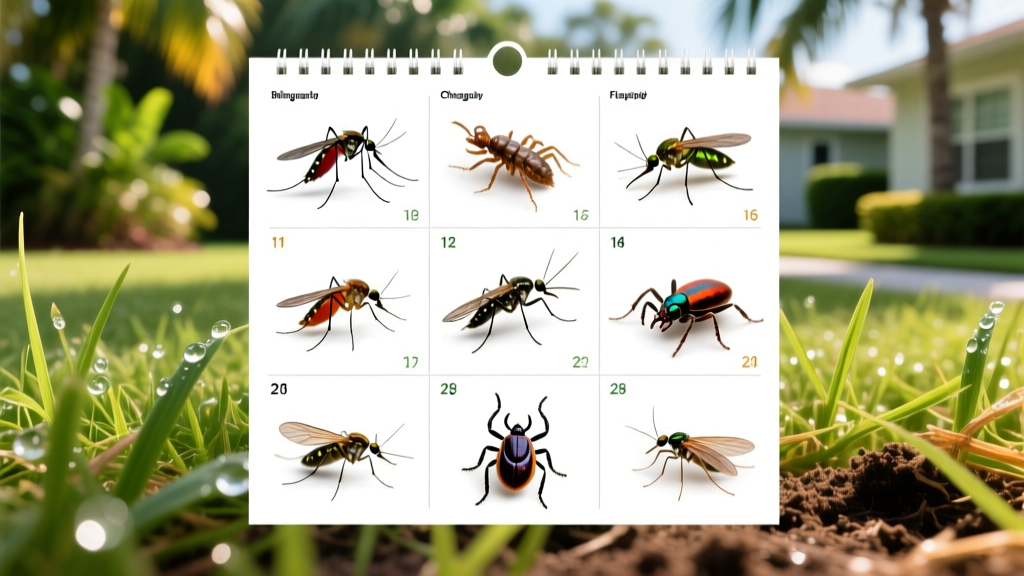
Bugs That Bite in Florida: A Seasonal Calendar & Control Guide
The Year-Round Reality of Florida Biting Pests
Florida spans USDA Hardiness Zones 8a through 11a, creating a fragmented climate where 'winter' in Pensacola means frost and dormancy, while 'winter' in Key West means peak dry-season outdoor living. Because of this subtropical and tropical overlap, the bugs that bite in Florida do not adhere to a single, unified calendar. Instead, their activity is dictated by localized humidity, rainfall patterns, and soil temperatures.
Managing these pests requires moving beyond reactive spraying. Effective control hinges on pre-emptive seasonal timing—targeting pests during their larval or nymph stages before they reach biting maturity. This guide breaks down the exact seasonal triggers, regional variations, and specific chemical and organic interventions required to reclaim your yard.
Regional Baseline: North Florida (Zones 8b-9a) experiences 30-60 days of frost, naturally suppressing tick and mosquito populations in January. South Florida (Zones 10-11) rarely drops below 40°F, allowing mosquitoes and biting midges to breed year-round, requiring continuous 21-day treatment cycles.
Seasonal Peak Calendar for Florida Biters
Timing your interventions to the life cycle of the pest is the most cost-effective control strategy. Applying expensive bifenthrin barrier sprays during a drought when mosquitoes are dormant wastes capital, while missing the spring fire ant mating flight guarantees a summer of painful mounds.
| Season | Primary Biting Pests | Environmental Trigger | Pre-Emptive Action Window |
|---|---|---|---|
| Spring (Mar-May) | Fire Ants, Ticks (Lone Star) | Soil temps reach 65°F-70°F; spring rains | Late February (broadcast baits) |
| Summer (Jun-Aug) | No-See-Ums, Chiggers, Horse Flies | High humidity, daily afternoon thunderstorms | May (source reduction & mesh screening) |
| Fall (Sep-Nov) | Mosquitoes (Peak), Sand Flies | Lingering heat + heavy late-summer rain accumulation | Late August (Bti treatments & yard cleanup) |
| Winter (Dec-Feb) | Fire Ants (sunny days), South FL Mosquitoes | Warm fronts, dry season in southern zones | December (mound drenching on warm days) |
Deep Dive: Top Biters and Targeted Eradication Tactics
1. Mosquitoes (Aedes and Culex Species)
The Asian tiger mosquito (Aedes albopictus) is Florida's most aggressive daytime biter. Unlike Culex species that breed in stagnant ditches, Aedes lay eggs in damp soil and artificial containers holding as little as 0.5 ounces of water. According to the University of Florida IFAS Mosquito Information Website, source reduction is infinitely more effective than fogging.
- DIY Treatment: Use Bacillus thuringiensis israelensis (Bti) dunks. Products like Mosquito Dunks ($8 for a 6-pack) release Bti for 30 days. Place them in birdbaths, gutters, and French drains. Bti is non-toxic to pets and birds.
- Pro Treatment: Barrier sprays using Bifenthrin 7.9% (e.g., Talstar P). Apply at 0.5 fl oz per 1,000 sq ft to the underside of shrub leaves where mosquitoes rest during the heat of the day. Expect to pay $90-$150 per acre for professional applications every 21 days.
2. Red Imported Fire Ants (Solenopsis invicta)
Fire ants do not just bite; they latch on with their mandibles and sting repeatedly in a circular pattern, injecting solenopsin venom. The UF Entomology Department recommends the 'Two-Step Method' for long-term suppression, which costs roughly $30-$45 per acre annually.
- Step 1 (Broadcast Bait): In late March and early October, apply a bait containing hydramethylnon and methoprene (e.g., Extinguish Plus, ~$28 for 1.5 lbs). Worker ants carry the bait into the colony, sterilizing the queen. Do not water the lawn for 48 hours after application.
- Step 2 (Mound Drench): For nuisance mounds near patios or play areas, use a fast-acting contact insecticide like Ortho Fire Ant Killer ($10/bottle) poured directly into the mound center to kill foraging workers instantly.
Warning: Never use broad-spectrum liquid pyrethroids (like permethrin or bifenthrin) as a broadcast spray for fire ants. This kills native competitor ants and destroys the fire ants' natural predators, often resulting in a 'rebound effect' where fire ant populations return 300% stronger the following season.
3. No-See-Ums (Biting Midges / Culicoides)
Measuring just 1-2mm, no-see-ums are notorious in coastal Florida, particularly near mangroves and estuaries. They easily pass through standard 16x18 mesh window screens.
- Structural Fix: Upgrade lanai and window screens to a 20x20 mesh or finer 'no-see-um mesh'. This reduces airflow slightly but blocks 99% of midges.
- Yard Treatment: No-see-ums breed in moist, decaying organic matter and muddy shorelines, not open water. Treat shaded, damp perimeter soil with a residual pyrethroid. For immediate patio relief, spatial repellents like the Thermacell E55 ($55) use a heated metofluthrin mat to create a 20-foot protection zone, significantly outperforming citronella candles or ultrasonic plugins, which university studies have proven ineffective.
4. Chiggers (Trombiculidae)
Chiggers are microscopic mite larvae that peak in Florida from May through July, particularly in overgrown St. Augustine grass and shaded, damp areas. They do not burrow into the skin; they inject digestive enzymes that liquefy skin cells, causing intense, localized itching that peaks 24-48 hours after exposure.
- Lawn Management: Keep turf mowed to 3.5–4 inches. Chiggers require high humidity at the soil surface to survive; proper mowing and morning-only irrigation (before 10 AM) allow the soil surface to dry out, drastically reducing chigger habitat.
- Personal Protection: Treat clothing and shoes with 0.5% Permethrin spray (Sawyer brand, ~$15). Permethrin binds to fabric fibers and survives up to 6 washes, killing chiggers on contact before they can reach the skin.
Decision Framework: DIY vs. Professional Pest Control
Choosing between DIY management and hiring a licensed operator depends on your property size, proximity to water, and the specific pests you are targeting.
| Criteria | DIY Approach | Professional Service (e.g., Mosquito Joe, Orkin) |
|---|---|---|
| Best For | Fire ants, source reduction, localized patio defense | Tick/mosquito barrier sprays, large properties (>0.5 acres) |
| Estimated Cost | $50-$150 / season (baits, dunks, pump sprayers) | $85-$150 / visit (21-day barrier spray programs) |
| Environmental Risk | Low (if using targeted Bti and baits) | Moderate (barrier sprays can harm foraging bees if applied to blooming weeds) |
| Efficacy Timeline | Slow (baits take 2-4 weeks to collapse colonies) | Immediate (contact kill of resting adults) |
The Aquatic Buffer Rule
If your Florida property borders a canal, retention pond, or the Intracoastal Waterway, strict environmental regulations apply. The CDC and EPA warn that pyrethroids like bifenthrin and permethrin are highly toxic to fish and aquatic invertebrates. Homeowners within 50 feet of a water body must avoid liquid broadcast sprays entirely. Instead, rely on Bti dunks for mosquitoes, granular fire ant baits applied with a drop spreader to avoid water drift, and physical barriers like fine mesh screens.
Summary of Actionable Timing
Stop treating your lawn reactively. Buy your fire ant broadcast baits in February before the soil warms. Install Bti dunks in all yard drains and birdbaths in April before the summer rains begin. Upgrade your lanai screens to 20x20 mesh in May to block no-see-ums. By aligning your pest control budget with the biological clocks of these regional biters, you can maintain a usable outdoor space year-round without over-applying harsh chemicals to Florida's fragile subtropical ecosystem.

