
Pest Control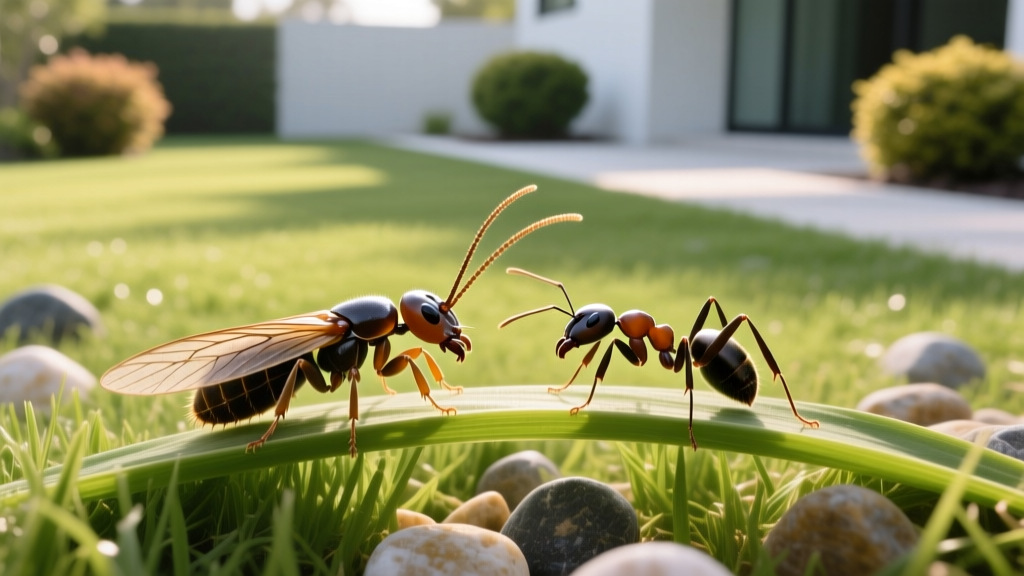
Bugs That Look Like Ants With Wings: Termite vs. Ant Guide
The Anatomy of the Confusion: Why They Look Alike
When homeowners spot bugs that look like ants with wings clustering near window sills, light fixtures, or patio doors in early spring, panic often sets in. These winged insects are technically known as alates or swarmers. Their primary biological function is to leave their parent colony, mate, and establish new nests. While both carpenter ants and termites produce winged reproductive swarmers, their threat levels to your home's structural integrity are vastly different. Misidentifying these pests can lead to ineffective treatments, wasted money, and unchecked structural damage. This guide provides a definitive, expert-level framework for identifying these swarmers and executing the correct elimination protocol.
The 3-Point Visual ID Matrix
To accurately distinguish between a termite swarmer and an ant swarmer, you must examine three specific anatomical features. Relying on a quick glance is insufficient; use a magnifying glass or your smartphone's macro lens to inspect a captured specimen.
| Anatomical Feature | Carpenter Ant Swarmer (Camponotus spp.) | Termite Swarmer (Reticulitermes / Coptotermes) |
|---|---|---|
| Waist (Thorax-Abdomen) | Pinched, narrow, and sharply defined (hourglass shape). | Broad, thick, and straight (no distinct pinching). |
| Antennae | Elbowed (geniculate) with a distinct bend or joint. | Straight, beaded, or moniliform (looks like a string of tiny pearls). |
| Wings | Unequal length (front wings are noticeably larger than hind wings); slightly tinted or translucent. | Equal length (both pairs are identical); milky, opaque, and highly fragile. |
Decoding the Clues: Discarded Wings and Frass
If the swarmers have already shed their wings or died, you can still identify the culprit by examining the debris left behind.
⚠️ Warning: The Discarded Wing Trap
Termites shed their wings almost immediately after landing to begin burrowing. If you find neat, uniform piles of translucent, identical-sized wings on your windowsills or baseboards, you are almost certainly dealing with termites. Ants rarely shed their wings indoors unless they are dead or dying, and their discarded wings will show distinct size variations between the forewings and hindwings.
Termites shed their wings almost immediately after landing to begin burrowing. If you find neat, uniform piles of translucent, identical-sized wings on your windowsills or baseboards, you are almost certainly dealing with termites. Ants rarely shed their wings indoors unless they are dead or dying, and their discarded wings will show distinct size variations between the forewings and hindwings.
Frass Analysis: Carpenter ants do not eat wood; they excavate it. They push out a sawdust-like material called frass, which often contains tiny, hard, hexagonal insect parts and feels gritty. Termites consume wood and produce fecal pellets (drywood termites) or use soil and saliva to build mud tubes (subterranean termites). Finding smooth, six-sided pellets the size of a grain of sand indicates drywood termites, while pencil-width mud tubes on your foundation indicate subterranean termites.
Carpenter Ant Swarmers: Targeted Elimination Protocol
Carpenter ants typically swarm between May and July, often in the late evening. While they do not eat wood, their excavation can compromise structural timbers over several years. According to Penn State Extension, carpenter ants usually establish a main colony outdoors in decaying wood and create satellite colonies indoors in moist, compromised structural lumber.
Recommended Treatment Strategy
Avoid using fast-acting repellent sprays (like Bifenthrin or Permethrin) indoors. These cause the colony to "bud," splitting into multiple satellite colonies and worsening the infestation. Instead, use a delayed-action bait transfer method.
- Product Selection: Advance Carpenter Ant Bait (Abamectin 0.011%) or Maxforce Fleet Ant Bait Gel (Imidacloprid 0.03%).
- Pricing: Expect to pay between $35 and $45 for a professional-grade 2 lb container or a box of gel cartridges.
- Application: Apply small dabs (pea-sized) of gel near frass piles, along baseboards, and near moisture-damaged window frames. The worker ants will carry the toxic bait back to the queen, collapsing the colony within 14 to 21 days.
Termite Swarmers: The Structural Threat and Trenching
Subterranean termites usually swarm on warm, sunny mornings following a heavy spring rain. The U.S. Environmental Protection Agency (EPA) notes that subterranean termites cause billions of dollars in structural damage annually. If you identify termite swarmers, immediate perimeter defense is required.
The DIY Liquid Trenching Method
For comprehensive exterior defense, non-repellent liquid termiticides are the industry standard. These chemicals are undetectable to termites, allowing them to pass through the treated soil, pick up a lethal dose, and transfer it to the colony via grooming.
- Choose the Termiticide: Taurus SC (Fipronil 9.1%) is the current gold standard for DIY and professional trenching. A 20 oz bottle costs approximately $90 in 2026 and treats roughly 60 linear feet of foundation.
- Dig the Trench: Using a trenching shovel, dig a continuous trench 6 inches wide and 6 inches deep directly against the home's foundation.
- Mix the Solution: Dilute Taurus SC at a rate of 0.8 fluid ounces per gallon of water. You will need 4 gallons of finished solution for every 10 linear feet of trench.
- Apply and Backfill: Pour the solution evenly into the trench. Once applied, backfill the trench with the excavated soil and treat the backfill with a lighter surface spray to ensure a continuous chemical barrier.
Edge Cases: Other Bugs That Look Like Ants With Wings
Occasionally, homeowners encounter winged insects that mimic ants but belong to entirely different taxonomic orders.
Expert Insight: Velvet ants (Mutillidae) are frequently mistaken for large, fuzzy ants with wings. However, velvet ants are actually flightless female wasps. Males have wings but lack the stinger. If you see a brightly colored, fuzzy "ant" in your garden, leave it alone; they are solitary, non-structural pests that prey on ground-nesting bees.
Another common mimic is the Acrobat ant (Crematogaster spp.). These ants also produce winged swarmers, but they can be identified by their distinct heart-shaped abdomen, which they often raise above their head when disturbed. They nest in moist wood and require similar baiting strategies to carpenter ants.
Frequently Asked Questions
Can I use a generic bug spray on both ants and termites?
No. Over-the-counter aerosol sprays containing Pyrethroids act as contact killers and repellents. While they may kill a few visible ant swarmers, spraying termites with repellents will cause the colony to avoid the treated area and find a new, undetected entry point into your home. Always use non-repellent termiticides (Fipronil) for termites and slow-acting baits for ants.
How long does a swarming event last?
A single termite or ant swarming event is highly transient, typically lasting only 30 to 45 minutes. However, a mature colony will release multiple swarms over a period of three to four weeks. If you are seeing daily swarms, the parent colony is likely located within 100 yards of your home.
Do termite swarmers mean my house is already infested?
Not necessarily. Swarmers found outdoors near a stump or fence indicate a nearby colony, but your home may not yet be compromised. However, if swarmers are emerging from inside your home (e.g., from baseboards, drywall, or interior window sills), it is a definitive indicator of an active, mature indoor infestation requiring immediate professional or aggressive DIY intervention.

