
Pest Control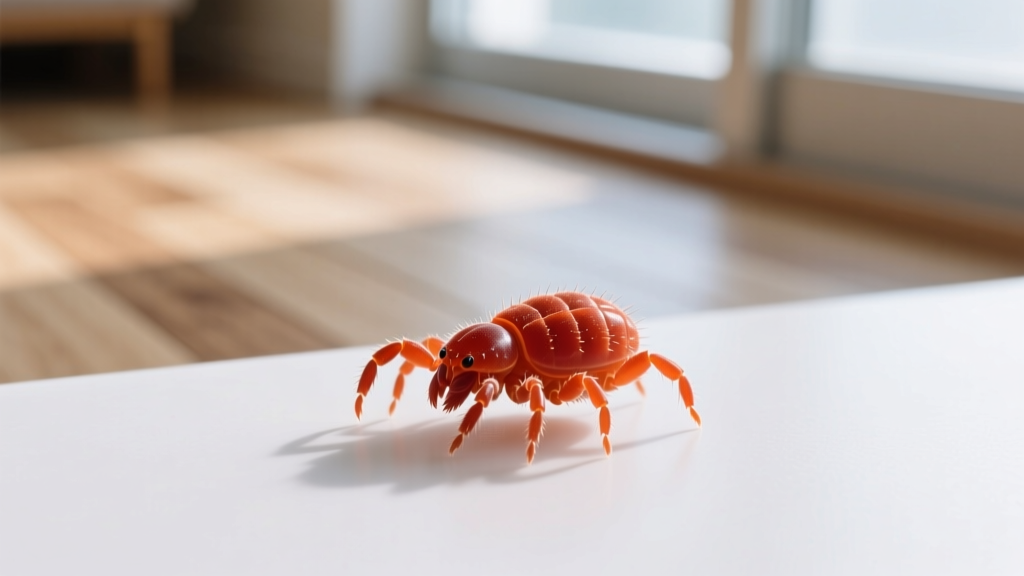
Can Chiggers Live in Your House? The Truth About Indoor Infestations
The Short Answer: Can Chiggers Live in Your House?
If you have returned from a hike or yard work covered in itchy red welts and are worried about bringing an infestation inside, you can breathe a sigh of relief. Chiggers cannot live, survive, or reproduce in your house. Unlike bed bugs or fleas, chiggers (the larval stage of trombiculid mites) are strictly outdoor pests that require very specific environmental conditions to survive. If a chigger hitches a ride into your home on your clothing or a pet, it will die of desiccation (drying out) within 48 to 72 hours.
⚠️ The 72-Hour Rule: Chiggers require a relative humidity level between 70% and 90% to survive. Modern indoor HVAC systems typically maintain indoor humidity between 30% and 50%. This drastic drop in moisture guarantees that any chigger brought indoors will rapidly desiccate and die before it can establish any sort of population.
The Biology of Indoor Desiccation
To understand why your home is an inhospitable environment for chiggers, you must understand their life cycle. According to entomology research from the University of Minnesota Extension, only the six-legged larval stage of the chigger bites mammals. The nymph and adult stages are harmless predators that feed on other small soil insects and require deep, moist leaf litter to thrive.
When a larval chigger attaches to a host, it does so to consume a single tissue meal. Once it has fed (which takes 2 to 4 days), it drops off the host into the soil to molt into a nymph. If it drops off onto your living room carpet instead of moist soil, it lacks the necessary ambient moisture to survive the molting process. Furthermore, chiggers do not infest carpets, upholstery, or bedding because they have no evolutionary mechanism to digest the dried blood or skin flakes that sustain indoor pests like dust mites.
Busting the Burrowing Myth: How Chiggers Actually Feed
A major reason homeowners panic about indoor chiggers is the persistent myth that chiggers burrow under the skin and lay eggs. This is biologically false. Penn State Extension notes that chiggers do not burrow into the skin, nor do they suck blood.
Instead, the chigger uses specialized mouthparts to pierce the epidermis and inject digestive enzymes that liquefy skin cells. The host's immune system reacts to these enzymes by hardening the surrounding tissue, forming a tube-like structure called a stylostome. The chigger feeds through this stylostome. The intense itching you feel is an allergic reaction to the digestive enzymes, not the physical presence of a bug living under your skin. Once the chigger drops off, the stylostome remains in your skin for days, continuing to itch long after the mite is dead and gone.
The Usual Suspects: What Is Actually Biting You Indoors?
If you are waking up with new bites every morning, or noticing bugs actively crawling on your baseboards and furniture, you do not have chiggers. You are likely dealing with a different indoor pest. Use the diagnostic matrix below to identify the true culprit.
| Pest | Visual Identification | Bite Pattern & Location | Indoor Survival |
|---|---|---|---|
| Chiggers | Microscopic, bright red, 6 legs (larvae) | Clusters around tight clothing lines (waistbands, sock lines, behind knees) | 48-72 hours (then dies) |
| Bed Bugs | Apple-seed sized, flat, mahogany brown | Linear rows or zig-zags on exposed skin (arms, neck, face) while sleeping | Months to over a year |
| Fleas | 1/8 inch, dark brown, laterally flattened, jumps | Random clusters heavily concentrated on ankles and lower legs | Indefinite (reproduces indoors) |
| Bird/Rodent Mites | Pinhead-sized, translucent/gray, 8 legs, moves rapidly | Random, intense biting all over the body; often felt crawling | Weeks (if host nest is nearby) |
| Clover Mites | Tiny, reddish-brown, long front legs, crushes to red stain | DO NOT BITE HUMANS. Nuisance invader only. | Days (leaves red stains on walls) |
The Post-Exposure Decontamination Protocol
While chiggers cannot establish an infestation, you still want to remove them from your person and belongings immediately after returning from a chigger-heavy area (like tall grass, berry patches, or forest edges). Follow this exact protocol to neutralize any hitchhikers.
Step 1: The Hot Wash
Strip off all outdoor clothing before sitting on upholstered furniture. Wash the garments in a washing machine using the hottest water setting available. The water temperature must reach at least 130°F (54°C) to effectively kill any attached larvae. Follow this with a minimum of 30 minutes in the dryer on the highest heat setting.
Step 2: The Soap Scrub
Take a shower immediately. Use a washcloth and a standard antibacterial or deodorant soap to vigorously scrub your skin, paying special attention to the ankles, groin, waistline, and armpits. The physical friction of the washcloth is more important than the soap brand, as it will dislodge any chiggers that have not yet attached or have just begun forming a stylostome.
Step 3: Proactive Clothing Treatment (For Future Prevention)
If you frequently work in chigger-prone areas, treat your outdoor workwear with 0.5% Permethrin spray (such as Sawyer Products Premium Insect Repellent, typically priced around $15 for a 24 oz bottle). Apply it to the outside of your pants, socks, and boots, and allow it to dry completely. Permethrin binds to fabric fibers and remains effective through 6 washings, killing chiggers on contact before they can reach your skin.
Expert Pet Note: Permethrin is highly toxic to cats. If you have feline companions, do not use permethrin-treated clothing around them until the spray is 100% dry, and never apply liquid permethrin spot treatments meant for dogs onto cats. For dogs returning from the woods, a standard bath with a canine oatmeal shampoo will easily wash away unattached chiggers.
Eradicating the Real Indoor Culprits
If you have confirmed via the matrix above that your indoor bites are caused by fleas or bird mites, standard chigger prevention will not help. You must pivot your pest control strategy.
- For Fleas: You must break the reproductive cycle. Treat all pets with a veterinary-grade IGR (Insect Growth Regulator) product like Frontline Plus (Fipronil and (S)-methoprene). Simultaneously, vacuum all carpets daily and dispose of the vacuum bag outside immediately to remove flea eggs and pupae.
- For Bird/Rodent Mites: These mites migrate indoors when their primary host (birds nesting in vents, or rats in the attic) dies or leaves. The primary fix is physical exclusion: remove the nest and seal the entry point. For residual indoor treatment, pest professionals use microencapsulated pyrethroids like Demand CS (Lambda-cyhalothrin 9.7%), which provides a long-lasting residual barrier along baseboards and window frames where mites travel.
Frequently Asked Questions
Can chiggers live in my bed or mattress?
No. Chiggers cannot survive in a mattress. They do not feed on dried skin flakes or blood stains like bed bugs or dust mites. If a chigger falls off your body in bed, it will die from the dry indoor air within a few days. If you are getting bitten in bed repeatedly, you almost certainly have a bed bug infestation.
Why do my chigger bites keep itching for weeks if the bug is dead?
The itching is caused by the stylostome (the hardened tube of tissue) and the digestive enzymes the chigger injected into your skin. Even after the mite drops off and dies, your immune system continues to react to the foreign enzymes trapped in your epidermis. Over-the-counter hydrocortisone 1% cream or oral antihistamines (like Cetirizine) are the most effective treatments to calm the localized allergic reaction.
Do chiggers jump like fleas?
No, chiggers do not jump or fly. They climb to the top of a blade of grass or a small twig and wait with their front legs extended (a behavior called 'questing') for a host to brush past them. Once on the host, they wander upward until they hit a barrier like a tight sock band or waistband, which is where they stop and feed.

