
Pest Control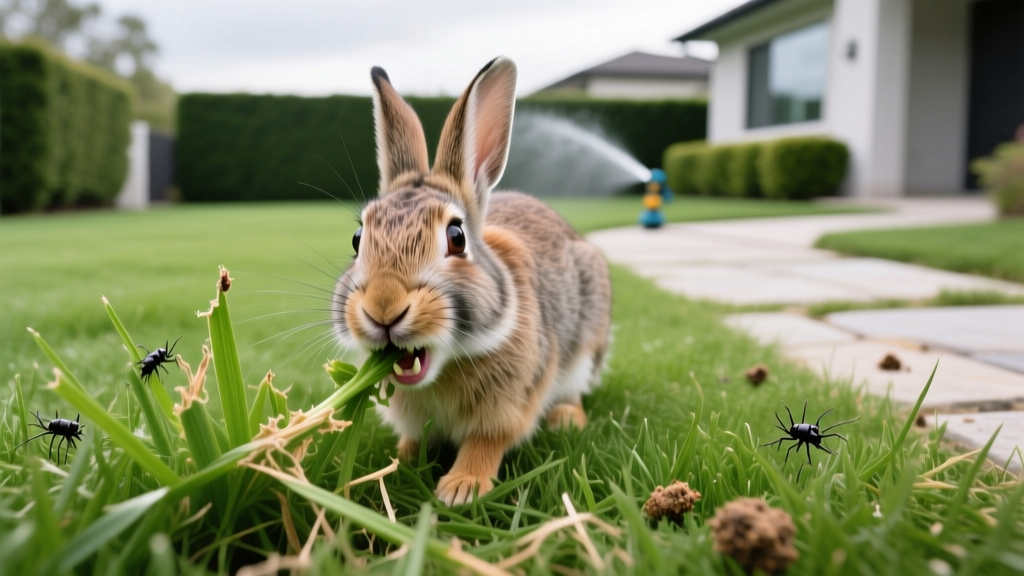
Can a Rabbit Eat Grass? Identifying Lawn Damage & Pest Control
The Biology of Rabbit Grazing on Turfgrass
When homeowners ask, can a rabbit eat grass, the biological answer is an absolute yes. Grasses and forbs constitute up to 90% of a wild cottontail rabbit’s summer diet. Unlike rodents that primarily seek seeds or roots, rabbits are hindgut fermenters that require a constant intake of high-fiber vegetation to maintain gastrointestinal motility and produce cecotropes (nutrient-rich fecal pellets they re-ingest).
While this grazing behavior is natural, it becomes a significant pest control issue when rabbit populations concentrate in suburban lawns. A single adult cottontail can consume up to one pound of vegetation per day. In a newly seeded or meticulously maintained turf environment, this translates to localized defoliation, stunted root development, and unsightly brown patches that mimic fungal diseases or grub damage.
⚠️ Pest Control Warning: Do not confuse rabbit grazing with drought stress. Rabbit damage typically appears overnight in localized, circular patterns near brush piles or fence lines, whereas drought stress presents uniformly across sun-exposed areas.
Identifying Rabbit Damage vs. Other Lawn Pests
Accurate identification is the first step in any integrated pest management (IPM) protocol. Because rabbits, voles, and certain turf diseases all cause thinning grass, misidentification leads to wasted time and ineffective chemical applications. Use the diagnostic matrix below to confirm the culprit.
| Pest / Issue | Clipping Pattern | Secondary Evidence | Active Time |
|---|---|---|---|
| Rabbits | Clean, 45-degree angle cuts 1-2 inches above soil | Pea-sized, perfectly round brown droppings | Dawn and Dusk |
| Voles | Irregular gnawing; grass clipped at soil line | 1.5-inch wide dirt runways hidden under turf/snow | Day and Night |
| White Grubs | No clipping; turf detaches from soil entirely | Spongy turf that rolls back like a carpet; C-shaped white larvae | N/A (Subsurface) |
| Dollar Spot | Bleached leaf tips with hourglass lesions | Cobweb-like mycelium in morning dew | N/A (Fungal) |
Turfgrass Palatability and Resistance Profiles
Not all grass species react equally to rabbit herbivory. When repairing a damaged lawn or selecting seed for a rabbit-heavy zone, you must factor in both palatability (how much the rabbit wants to eat it) and agronomic resilience (how fast the grass recovers).
- Kentucky Bluegrass (Poa pratensis): Highly palatable and highly susceptible. Rabbits prefer the tender, succulent new shoots of bluegrass. It spreads via rhizomes, which aids recovery, but heavy grazing will quickly expose bare soil.
- Tall Fescue (Festuca arundinacea): Moderate palatability and high resistance. The coarse, silica-rich leaf blades are less appealing to rabbits. Its deep root system (often exceeding 24 inches) allows it to survive moderate surface defoliation without dying.
- Bermudagrass (Cynodon dactylon): Moderate palatability but exceptional recovery. While rabbits will eat it, Bermudagrass’s aggressive stolon and rhizome network allows it to rapidly fill in grazed patches during the warm season.
- Fine Fescues (Festuca spp.): Low palatability. Often used in shade mixes, the needle-like blades are largely ignored by rabbits unless no other forage is available.
Humane Pest Control and Exclusion Strategies
Lethal control is rarely effective for suburban rabbit populations due to rapid breeding cycles (a single female can produce up to 6 litters of 3-8 kits per year). According to wildlife management guidelines from the Humane Society of the United States, exclusion and habitat modification yield the highest long-term success rates.
Step 1: Physical Exclusion (The Gold Standard)
Fencing is the only 100% effective deterrent. Standard chicken wire is insufficient because rabbits can squeeze through larger gaps or push through weak points.
- Material Selection: Use 1-inch hexagonal woven wire mesh (18-gauge or thicker).
- Height Requirement: The fence must extend at least 24 inches above the ground to account for snow depth and reaching behavior.
- Subsurface Footer: Bend the bottom 6 inches of the mesh outward at a 90-degree angle (an L-footer) and bury it shallowly or pin it to the soil with landscape staples. This prevents rabbits from digging underneath.
Step 2: Chemical and Sensory Repellents
Repellents are secondary defenses and require strict maintenance. As noted by experts at The Old Farmer's Almanac, taste and odor repellents must be applied before damage begins.
"Putrescent egg solids and capsaicin-based sprays are the most effective active ingredients for mammalian herbivores. However, they degrade under UV exposure and wash off after 1 inch of rainfall. You must reapply every 3 to 4 weeks during the growing season."
Recommended Active Ingredients:
- Putrescent Egg Solids: Triggers a predator-avoidance instinct. Highly effective but carries a strong sulfur odor for the first 48 hours.
- Capsaicin (Hot Pepper Wax): Creates a burning sensation in the rabbit's mucous membranes. Best used as a spot treatment on high-value garden borders rather than broad lawn applications.
- Motion-Activated Sprinklers: Devices like the Orbit 62100 Yard Enforcer use infrared sensors to blast a sudden jet of water. This provides excellent seasonal deterrence without chemicals, though it requires access to a pressurized hose spigot and winterization in freezing climates.
Lawn Recovery Protocol After Overgrazing
If rabbits have severely defoliated your turf, passive recovery is often insufficient due to weed invasion in the bare spots. Implement this targeted recovery protocol:
🌱 The 3-Step Recovery Matrix:
- Core Aeration: Rent a walk-behind core aerator to pull 3-inch plugs. This relieves soil compaction caused by rabbit foot traffic and creates micro-environments for seed-to-soil contact.
- Overseeding: Apply a mix dominated by Tall Fescue (at a rate of 5-7 lbs per 1,000 sq ft). The coarse texture will deter future grazing.
- Strategic Fertilization: Avoid high-nitrogen, fast-release fertilizers (like standard urea). Rapid, succulent growth acts as a beacon for rabbits. Instead, use a slow-release, methylene-urea based fertilizer with an N-P-K ratio of 16-4-8 to promote steady root development over explosive top-growth.
By understanding the dietary mechanics of rabbits and accurately identifying their specific clipping patterns, homeowners can transition from reactive frustration to proactive turf management. Combining physical exclusion with resilient grass cultivars ensures your lawn remains intact without resorting to ecologically disruptive eradication methods.

