
Pest Control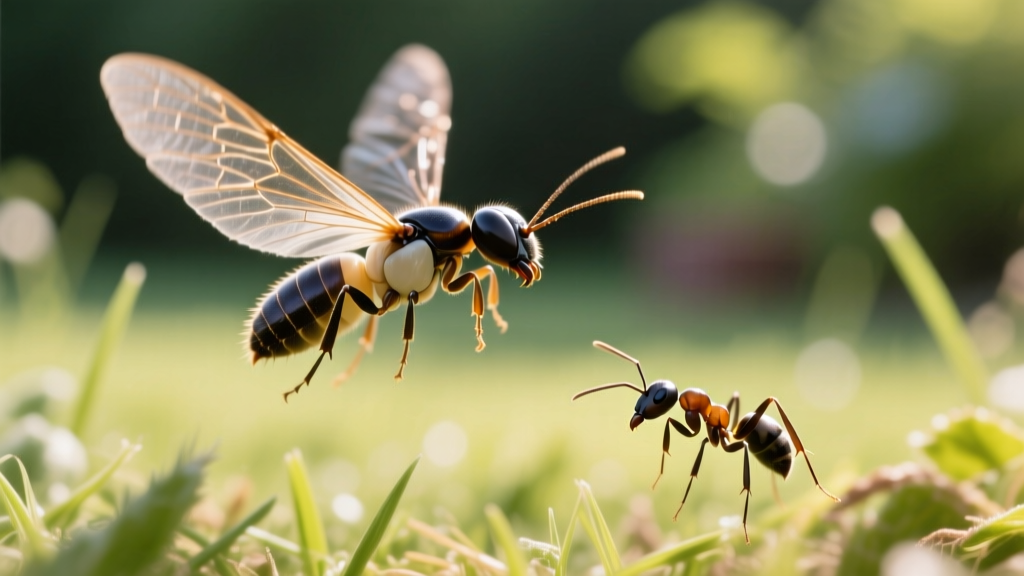
Can Termites Fly? Identifying Swarmers vs. Flying Ants
The short answer to whether termites can fly is yes, but only a specific caste within the colony possesses this ability. Known as alates or swarmers, these reproductive termites take to the air during brief, highly synchronized nuptial flights to mate and establish new colonies. For homeowners, spotting these flying insects is a critical warning sign that requires immediate identification and action.
The Biology of Flying Termites (Alates)
Termite colonies operate on a strict caste system: workers, soldiers, and reproductives. Workers and soldiers are entirely wingless and spend their lives hidden within wood or soil. Alates, however, develop two pairs of long, translucent wings specifically for a single reproductive event.
Nuptial flights are triggered by specific environmental variables. For Eastern Subterranean termites (Reticulitermes flavipes), swarming usually occurs on warm, humid mornings following a heavy spring rain, when soil temperatures reach approximately 70°F to 75°F. Conversely, Drywood termites (Incisitermes minor) tend to swarm in the late summer or early fall, often during the evening hours. Once they land, the alates shed their wings, pair off, and burrow into wood or soil to start a new colony.
Termite Swarmers vs. Flying Ants: A Visual Breakdown
Because termite swarmers and flying carpenter ants often emerge during the same springtime conditions, misidentification is common. Distinguishing between the two dictates your entire pest management strategy, as carpenter ants do not consume structural wood in the same destructive manner as subterranean termites.
| Anatomical Feature | Termite Swarmer | Flying Carpenter Ant |
|---|---|---|
| Wings | Two pairs of equal length, milky/translucent, extending far past the abdomen. | Two pairs of unequal length (front wings longer), tinted brownish, with visible veins. |
| Antennae | Straight and beaded (moniliform). | Elbowed (geniculate) with a distinct bend. |
| Waist/Thorax | Broad, uniform, and thick; no distinct separation between thorax and abdomen. | Narrow, pinched "hourglass" waist connecting the thorax and abdomen. |
| Body Color | Dark brown to black, though some drywood species are pale yellow-brown. | Typically solid black, reddish-black, or multi-colored. |
What It Means If You See Flying Termites
The location of the swarmers is the most vital diagnostic clue for pest control professionals.
Outdoor Sightings
Seeing dozens of swarmers emerging from a mulch bed, a dead tree stump, or a neighbor's fence line indicates a mature outdoor colony. While this does not mean your house is currently infested, it confirms that your property is in a high-pressure termite zone. Preventative exterior treatments are highly recommended in this scenario.
Indoor Sightings
If you find live swarmers inside your home, or notice piles of discarded wings on interior window sills, baseboards, or near attic vents, you almost certainly have an active infestation within the structure. Subterranean termites build mud tubes from the soil into your foundation to access wood. When the indoor alates swarm, they are drawn to light, congregating at windows and doors, but they cannot penetrate standard glass screens to escape.
Immediate Action Plan: Finding Discarded Wings
Termite swarmers are fragile. Most die within hours of swarming if they cannot reach soil. However, they leave behind their shed wings, which are the most common evidence of an indoor swarm.
- Do Not Use Over-the-Counter Sprays: Avoid spraying Raid or similar contact insecticides on the swarmers or wings. Repellent sprays disrupt the foraging trails and mud tubes, making it significantly harder for a professional exterminator to locate the primary colony entry point.
- Collect Evidence: Use a vacuum with a hose attachment to clean up the wings and dead bodies. Place a small sample into a sealed ziplock bag or glass jar for your inspector to verify the species.
- Map the Locations: Note exactly which rooms and windowsills had the highest concentration of wings. This data helps inspectors pinpoint the underlying mud tubes or drywood kick-out holes.
- Schedule a WDI Inspection: Contact a licensed pest control operator for a Wood Destroying Insect (WDI) inspection. According to the Environmental Protection Agency (EPA), hiring a certified professional is the safest and most effective route for structural termite remediation.
Treatment & Prevention Framework
Once an infestation is confirmed, you must choose a remediation strategy. The two primary commercial frameworks are liquid soil barriers and baiting systems. As of 2026, pricing for a standard 2,000-square-foot home typically falls within the ranges below.
Liquid Termiticides (Soil Barriers)
Modern liquid treatments rely on non-repellent active ingredients, primarily Fipronil (e.g., Termidor SC) or Imidacloprid (e.g., Premise). Because termites cannot detect the chemical, they tunnel through the treated soil, pick up a lethal dose, and transfer it to the rest of the colony via grooming and trophallaxis (food sharing).
- Cost: $1,200 to $2,500 for initial trenching and rodding application.
- Longevity: Fipronil barriers remain active in the soil for 10 years or more, according to University of Kentucky Entomology research.
- Best For: Immediate colony elimination, heavy active infestations, and properties with complex concrete slab foundations.
Bait Station Systems
Systems like Sentricon Always Active or the Advance Termite Bait System utilize cellulose matrices laced with chitin synthesis inhibitors (e.g., Noviflumuron). Termites feed on the bait and carry it back to the nest, where it prevents the colony from molting, eventually leading to total colony collapse.
- Cost: $800 to $1,500 for initial installation, plus $400 to $600 annually for mandatory monitoring and bait replenishment.
- Longevity: Continuous protection as long as the annual maintenance contract is active.
- Best For: Homes with sensitive landscaping, wells, or adjacent water features where soil trenching is prohibited or ecologically risky.
Frequently Asked Questions
Do flying termites bite humans or pets?
No. Termite swarmers possess mandibles designed for chewing wood and excavating soil, not for biting skin. They are entirely harmless to humans and pets, though their presence indicates a threat to your property's structural integrity.
How long do termite swarmers live after they fly?
If they fail to find a mate and a suitable damp soil or wood crevice to start a nest, alates typically die of dehydration or predation within 24 to 48 hours. The piles of dead bodies and wings you find on your floor are the result of this rapid mortality rate indoors.
Will a bug zapper or porch light trap kill the swarmers?
While termite alates are highly phototactic (attracted to light), a bug zapper will only kill a tiny fraction of the swarm. Furthermore, relying on a zapper provides a false sense of security. The National Pest Management Association (NPMA) emphasizes that killing the visible swarmers does nothing to stop the thousands of blind, wingless workers currently consuming your home's framing lumber beneath the foundation.

