
Pest Control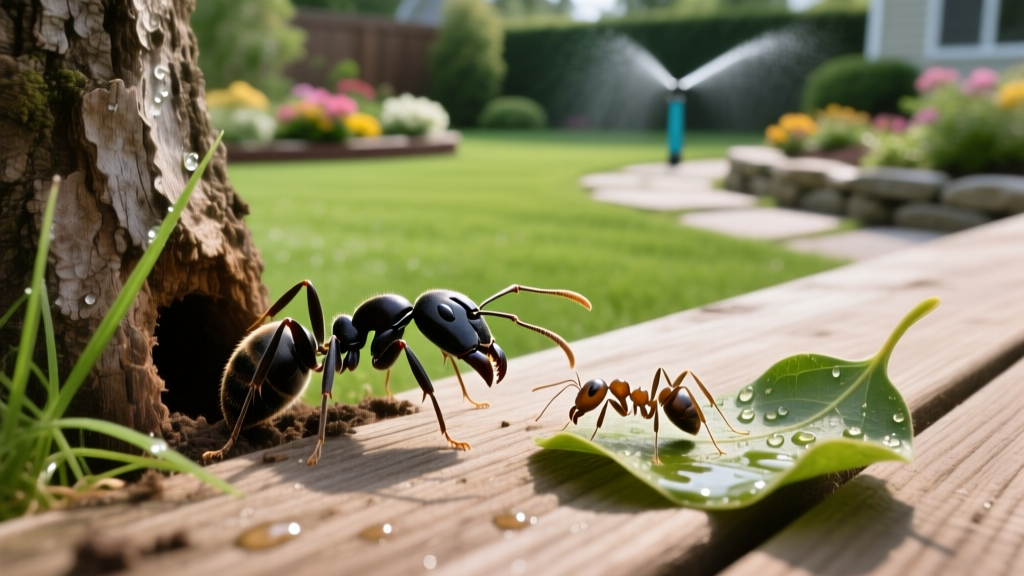
Carpenter Ants vs Sugar Ants: Yard Defense & Treatment Guide
The Core Distinction: Wood Destroyers vs. Nuisance Foragers
When managing perimeter pests, misidentifying your target leads to wasted chemicals and ongoing infestations. The comparison of carpenter ants vs sugar ants represents two entirely different threat models in yard defense. Carpenter ants (Camponotus spp.) are structural excavators that require moist, decaying wood to establish satellite colonies. Sugar ants—a North American colloquialism primarily referring to the Odorous House Ant (Tapinoma sessile) and Argentine Ant (Linepithema humile)—are soil-nesting, sweet-foraging nuisance pests that exploit aphid honeydew and outdoor food sources.
| Feature | Carpenter Ants (Camponotus) | Sugar Ants (Tapinoma / Linepithema) |
|---|---|---|
| Primary Threat | Structural wood excavation (frass production) | Massive nuisance foraging; indoor invasion |
| Yard Nesting Sites | Tree stumps, rotting landscape timbers, hollow fence posts | Under mulch, pavement cracks, shallow soil near foundations |
| Dietary Preference | Proteins and complex carbohydrates (insects, plant sap) | Simple sugars, honeydew, nectar, synthetic sweets |
| Colony Structure | Single queen primary nest; multiple satellite nests | Polydomous (multiple queens/nests); supercolonies |
| Diagnostic Sign | Piles of wood shavings (frass) mixed with insect parts | Rotten coconut odor when crushed; continuous foraging trails |
Identifying the Invader: Morphological & Behavioral Tells
Accurate identification dictates your chemical selection. Carpenter ants and sugar ants differ drastically in size, behavior, and nesting biology.
Carpenter Ant Field Marks
Carpenter ant workers range from 1/4 to 1/2 inch in length, featuring a uniformly rounded thorax and a single-node petiole. According to Penn State Extension, the most reliable yard indicator is the presence of frass—coarse, sawdust-like material pushed out of gallery entrances. If you find frass beneath a decaying landscape tie or a dead oak branch, you are dealing with a carpenter ant satellite colony.
Sugar Ant Field Marks
North American "sugar ants" are tiny, typically 1/16 to 1/8 inch long. The Odorous House Ant is dark brown to black and emits a distinct, pungent smell resembling rotting coconut when crushed. The University of Florida IFAS notes that these ants form massive, interconnected supercolonies with hundreds of queens, making localized spraying entirely counterproductive as it triggers colony budding.
Yard Defense Perimeter: Stopping the Colony Before It Enters
Effective yard defense requires altering the microclimate that supports these pests. Both species exploit excess moisture and physical bridges to your home's exterior.
⚠️ Critical Mulch Warning: Piling hardwood mulch deeper than 3 inches against your foundation creates a high-moisture incubator. Carpenter ants will use this as a staging area before invading your sill plates. Maintain a 12-inch gap of bare soil or gravel between mulch beds and your foundation.
- Canopy and Branch Management: Trim all tree branches and shrubs at least 18 inches away from your roofline and siding. Carpenter ants use these as aerial highways to bypass ground-level chemical barriers.
- Stump and Timber Removal: Grind down dead tree stumps below the soil line. Replace rotting railroad ties or landscape timbers with composite materials or natural stone.
- Aphid Control for Sugar Ants: Sugar ants farm aphids and scale insects on your ornamental shrubs for their honeydew. Apply a systemic imidacloprid soil drench (e.g., BioAdvanced 12-Month Tree and Shrub Protect & Feed) to ornamentals in early spring to cut off the sugar ant food supply.
- Moisture Diversion: Extend downspouts at least 4 feet from the foundation. Soil saturated by roof runoff attracts both wood-destroying and soil-nesting ants.
Targeted Treatment Protocols (2026 Formulations)
Over-the-counter repellent sprays (like bifenthrin or permethrin) will fail against both species. Repellents kill the foragers you see but cause the hidden colony to panic and splinter into new nests. You must use non-repellent transfer agents and targeted baits.
Protocol A: Eradicating Carpenter Ants (Wood Nesters)
Carpenter ants require a dual approach: perimeter interception and direct satellite nest baiting.
- Perimeter Interception: Apply Termidor SC (9.1% Fipronil). Mix at a rate of 0.8 fluid ounces per gallon of water. Apply a continuous band 1 foot up the foundation and 1 foot out into the soil. Fipronil is a non-repellent; foraging ants will walk through the treated zone, pick up a lethal dose, and transfer it to the colony via trophallaxis (food sharing). Cost: ~$75 for a 20oz bottle (yields ~25 gallons).
- Direct Baiting: For active frass piles or visible gallery entrances in yard timbers, inject Advance Carpenter Ant Bait (0.011% Abamectin B1). This formulation mimics the complex carbohydrates and proteins carpenter ants prefer over simple sugars. Cost: ~$35 per 8oz container.
Protocol B: Managing Sugar Ants (Sweet Foragers)
Sugar ants require aggressive, colony-wide baiting using slow-acting toxicants that allow foragers to return and feed the queens.
- Gel Baiting: Use Optigard Ant Gel (0.01% Thiamethoxam). Apply 3-to-6 bead placements directly on foraging trails near foundation cracks and patio joints. Thiamethoxam is highly attractive to sweet-foraging ants and features a delayed kill. Cost: ~$28 for a 4-tube pack.
- Non-Repellent Spray: If trails are too widespread for gel, mix Alpine WSG (40% Dinotefuran) at a rate of 10 grams per gallon of water. Spray the perimeter and base of trees. Dinotefuran is a neonicotinoid that provides a massive transfer effect across supercolonies. Cost: ~$120 for a box of 50g packets (highly concentrated; one box treats multiple acres).
Troubleshooting Bait Aversion & Colony Budding
A common failure mode in sugar ant management is bait aversion. If ants swarm a gel bait on day one but ignore it on day three, the colony has recognized the toxicant or the bait matrix has dried out.
"Rotating the active ingredient and the bait matrix (carbohydrate vs. protein) every 30 days is critical for managing polydomous ant colonies. Continuous use of a single sugar-based gel will result in behavioral resistance."
— University of California Statewide Integrated Pest Management Program
If you spray a sugar ant trail with a fast-acting contact killer (like Raid or Ortho Home Defense), the colony will undergo budding. The surviving queens will split the colony, establishing three or four new satellite nests deeper in your yard, multiplying your problem. Always default to slow-acting baits and non-repellent transfer sprays.
FAQ: Rapid Identification & Action
Do carpenter ants eat wood like termites?
No. Carpenter ants lack the gut protozoa required to digest cellulose. They merely excavate wood to create smooth, clean galleries for nesting. Termites consume the wood, leaving behind mud tubes and dirt-packed tunnels. Finding clean sawdust (frass) is the definitive sign of carpenter ants.
Why are sugar ants swarming my aphid-infested rose bushes?
Sugar ants have a mutualistic relationship with aphids. The ants protect the aphids from predators (like ladybugs) in exchange for honeydew, a sugary excretion. To stop the ants, you must eliminate the aphids using insecticidal soap or a systemic horticultural oil.
Can I use the same bait for both ant types?
No. Carpenter ants require protein/carbohydrate complex baits (like Advance Carpenter Ant Bait), especially in spring when they are feeding larvae. Sugar ants require high-moisture, simple-sugar gel baits (like Optigard or Advion Ant Gel). Using a sugar gel on a protein-seeking carpenter ant colony will result in zero uptake.

