
Pest Control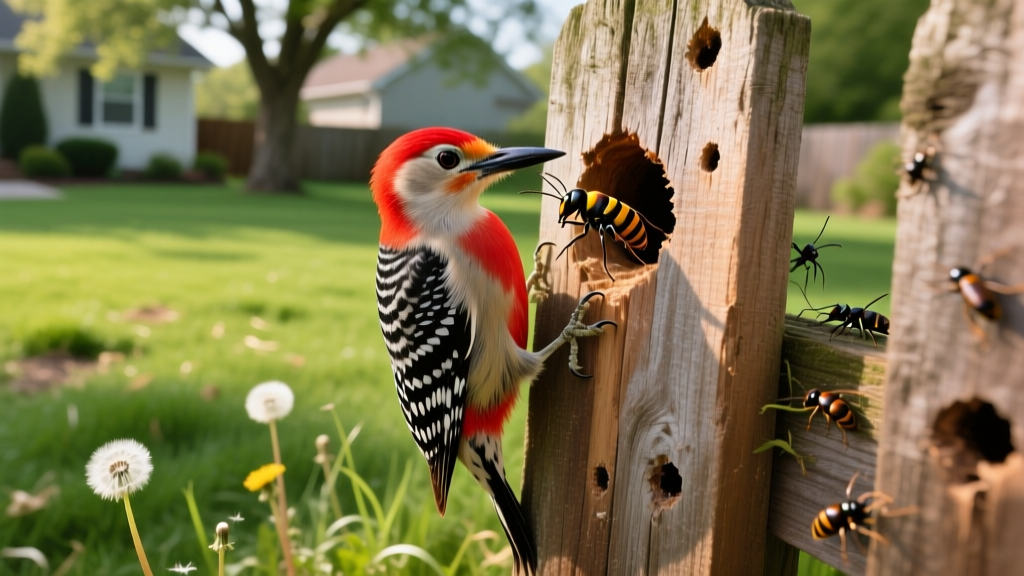
What Eats Carpenter Bees? 7 Natural Predators & Control Tips
The Carpenter Bee Food Web: Friends, Foes, and Wood Damage
Carpenter bees (Xylocopa genus) present a unique paradox for homeowners. As robust native pollinators, they are vital to local ecosystems, yet their nesting habits—boring perfectly circular, half-inch tunnels into untreated wood—can compromise structural integrity over time. When facing an infestation in fascia boards, decks, or eaves, many homeowners naturally wonder: what eats carpenter bees? Understanding the natural predators of Xylocopa virginica (Eastern carpenter bee) and Xylocopa californica (Western carpenter bee) reveals a complex food web. However, relying solely on natural predation often introduces secondary property damage that requires targeted intervention.
Ecological Baseline: Carpenter bees do not eat wood. They excavate it to create brood galleries. The actual diet of adult carpenter bees consists entirely of pollen and nectar, meaning predators are hunting them for protein and fat reserves, not because the bees are consuming the timber.
Avian Predators: The Primary Hunters
Birds are the most significant vertebrate predators of carpenter bees, targeting both the flying adults and the developing larvae hidden inside wood. However, their hunting methods dictate the level of threat to your property.
Woodpeckers and the Secondary Damage Problem
Species like the Downy Woodpecker (Dryobates pubescens), Hairy Woodpecker (Dryobates villosus), and Northern Flicker (Colaptes auratus) possess acute hearing capable of detecting the faint chewing vibrations of carpenter bee larvae deep inside wood galleries. Rather than catching adults in flight, woodpeckers excavate the wood to extract the protein-rich pupae.
Warning: The Woodpecker Multiplier Effect
While a carpenter bee bores a neat 1/2-inch hole, a woodpecker will tear a 2-to-3-inch jagged crater into your fascia or siding to reach the brood cells. According to Penn State Extension, the structural and cosmetic damage caused by woodpeckers foraging for carpenter bee larvae frequently exceeds the original damage caused by the bees themselves.
While a carpenter bee bores a neat 1/2-inch hole, a woodpecker will tear a 2-to-3-inch jagged crater into your fascia or siding to reach the brood cells. According to Penn State Extension, the structural and cosmetic damage caused by woodpeckers foraging for carpenter bee larvae frequently exceeds the original damage caused by the bees themselves.
Shrikes, Flycatchers, and Bee-Eaters
Aerial insectivores hunt adult carpenter bees in flight. The Loggerhead Shrike (Lanius ludovicianus) is particularly notable; it catches large insects and impales them on thorns or barbed wire to cache them. Various flycatchers (Tyrannidae family) will also snatch foraging adults near blooming ornamentals, though they generally prefer smaller, softer-bodied prey due to the carpenter bee's dense exoskeleton and stinger.
Arthropod Predators: Insect vs. Insect
The invertebrate world hosts several specialized hunters that keep adult carpenter bee populations in check without causing any collateral damage to your home's woodwork.
| Predator | Scientific Classification | Hunting Method | Target Life Stage |
|---|---|---|---|
| Robber Flies | Family Asilidae | Mid-air interception; inject paralyzing neurotoxin via proboscis | Foraging Adults |
| Golden Silk Orbweaver | Trichonephila clavipes | Passive web trapping; wraps and envenomates struggling bees | Foraging Adults |
| Praying Mantids | Order Mantodea | Ambush predation on flowers or near nest entrances | Adults & Deutonymphs |
| Crab Spiders | Family Thomisidae | Camouflaged ambush on blossoms where bees forage | Foraging Adults |
Robber flies are arguably the most effective natural control for adult carpenter bees. These aggressive dipterans possess immense flight agility and a stout proboscis capable of piercing the thick cuticle of a carpenter bee, delivering proteolytic enzymes that liquefy the bee's internal tissues. Encouraging robber fly populations by maintaining diverse native flowering borders provides a natural, non-destructive check on bee numbers.
Mammalian and Reptilian Foragers
Ground-dwelling predators primarily target carpenter bees when they are vulnerable. Skunks (Mephitidae) are nocturnal foragers that will scratch at the base of wooden structures or low-hanging eaves at night to extract pupae. In the American Southwest and West, badgers and even black bears may tear into heavy timber or log structures if carpenter bee colonies have established extensive, multi-generational gallery networks. Arboreal lizards, such as the Eastern Fence Lizard (Sceloporus undulatus), will bask near sun-exposed fascia boards and snap up emerging adults in the spring.
The Hidden Threat: Brood Parasites and Parasitoids
The most devastating predators of carpenter bees do not eat the wood, nor do they hunt the adults. Instead, they infiltrate the nest. According to entomologists at the University of Florida IFAS Extension, carpenter bees suffer high rates of brood parasitism.
"Cuckoo bees of the genus Triepeolus are obligate brood parasites of Xylocopa. The female cuckoo bee sneaks into the carpenter bee's gallery while the host is foraging, laying her egg in the host's provisioned cell. Upon hatching, the Triepeolus larva uses specialized mandibles to kill the carpenter bee egg or early-instar larva, then consumes the pollen mass intended for the host."
Additionally, blister beetle larvae (Meloidae) utilize phoresy, hitching a ride on adult carpenter bees to enter the nest, where they consume the bee's egg and pollen provisions. While fascinating biologically, these parasitoids do not solve the homeowner's structural problem, as the adult carpenter bees still bore the initial tunnels before parasitism occurs.
Decision Framework: Natural Predation vs. Active Intervention
Should you rely on the food web to manage your carpenter bee problem? Use this framework to decide your next steps.
- Scenario A: Solitary bees, minimal damage, high predator activity. If you see only 2-3 holes and observe robber flies or shrikes in the area, monitor the situation. Plug inactive holes with steel wool and wood putty in the fall.
- Scenario B: Active woodpecker damage. INTERVENE IMMEDIATELY. If you hear woodpeckers drumming on your eaves, the bees have established a multi-cell gallery. Relying on birds will result in hundreds of dollars in siding repair. You must evict the bees and seal the wood.
- Scenario C: Extensive historical tunneling (10+ holes per board). INTERVENE. Natural predators cannot collapse an established, multi-generational colony fast enough to prevent moisture intrusion and wood rot.
Actionable Wood Protection: Exclusion Without Ecological Harm
If natural predators are insufficient or causing secondary damage, you must protect the wood. Carpenter bees strongly prefer untreated, unpainted, and weathered softwoods (cedar, cypress, pine). They rarely attack painted or pressure-treated wood.
Step 1: Eradicate Active Galleries
Do not seal a hole while a bee or larva is inside; they will simply chew a new exit hole, creating more damage. At dusk, when bees are resting inside, apply a targeted dust insecticide like Delta Dust (deltamethrin) directly into the gallery using a hand duster. Wait 48 hours for the insecticide to take effect.
Step 2: Borate Wood Treatment (The Long-Term Fix)
For unpainted wood where you want to maintain a natural look, apply a disodium octaborate tetrahydrate (DOT) solution. Products like Bora-Care or Tim-bor Professional penetrate deep into the wood cellulose.
- Mix Rate: Combine 1 lb of Tim-bor powder per 1 gallon of water to create a 15% active ingredient solution.
- Application: Apply using a pump sprayer to the point of refusal (when the wood stops absorbing and begins to drip). Typically, this requires 1 gallon per 200 square feet of bare wood.
- Cost Expectation: A 1.5 lb pouch of Tim-bor costs approximately $25-$30, sufficient to treat roughly 300 square feet of fascia or decking.
Borate treatments are highly toxic to wood-destroying insects and fungi but possess very low mammalian toxicity. For deeper chemical safety profiles, refer to the National Pesticide Information Center's borate technical fact sheet.
Step 3: Physical Exclusion
Once galleries are confirmed empty, pack them tightly with copper mesh or steel wool, then seal with a high-quality exterior polyurethane caulk. Finally, apply a coat of 100% acrylic latex exterior paint. Paint forms a physical film that carpenter bees cannot easily chew through, whereas solid wood stains offer virtually zero deterrent value.
Frequently Asked Questions
Do carpenter bees sting predators?
Female carpenter bees possess stingers and will use them if physically handled or trapped, but they are highly docile compared to yellowjackets or honeybees. Males lack stingers entirely but will aggressively "buzz" and hover near intruders (including humans and birds) in a bluffing display to protect the nest perimeter.
Will putting up a birdhouse attract predators to eat the bees?
Attracting insectivorous birds like bluebirds or swallows will marginally increase adult bee predation, but it will not stop females from boring into your home. Furthermore, attracting woodpeckers via suet feeders during a carpenter bee infestation is highly discouraged, as it increases the risk of secondary wood excavation.

