
Pest Control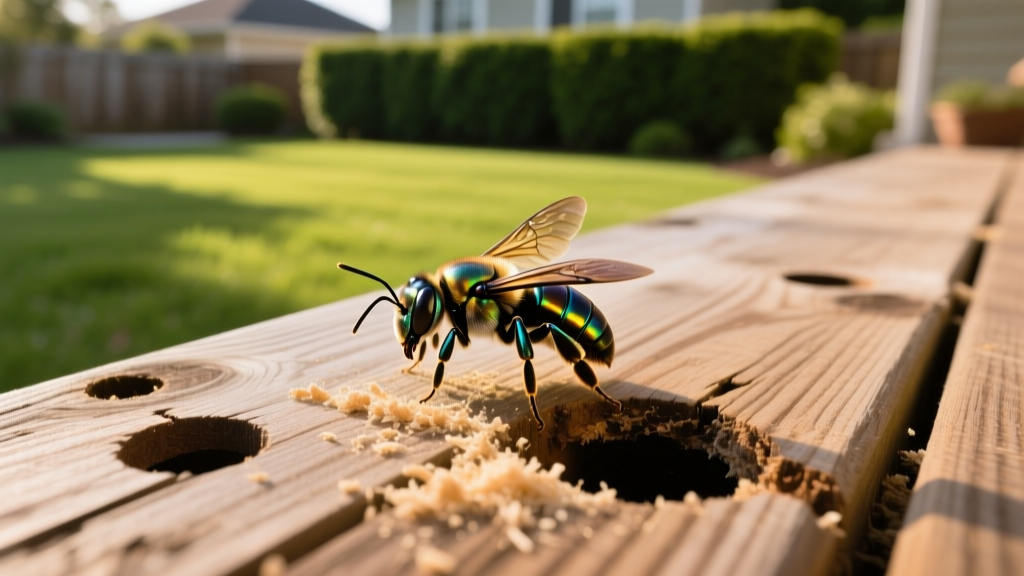
Carpenter Bee Pest Control: Protect Your Deck and Yard Woodwork
The Biology of Wood-Boring Yard Pests
Carpenter bees (Xylocopa species) are large, solitary insects that excavate precise, cylindrical galleries in dead wood to rear their young. Unlike termites or carpenter ants, they do not consume the wood for nutrition; they simply tunnel through it, ejecting coarse sawdust known as frass. In North America, the Eastern carpenter bee (Xylocopa virginica) and the Valley carpenter bee (Xylocopa varipuncta) are the primary culprits for structural damage to residential decks, fascia boards, pergolas, and privacy fences.
While a single tunnel rarely compromises a structural beam, carpenter bees are philopatric—meaning offspring return to the same wood to expand existing galleries year after year. According to University of Kentucky Entomology, a neglected infestation can riddle a 4x4 pine post with dozens of intersecting 6-to-10-inch tunnels over three seasons, leading to moisture intrusion, wood rot, and eventual structural failure.
Identifying the Target: Xylocopa vs. Bombus
Homeowners frequently confuse carpenter bees with bumblebees (Bombus species). Accurate identification is the first step in targeted yard defense.
- Abdomen Texture: Carpenter bees feature a shiny, hairless, metallic black abdomen. Bumblebees are densely covered in fuzzy yellow and black hairs.
- Nesting Behavior: Bumblebees nest underground in abandoned rodent burrows. Carpenter bees nest exclusively in above-ground wooden structures.
- Flight Patterns: Male carpenter bees are highly territorial and will aggressively dive-bomb intruders near their nest sites. However, males lack a stinger. Only the females possess a stinger, and they are generally docile unless physically handled or trapped.
The 1/2-Inch Telltale Sign
The definitive signature of an active infestation is a perfectly circular entry hole measuring exactly 1/2 inch in diameter. The female bores straight in for about an inch, then makes a sharp 90-degree turn to tunnel parallel to the wood grain. Below these entry holes, you will find small, conical piles of pale yellow sawdust (frass) accumulating on the ground or deck surface.
Vulnerability Mapping: Which Yard Structures Are at Risk?
Carpenter bees exhibit strong preferences for specific wood types and finishes. Understanding these preferences allows you to prioritize your yard defense strategy.
High-Risk Materials: Untreated, unpainted softwoods are highly vulnerable. Pine, fir, cypress, redwood, and cedar are the most frequently targeted species. Bare wooden eaves, deck railings, fence posts, and unpainted window trim are prime real estate.
Low-Risk Materials: Pressure-treated wood (infused with copper azole or ACQ preservatives) is largely ignored by carpenter bees due to the chemical taste and hardness. Furthermore, wood that is heavily coated in oil-based or alkyd-based paint is virtually impenetrable to their mandibles. Stained wood, however, offers almost zero protection, as stains do not build a thick physical film.
Active Carpenter Bee Pest Control: Treatment Matrix
When active tunnels are discovered, immediate intervention is required. The choice of insecticide depends on the location of the nest and environmental factors. As of 2026, the following professional-grade and consumer products represent the most effective options on the market.
| Treatment Type | Active Ingredient | Best Use Case | Avg. Cost (2026) | Rainfastness |
|---|---|---|---|---|
| Insecticidal Dust (e.g., Drione, Delta Dust) | Silica Aerogel + Pyrethrins / Deltamethrin | Deep gallery treatment; clings to bee legs and transfers to larvae | $22 - $35 | Excellent (if kept inside hole) |
| Foaming Aerosol (e.g., Spectracide Carpenter Bee Killer) | Prallethrin / Lambda-cyhalothrin | Quick knockdown for shallow, accessible holes on eaves and decks | $7 - $12 | Poor (washes away easily) |
| Microencapsulated Liquid (e.g., Cyzmic CS, Demand CS) | Lambda-cyhalothrin (9.7%) | Residual surface barrier sprayed on fascia boards and raw timber | $35 - $50 | High (binds to wood pores) |
Step-by-Step Eradication Protocol
Spraying a liquid insecticide into a carpenter bee hole is largely ineffective because the liquid will not penetrate the 90-degree bend of the tunnel, nor will it reach the larvae at the back of the gallery. Follow this precise protocol for complete eradication.
- Locate and Mark: Inspect all softwood structures at dusk when the bees are resting inside their tunnels. Mark active holes with a piece of chalk.
- Apply Insecticidal Dust: Use a hand-held bulb duster (like a JT Eaton Duster) filled with Drione Dust or Delta Dust. Insert the nozzle slightly into the 1/2-inch hole and puff a small amount of dust inside. Do not pack the hole with dust; you want a light coating that the bee will walk through.
- Wait 48 to 72 Hours: This is the most critical step. You must allow the foraging female to enter and exit the hole multiple times. As she walks through the dust, it clings to her tarsi (feet) and is tracked deep into the gallery, eventually contacting and killing the developing larvae.
- Plug and Seal: After 3 days, seal the entry hole to prevent future bees from reusing the gallery. Pack a small piece of copper mesh or coarse steel wool into the hole, then seal it flush with the wood surface using an exterior-grade polyurethane caulk or a wooden dowel glued in place with wood glue.
Long-Term Yard Defense and Exclusion
Eradication is only a temporary fix if the wood remains attractive to new scouting females. Penn State Extension recommends physical and chemical exclusion methods to protect your yard infrastructure long-term.
Painting and Coating Strategies
The single most effective preventative measure is painting exposed wood surfaces. A high-build acrylic latex or alkyd-based exterior paint creates a physical barrier that carpenter bees cannot chew through. If you prefer the natural look of wood, you must accept a higher maintenance burden. Apply a penetrating wood preservative containing borates (such as Bora-Care or Timbor) to raw wood before staining. While borates won't entirely deter the bees from drilling, they will kill the larvae that attempt to feed on the wood pulp or fungi growing inside the tunnels.
The Trap Nest Strategy
Because carpenter bees are vital native pollinators, many eco-conscious homeowners prefer to divert them away from their decks rather than kill them.
DIY Trap Nest Instructions:
Cut a 12-inch length of untreated 4x4 pine or cedar. Drill a series of 1/2-inch holes into the sides of the wood, spacing them 2 inches apart. Crucial detail: Drill the holes at a slight upward angle (about 5 to 10 degrees) so that rainwater cannot pool inside the gallery. Paint the front face of the block white or yellow to attract the bees. Hang the block on a fence line at least 50 feet away from your home's eaves and decks. The bees will naturally colonize the pre-drilled holes, sparing your actual structures.
Cut a 12-inch length of untreated 4x4 pine or cedar. Drill a series of 1/2-inch holes into the sides of the wood, spacing them 2 inches apart. Crucial detail: Drill the holes at a slight upward angle (about 5 to 10 degrees) so that rainwater cannot pool inside the gallery. Paint the front face of the block white or yellow to attract the bees. Hang the block on a fence line at least 50 feet away from your home's eaves and decks. The bees will naturally colonize the pre-drilled holes, sparing your actual structures.
Frequently Asked Questions
Do carpenter bees cause as much damage as termites?
No. Termites consume the structural cellulose of wood, leading to rapid and catastrophic failure. Carpenter bees only remove a small volume of wood to create hollow tubes. However, the entry holes allow moisture to penetrate deep into the timber, which accelerates fungal decay and attracts woodpeckers that will tear the wood apart to eat the bee larvae.
Can I use wasp freeze spray on carpenter bees?
Aerosol "wasp freeze" sprays (typically containing Tetramethrin) provide an instant knockdown for adult bees flying outside the hole, but they do not leave a residual effect inside the wood. If you use a freeze spray, you must follow up with an insecticidal dust application inside the hole to eliminate the hidden larvae, otherwise, the next generation will emerge the following spring.
When is the best time of year to treat carpenter bee holes?
The optimal treatment windows are early spring (April to May) when females are actively excavating new nests, and late summer (August to September) when the new generation of adults is preparing to overwinter inside the galleries. Treating in late summer is highly effective because it eliminates the population before they emerge to mate the following year.

