
Pest Control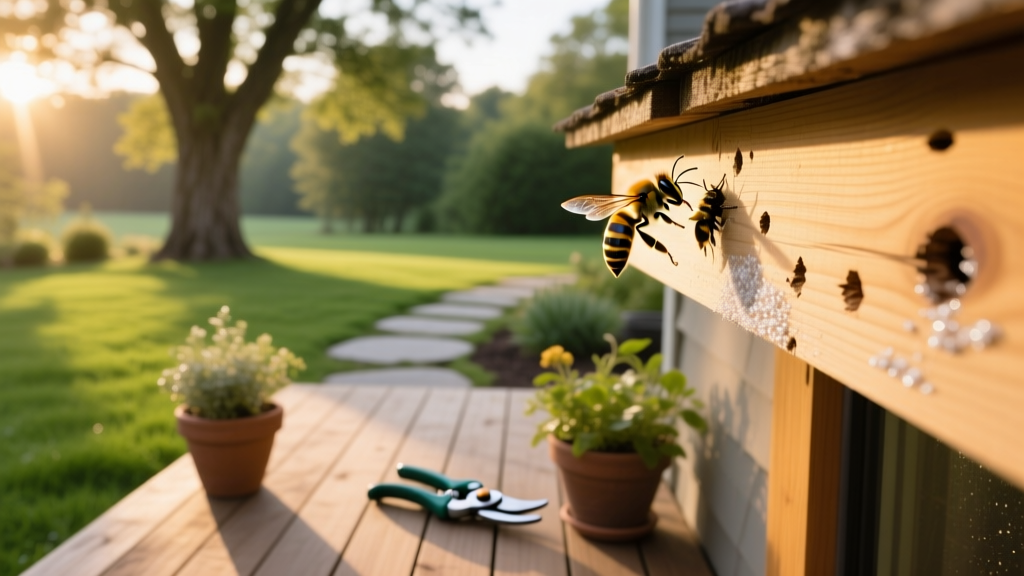
Effective Carpenter Bee Repellent Strategies for Wooden Decks and Eaves
Carpenter bees (genus Xylocopa) are critical pollinators, but their nesting habits make them a formidable threat to residential wooden structures. Unlike termites, these insects do not consume wood for sustenance. Instead, females use their powerful mandibles to excavate perfectly round, 1/2-inch diameter tunnels—often extending 6 to 10 inches deep—to create brood galleries. Over successive seasons, repeated tunneling compromises the structural integrity of eaves, deck railings, fascia boards, and yard furniture, while the resulting wood dust attracts secondary pests like woodpeckers and carpet beetles.
Finding a reliable carpenter bee repellent requires understanding their sensory biology and nesting preferences. Reactive extermination is often ineffective because new bees will quickly colonize abandoned galleries. The most successful yard defense strategies combine olfactory deterrents with physical wood modifications to make your property inherently unappealing to Xylocopa virginica (Eastern carpenter bee) and Xylocopa varipuncta (Valley carpenter bee).
The Biology of Wood Selection: What Attracts Xylocopa?
Carpenter bees exhibit a strong preference for untreated, unpainted, and weathered softwoods. Cedar, redwood, cypress, and pine are prime targets because their softer grain requires less caloric energy to excavate. According to Penn State Extension, weathering breaks down the lignin in wood, making it significantly easier for the bees to chew through. Furthermore, bare wood emits specific volatile organic compounds (VOCs) that signal a suitable nesting environment. Effective repellents work by either masking these VOCs or introducing scents that trigger avoidance behaviors in the bees' olfactory receptors.
Carpenter Bee Repellent Methods: Comparison Matrix
Not all repellents are created equal. Below is a breakdown of the most effective deterrent categories, their active mechanisms, and real-world cost estimates for a standard 2,000 sq. ft. home perimeter.
| Repellent Type | Active Mechanism | Durability | Best Application Scenario | Est. Cost |
|---|---|---|---|---|
| Almond Oil (Benzaldehyde) | Olfactory masking & sensory irritation | 3-4 weeks | Eaves, window trim, fascia boards | $18 - $25 |
| Citrus Oil (d-limonene) | Repellent scent & mild insecticidal properties | 2-3 weeks | Deck railings, outdoor furniture | $15 - $22 |
| Exterior Latex Paint | Physical barrier & VOC sealing | 5-10 years | Siding, soffits, structural beams | $45 - $65 / gal |
| Polyurethane Sealant | Physical barrier & gallery blocking | 1-3 years | Active hole remediation, joints | $8 - $12 / tube |
| Borate Wood Preservative | Toxic ingestion deterrent | Permanent (if sealed) | New construction, raw lumber prep | $30 - $45 / gal |
Step-by-Step: Applying Liquid Olfactory Repellents
Liquid repellents are your first line of defense in early spring, typically when soil temperatures consistently reach 60°F and overwintered females emerge to seek nesting sites. Almond oil and citrus oil are the two most scientifically validated natural repellents for carpenter bees.
1. The Almond Oil Formulation
Bitter almond oil contains benzaldehyde, a compound that carpenter bees find highly aversive. Do not use synthetic baking extracts; you need pure, cold-pressed bitter almond oil or a commercially formulated botanical insect repellent containing benzaldehyde.
- Mixing Ratio: Combine 1 part pure almond oil with 3 parts water.
- Emulsifier: Add 1 teaspoon of mild liquid dish soap per quart of mixture to bind the oil and water.
- Application: Spray generously on unpainted eaves, fascia boards, and the underside of deck railings using a pump sprayer.
- Reapplication: Reapply every 21 days during the peak mating season (April through June).
2. The Citrus Oil Boil (DIY d-limonene)
d-limonene, extracted from citrus peels, disrupts the bees' sensory navigation. While commercial d-limonene sprays exist, a concentrated DIY boil is highly effective for localized yard defense.
- Boil the peels of 4-5 lemons or oranges in 2 cups of water for 15 minutes.
- Allow the mixture to cool and strain out the peels.
- Transfer to a spray bottle and apply directly to wooden patio furniture and pergola joints.
⚠️ Warning: Staining Risks
Both almond and citrus oils can leave a slight residue or darken raw, highly porous woods like untreated pine. Always test your repellent mixture on a hidden 2x2 inch section of the wood 24 hours before full application to ensure it does not compromise the aesthetic finish.
Both almond and citrus oils can leave a slight residue or darken raw, highly porous woods like untreated pine. Always test your repellent mixture on a hidden 2x2 inch section of the wood 24 hours before full application to ensure it does not compromise the aesthetic finish.
Physical Deterrents: The Long-Term Structural Fix
While olfactory repellents buy you time during peak season, modifying the wood itself provides permanent protection. The University of Kentucky Entomology department notes that carpenter bees rarely attack painted or heavily varnished wood because the physical barrier prevents them from gripping and chewing the surface.
Paint vs. Stain: The Efficacy Gap
Many homeowners rely on semi-transparent deck stains to protect their wood, assuming it deters boring insects. This is a critical error. Stains penetrate the wood but do not form a surface film. Carpenter bees can easily chew through stained wood. Exterior latex paint, however, forms a thick, impenetrable polymer film. If painting is not aesthetically viable for your deck, opt for a heavy-duty, film-forming clear polyurethane spar varnish (e.g., Minwax Helmsman) applied in at least three coats.
Expert Troubleshooting: Remediating Active Bore Holes
If you discover existing 1/2-inch holes with coarse sawdust (frass) accumulating below them, repellents alone will not solve the problem. You must physically evict the occupant and seal the gallery to prevent future generations from expanding the tunnel.
The 3-Step Plugging Protocol
- Treat the Gallery (Nighttime): Wait until dusk or after dark when the bees are inactive inside the nest. Apply a targeted insecticidal dust (such as Delta Dust containing deltamethrin) directly into the hole using a hand duster. Do not use liquid sprays, as they will soak into the wood and fail to reach the deep brood cells.
- Insert a Physical Plug: Wait 48 hours to ensure the nest is neutralized. Cut a small piece of 1/2-inch copper mesh (hardware cloth) or coarse steel wool and push it tightly into the hole. This prevents woodpeckers from tearing the wood open to eat the larvae and stops future bees from reusing the tunnel.
- Seal and Camouflage: Fill the remaining cavity with an exterior-grade, paintable polyurethane sealant (e.g., Loctite PL Premium or Gorilla Wood Filler). Smooth it flush with the surface using a putty knife, and touch up with exterior paint once cured.
💡 Pro-Tip: Decoy Traps vs. Repellents
Carpenter bee decoy traps (wooden boxes with pre-drilled holes leading to a plastic bottle) are often marketed as repellents. They are actually traps. They work on the biological principle that carpenter bees avoid areas with high existing populations due to resource competition. Hang traps 20-30 feet away from your house to draw bees away from your eaves, rather than hanging them directly on the structure you are trying to protect.
Carpenter bee decoy traps (wooden boxes with pre-drilled holes leading to a plastic bottle) are often marketed as repellents. They are actually traps. They work on the biological principle that carpenter bees avoid areas with high existing populations due to resource competition. Hang traps 20-30 feet away from your house to draw bees away from your eaves, rather than hanging them directly on the structure you are trying to protect.
Seasonal Yard Defense Calendar
Timing is everything in insect management. Align your carpenter bee defense with their biological clock to maximize the efficacy of your repellents and physical barriers.
- Early Spring (March - April): Inspect all wooden structures for old, unplugged holes. Plug them immediately before overwintered females emerge. Apply the first round of almond or citrus oil repellent to vulnerable eaves.
- Peak Mating Season (May - June): Reapply liquid repellents every 21 days. Monitor deck railings and pergolas for fresh frass. Deploy decoy traps at the perimeter of the property.
- Late Summer (August - September): A second, smaller generation often emerges. Maintain repellent applications on highly exposed, sun-baked wood, which is most attractive to late-season foragers.
- Winter (November - February): Perform structural maintenance. Sand down weathered wood, apply borate preservatives to raw lumber, and paint or varnish exposed surfaces before the spring emergence.
Summary: Your Carpenter Bee Defense Arsenal
Successfully defending your yard from carpenter bees requires a layered approach. Use almond or citrus oil repellents for seasonal, non-toxic deterrence on sensitive wood. Rely on exterior paint or polyurethane varnish for permanent, long-term physical barriers. Finally, always plug existing holes with copper mesh and polyurethane sealant to break the generational cycle of wood-boring. By combining olfactory masking with structural modification, you can preserve your wooden assets without harming these vital native pollinators.

