
Pest Control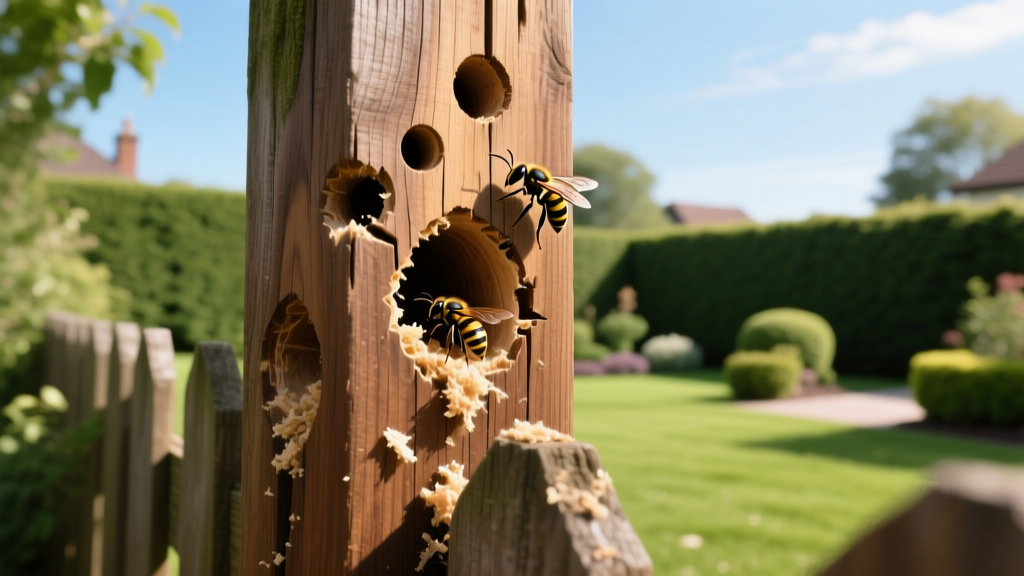
Carpenter Bees Fence Defense: Protecting Wood Posts
The Anatomy of a Carpenter Bee Fence Invasion
Eastern carpenter bees (Xylocopa virginica) are large, solitary insects that cause significant structural and aesthetic damage to untreated wooden fences, pergolas, and deck railings. Unlike termites or carpenter ants, carpenter bees do not consume wood for nutrition. Instead, female bees use their robust mandibles to excavate perfectly round, 1/2-inch diameter entrance holes into softwoods and hardwoods to create nesting galleries. These tunnels typically extend 1 to 2 inches inward before turning at a right angle to follow the wood grain, often reaching lengths of 6 to 10 inches.
Warning: The Bumblebee Lookalike
Carpenter bees are frequently mistaken for bumblebees. However, bumblebees have fuzzy, yellow-and-black hairy abdomens and nest exclusively in the ground. Carpenter bees have shiny, hairless, black abdomens and bore into wood. Never treat ground-dwelling bumblebee nests with wood-borer insecticides, as native bumblebees are crucial, protected pollinators.
Carpenter bees are frequently mistaken for bumblebees. However, bumblebees have fuzzy, yellow-and-black hairy abdomens and nest exclusively in the ground. Carpenter bees have shiny, hairless, black abdomens and bore into wood. Never treat ground-dwelling bumblebee nests with wood-borer insecticides, as native bumblebees are crucial, protected pollinators.
The primary indicator of an active infestation on your fence is the presence of coarse, sawdust-like excrement known as frass accumulating on the ground or fence rails directly beneath the entrance holes. Over successive seasons, offspring will reuse and expand these galleries, compromising the structural integrity of 4x4 fence posts and accelerating wood rot by exposing the untreated inner heartwood to moisture.
Step-by-Step Fence Inspection and Damage Assessment
Before applying any treatment, conduct a thorough inspection of your fence line during peak activity months (typically April through June, with a secondary peak in late summer). Focus on unpainted, weathered surfaces, particularly the top caps of fence posts, the undersides of horizontal rails, and the fascia boards of adjacent structures.
Identifying Active vs. Abandoned Galleries
- Active Galleries: Look for fresh, light-colored frass piles, yellowish-brown fecal staining directly below the hole, and audible buzzing or scratching sounds from within the wood when the sun is warm.
- Abandoned Galleries: Holes with darkened, weathered edges, spider webs across the opening, and no frass accumulation indicate the nest is vacant. These must still be sealed to prevent future overwintering bees from reclaiming them.
Treatment Matrix: Active Nest Eradication
When dealing with active nests, surface sprays are largely ineffective because the insecticide fails to penetrate deep into the winding galleries. Insecticidal dusts and specialized foams are the industry standard for eradicating larvae and adult bees inside the wood. Below is a comparison of the most effective professional-grade products available to homeowners in 2026.
| Product Type | Active Ingredient | Best Application | Avg. Cost (2026) |
|---|---|---|---|
| Insecticidal Dust | Deltamethrin (Delta Dust) | Deep, moisture-prone galleries | $28 / 1 lb |
| Desiccant Dust | Silica Aerogel + Pyrethrin (Drione) | Dry, hidden voids and eaves | $35 / 1 lb |
| Aerosol Foam | Imidacloprid / Prallethrin | Quick knockdown, shallow voids | $9 / 14 oz can |
| Microencapsulated Spray | Lambda-cyhalothrin (Cyzmic CS) | Surface barrier, fence rails | $45 / 8 oz bottle |
The 48-Hour Rule: Properly Plugging Galleries
A common and costly mistake homeowners make is sealing the entrance hole immediately after applying insecticide. According to NC State Extension entomologists, plugging the hole too soon traps the foraging adult bee outside, forcing it to simply bore a brand-new entrance hole a few inches away, rendering your treatment useless.
The Correct Plugging Protocol
- Apply Dust: Use a specialized bulb duster or a flexible straw to puff a small amount (about 1/4 teaspoon) of Delta Dust or Drione deep into the gallery. Do not overfill; the goal is to coat the walls, not pack the tunnel.
- Wait 48 to 72 Hours: Leave the hole completely open. This allows the adult bee to enter, track the dust deep into the nesting cells, and spread it to the developing larvae.
- Insert a Dowel: Cut a 1/2-inch wooden dowel to a 2-inch length. Coat the dowel in an exterior-grade waterproof wood glue (such as Titebond III) and tap it firmly into the hole with a rubber mallet.
- Seal and Paint: Once the glue sets, cap the remaining gap with a two-part exterior wood filler like Bondo Wood Filler ($12 per tub). Sand it flush once cured, and immediately prime and paint the patch to prevent moisture intrusion.
Long-Term Prevention: Coatings That Actually Deter Bees
Carpenter bees strongly prefer bare, weathered, or unpainted wood. While no coating is 100% bee-proof, creating a hard, non-porous surface drastically reduces excavation attempts. The choice of finish dictates your fence's vulnerability.
Paint vs. Stain vs. Polyurethane
100% Acrylic Latex Paint: This is the gold standard for carpenter bee prevention. A high-build exterior paint like Sherwin-Williams Duration ($95 per gallon) creates a thick, flexible polymer shell that bees find extremely difficult to chew through. Opaque, solid-color stains (e.g., Cabot Solid Color Acrylic, $55 per gallon) offer moderate protection but will eventually wear thin on horizontal surfaces, requiring annual reapplication.
Transparent and Semi-Transparent Stains: These products penetrate the wood but leave the surface grain exposed and relatively soft. According to Penn State Extension, penetrating oils and clear stains provide virtually zero deterrent effect against determined carpenter bees. If you prefer the natural wood look, you must use a marine-grade spar urethane.
Spar Urethane: Products like Minwax Helmsman Spar Urethane ($40 per gallon) contain UV blockers and flexible resins that build a hard, glossy film over the wood. Apply a minimum of three coats to all fence post caps and horizontal rails, paying special attention to the end-grain, which acts like a bundle of straws drawing moisture and inviting bee excavation.
Pro-Tip: Aluminum Post Caps
If you are installing a new wood fence or replacing rotted posts, install flat or pyramid aluminum post caps (approx. $8 to $15 each) over the 4x4 or 6x6 vertical posts. Since the top end-grain is the most common entry point for carpenter bees and water, capping them with metal permanently eliminates the primary vulnerability without requiring annual chemical treatments.
If you are installing a new wood fence or replacing rotted posts, install flat or pyramid aluminum post caps (approx. $8 to $15 each) over the 4x4 or 6x6 vertical posts. Since the top end-grain is the most common entry point for carpenter bees and water, capping them with metal permanently eliminates the primary vulnerability without requiring annual chemical treatments.
Ecological Considerations and Pollinator Safety
While carpenter bees cause cosmetic and structural damage to fences, they are native, highly effective pollinators for gardens, particularly for crops like tomatoes, eggplants, and peppers, which require 'buzz pollination' to release their pollen. When managing a carpenter bee fence infestation, adopt a targeted approach rather than broadcasting broad-spectrum insecticides across your yard.
Restrict insecticidal dust applications strictly to the interior of the gallery holes. Avoid spraying liquid residual insecticides like Cyzmic CS on the faces of fence boards near flowering garden beds, as these microencapsulated formulas can be picked up by foraging bees and transported back to non-target colonies. By combining targeted gallery dusting, meticulous hole plugging, and high-build opaque coatings, you can protect your wooden infrastructure while preserving the local pollinator population essential for a thriving landscape.

