
Pest Control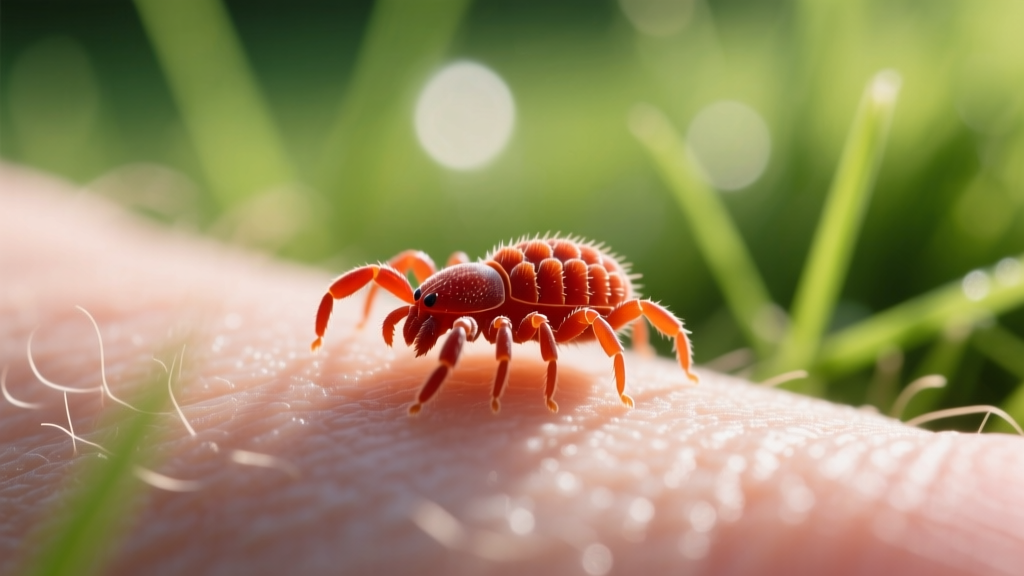
What Does a Chigger Look Like? Identification & Bite Guide
The Microscopic Reality: What Does a Chigger Look Like?
When homeowners ask, "what does a chigger look like," they are usually trying to spot the pest responsible for the intensely itchy welts on their ankles and waistlines. The most critical fact to understand is that the chiggers you encounter in your yard are virtually invisible to the naked eye. Chiggers are not insects; they are the larval stage of trombiculid mites (arachnids).
Under a 40x macro lens, a chigger larva presents as a tiny, velvety, bright red to reddish-orange organism. Because they measure only 0.17 to 0.21 millimeters in length (roughly 1/150th of an inch), they appear as microscopic, moving specks of red dust on your skin or clothing. Unlike adult mites and ticks, which possess eight legs, the biting larval stage of the chigger has only six legs. Their bodies are oval-shaped and densely covered in microscopic bristles called setae, which give them a fuzzy, velvet-like texture under magnification.
⚠ The "Red Bug" Misconception: Many people refer to chiggers as "red bugs" and assume they can see them crawling on their skin. If you can clearly see a red, eight-legged mite crawling on you, you are likely looking at a harmless clover mite or a predatory velvet mite, not a biting chigger larva. True chiggers are too small to be seen without optical aid.
Chigger vs. Tick vs. Flea: Visual Identification Matrix
Misidentifying yard pests leads to ineffective chemical applications. Use this diagnostic matrix to differentiate chiggers from other common lawn parasites before selecting a treatment protocol.
| Feature | Chigger (Larva) | Deer Tick (Nymph) | Cat Flea (Adult) |
|---|---|---|---|
| Size | 0.17 - 0.21 mm | 1.0 - 2.0 mm | 1.5 - 3.0 mm |
| Leg Count | 6 legs | 8 legs | 6 legs |
| Color | Bright red/orange | Translucent brown | Dark mahogany/black |
| Body Shape | Oval, fuzzy/bristled | Flat, teardrop | Laterally flattened |
| Mobility | Slow crawl | Slow crawl | Rapid jump (up to 8 inches) |
For authoritative taxonomic breakdowns of these mites, the Texas A&M AgriLife Extension provides excellent micro-photography and lifecycle data confirming that only the six-legged larval stage feeds on vertebrate hosts.
The Bite Mechanism: Identifying Chigger Damage on Skin
Understanding what a chigger bite looks like requires understanding how they feed. A pervasive myth is that chiggers burrow under the skin and drink blood. This is biologically false. Chiggers do not burrow, nor do they consume blood.
The Stylostome Formation
When a chigger larva locates a pore or hair follicle, it attaches its mouthparts to the epidermis and injects digestive saliva containing powerful proteolytic enzymes. These enzymes liquefy the surrounding skin cells. In response, the human immune system hardens the surrounding tissue, forming a microscopic, tube-like structure called a stylostome. The chigger uses this stylostome as a straw to suck up the liquefied skin tissue.
The visual progression of a chigger bite follows a distinct timeline:
- Hours 1-3: No visible mark. Intense, localized pruritus (itching) begins as the enzymes break down tissue.
- Hours 4-12: A raised, red papule (bump) forms, often with a central pinpoint vesicle (blister) where the stylostome is located.
- Days 1-3: Bites cluster in groups of 3 to 10. The central vesicle may become pustular if scratched.
- Days 4-14: The lesions slowly flatten and fade, leaving hyperpigmented spots that can last for weeks.
Anatomical Target Zones
Chiggers lack the mouthpart strength to pierce thick skin. They migrate upward from the soil until they encounter a physical barrier where clothing fits tightly against the body, trapping them. Consequently, bites are almost exclusively clustered around:
- The ankle line (where socks meet skin)
- Behind the knees (popliteal fossa)
- The groin and upper thighs
- The waistline (belt or underwear elastic lines)
Proven Yard Treatment & Prevention Protocols
Because chiggers thrive in humid, shaded microclimates with overgrown vegetation, eradication requires a dual approach: environmental modification and targeted chemical barriers.
Environmental Moisture Control
Chiggers require high relative humidity at the soil level to prevent desiccation. Modify your lawn care practices to disrupt their habitat:
- Mowing Height: Maintain turf at 3.0 to 4.0 inches. Scalping the lawn below 2.5 inches stresses the grass, while letting it grow past 5 inches traps the ground-level moisture chiggers need to survive.
- Canopy Thinning: Prune lower tree branches to allow direct UV penetration to the soil surface. Chiggers cannot survive in areas receiving more than 4 hours of direct, unfiltered sunlight daily.
- Thatch Reduction: Core aerate and dethatch lawns exceeding 0.5 inches of thatch buildup, as this layer acts as an incubator for mite eggs.
Chemical Barrier Application
For active infestations, rely on synthetic pyrethroids, which offer rapid knockdown and residual control. According to guidelines published by Clemson University Cooperative Extension, perimeter spraying is highly effective when timed correctly.
💡 Professional-Grade Application Recipe:
Use a Bifenthrin 7.9% EC formulation (such as Talstar P). Mix 0.5 to 1.0 fluid ounces per gallon of water. This mixture treats 1,000 square feet. Apply using a pump sprayer equipped with a fan-nozzle tip to ensure coverage on the lower 3 inches of grass blades and the thatch layer. Apply in late spring when soil temperatures consistently exceed 65°F. Cost: Approximately $45 for a 3/4 gallon jug, yielding over 14,000 sq ft of coverage.
Use a Bifenthrin 7.9% EC formulation (such as Talstar P). Mix 0.5 to 1.0 fluid ounces per gallon of water. This mixture treats 1,000 square feet. Apply using a pump sprayer equipped with a fan-nozzle tip to ensure coverage on the lower 3 inches of grass blades and the thatch layer. Apply in late spring when soil temperatures consistently exceed 65°F. Cost: Approximately $45 for a 3/4 gallon jug, yielding over 14,000 sq ft of coverage.
Personal Protection: Permethrin Treated Clothing
DEET (N,N-Diethyl-meta-toluamide) at 25% concentration will repel chiggers from exposed skin, but it degrades rapidly in high heat and sweat. The superior defense is Permethrin 0.5% (e.g., Sawyer Products Premium Insect Repellent). Spray permethrin directly onto clothing, socks, and shoes. Allow it to dry for 24 hours. Once cured, permethrin binds to fabric fibers and remains effective through 6 wash cycles, acting as a neurotoxin to any chigger that contacts the fabric.
Expert FAQ: Clearing Up Chigger Myths
Myth: You should paint nail polish over a chigger bite to suffocate it.
Fact: This is a dangerous and ineffective folk remedy. Because chiggers do not burrow under the skin, there is nothing to suffocate. Applying clear nail polish, rubbing alcohol, or bleach to the bite only causes contact dermatitis, compounding the tissue damage and increasing the risk of secondary staphylococcal infection. Treat the itch with 1% hydrocortisone cream and oral antihistamines (like Cetirizine 10mg) instead.
Myth: Chiggers fall from trees onto passing hikers.
Fact: Chiggers are ground-dwelling. They climb to the top of grass blades or low-lying shrubbery (rarely higher than 8 inches off the ground) and wait for a host to brush past. If you are getting bites on your neck or shoulders, you are likely dealing with bird mites or mosquitoes, not chiggers.
Summary Checklist for Homeowners
- Identify: Look for 6-legged, microscopic red specks; confirm by clustered bites at clothing constriction points.
- Prevent: Treat clothing with 0.5% Permethrin; keep lawn mowed to 3-4 inches.
- Treat Yard: Apply Bifenthrin 7.9% at 1 oz per 1,000 sq ft in shaded, humid perimeter zones.
- Treat Skin: Wash immediately with hot, soapy water; apply hydrocortisone. Never use nail polish.

