
Pest Control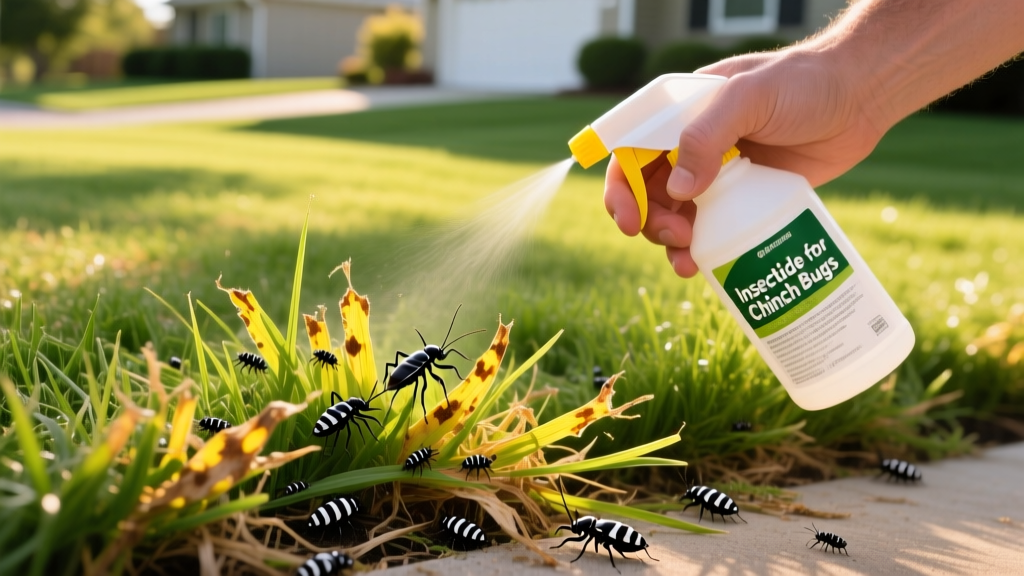
Insecticide for Chinch Bugs: Dosage, Coverage & Cost Guide
The True Cost of Chinch Bug Damage vs. Treatment
Chinch bugs (Blissus spp.) are among the most destructive turfgrass pests in North America. By piercing grass blades and injecting a salivary toxin that blocks water transport, they cause rapid, irreversible necrosis that mimics drought stress. Untreated, a severe infestation can destroy a 5,000-square-foot St. Augustine or Bermudagrass lawn in under three weeks during peak summer temperatures. Replacing dead sod costs between $0.80 and $1.50 per square foot, meaning a total lawn replacement could exceed $6,500. In stark contrast, a targeted, properly dosed chemical intervention costs a fraction of that amount. This guide provides the exact dosage calculations, product comparisons, and cost breakdowns required to select the right insecticide for chinch bugs and apply it without waste or failure.
Data Highlight: The Economic Threshold
University extension programs recommend treatment when populations exceed 15 to 20 chinch bugs per square foot. At this density, the cost of DIY liquid treatment averages $0.12 to $0.18 per 1,000 square feet, while professional application ranges from $4.50 to $8.00 per 1,000 square feet. Early intervention preserves the root system and avoids costly reseeding or sodding.
University extension programs recommend treatment when populations exceed 15 to 20 chinch bugs per square foot. At this density, the cost of DIY liquid treatment averages $0.12 to $0.18 per 1,000 square feet, while professional application ranges from $4.50 to $8.00 per 1,000 square feet. Early intervention preserves the root system and avoids costly reseeding or sodding.
Active Ingredient Efficacy & Product Matrix
Selecting an insecticide requires understanding the active ingredient (AI) and its mode of action. Pyrethroids (like bifenthrin) provide rapid knockdown but are contact-based. Neonicotinoids (like imidacloprid or clothianidin) offer systemic protection but take longer to act. According to turfgrass entomologists at the University of Florida IFAS, rotating chemical classes is critical due to documented pyrethroid resistance in Southern chinch bug populations.
| Product Name | Active Ingredient | Type | Rate per 1,000 sq ft | Est. Cost per 1,000 sq ft |
|---|---|---|---|---|
| Talstar P | Bifenthrin (7.9%) | Liquid Concentrate | 0.5 - 1.0 fl oz | $0.15 |
| Bifen XTS | Bifenthrin (25.1%) | Liquid Concentrate | 0.15 fl oz | $0.12 |
| Arena 50 WDG | Clothianidin (50%) | Water Dispersible Granule | 0.04 oz (1.1 g) | $0.45 |
| Scotts BugClear | Lambda-cyhalothrin (0.115%) | Granular | 2.5 lbs | $6.25 |
Calculating Your Exact Dosage and Coverage
The most common cause of treatment failure is under-dosing, which accelerates pesticide resistance, or over-dosing, which wastes money and harms the environment. The Environmental Protection Agency (EPA) mandates strict adherence to label rates. Here is the precise framework for calculating your tank mix.
Step 1: Determine Your Lawn's True Square Footage
Do not rely on property lot size. Subtract the footprint of your home, driveway, patios, and garden beds. A standard suburban lot of 10,000 sq ft typically yields only 5,000 to 6,000 sq ft of actual treatable turfgrass.
Step 2: Calibrate Your Sprayer Output
Liquid insecticides for chinch bugs must be applied with enough water to penetrate the thatch layer and reach the soil surface, but the amount of chemical is tied to the area, not the water volume. To calibrate:
- Mark a 1,000 sq ft test area (e.g., 20 ft x 50 ft).
- Fill your sprayer with plain water and spray the test area at your normal walking pace and pressure.
- Measure how much water was required to cover that 1,000 sq ft. Most lawns require between 1.5 and 2.0 gallons of carrier water per 1,000 sq ft to reach the crown.
Step 3: The Tank Mix Formula
Master Formula:
(Target Rate in oz per 1,000 sq ft) × (Total Lawn Sq Ft ÷ 1,000) = Total Ounces of Insecticide Needed.
Example: You have 5,500 sq ft of St. Augustine grass. You are using Talstar P at the maximum label rate of 1.0 fl oz per 1,000 sq ft.
1.0 oz × (5,500 ÷ 1,000) = 5.5 fl oz of Talstar P.
If your sprayer outputs 2 gallons per 1,000 sq ft, you will mix 5.5 oz of Talstar P into 11 gallons of water to cover the entire lawn evenly.
(Target Rate in oz per 1,000 sq ft) × (Total Lawn Sq Ft ÷ 1,000) = Total Ounces of Insecticide Needed.
Example: You have 5,500 sq ft of St. Augustine grass. You are using Talstar P at the maximum label rate of 1.0 fl oz per 1,000 sq ft.
1.0 oz × (5,500 ÷ 1,000) = 5.5 fl oz of Talstar P.
If your sprayer outputs 2 gallons per 1,000 sq ft, you will mix 5.5 oz of Talstar P into 11 gallons of water to cover the entire lawn evenly.
Cost Breakdown: DIY vs. Professional Application
When budgeting for chinch bug eradication, homeowners must weigh the upfront cost of equipment and chemicals against the convenience and warranty of professional pest control. According to turf management data from Texas A&M AgriLife Extension, DIY liquid applications offer the highest return on investment for recurring summer infestations.
| Application Method | Initial Setup Cost | Cost per Application (5k sq ft) | Pros & Cons |
|---|---|---|---|
| DIY Liquid Concentrate | $80 - $150 (Pump Sprayer) | $0.75 - $1.50 | Highest efficacy; requires calibration and physical labor. |
| DIY Granular | $30 - $50 (Spreader) | $30.00 - $45.00 | Easy to apply; much higher chemical cost; requires heavy watering. |
| Professional Service | $0 | $25.00 - $45.00 | Zero labor; includes commercial-grade surfactants and guarantees. |
Critical Application Protocols to Prevent Treatment Failure
Even the most expensive insecticide for chinch bugs will fail if environmental barriers prevent the active ingredient from reaching the target zone. Chinch bugs reside in the thatch layer and at the soil crown, not on the upper leaf canopy.
WARNING: The Thatch Barrier
If your lawn has a thatch layer thicker than 0.5 inches, liquid pyrethroids will bind to the organic matter and never reach the soil surface where nymphs are feeding. You must perform core aeration or mechanical dethatching before applying liquid insecticides. Alternatively, use a high-quality non-ionic surfactant (at 0.25% v/v) to break the surface tension and drive the chemical through the thatch mat.
If your lawn has a thatch layer thicker than 0.5 inches, liquid pyrethroids will bind to the organic matter and never reach the soil surface where nymphs are feeding. You must perform core aeration or mechanical dethatching before applying liquid insecticides. Alternatively, use a high-quality non-ionic surfactant (at 0.25% v/v) to break the surface tension and drive the chemical through the thatch mat.
Managing Pyrethroid Resistance
In regions like South Florida and the Gulf Coast, Southern chinch bugs have developed severe genetic resistance to bifenthrin and lambda-cyhalothrin. If you have applied Talstar P or Bifen XTS and the bugs persist after 48 hours, you are likely dealing with a resistant population. You must immediately rotate to a different mode of action (IRAC Group), such as:
- Neonicotinoids: Clothianidin (Arena) or Imidacloprid (Merit). These are systemic and absorbed by the grass roots, killing bugs when they feed.
- Diamides: Chlorantraniliprole (Acelepryn). Highly effective, safe for pollinators, and excellent for rotation management.
- Insect Growth Regulators (IGRs): Pyriproxyfen (Distance). Stops nymphs from molting into reproducing adults.
Watering and Timing Rules
Granular insecticides must be watered in immediately with 0.25 to 0.5 inches of irrigation to wash the active ingredient off the grass blades and into the thatch/soil interface. Liquid contact insecticides should be applied in the early morning or late evening. Applying pyrethroids during peak midday heat (above 85°F) can cause phytotoxicity (leaf burn) and rapid UV degradation of the chemical.
Frequently Asked Questions
How do I confirm I have chinch bugs and not drought stress?
Perform a soapy water flush test. Mix 2 tablespoons of lemon-scented dish soap into 2 gallons of water. Pour this mixture over a 2-square-foot area at the margin of the damaged turf (the border between green and brown grass). Wait 5 minutes. If chinch bugs are present, they will float to the surface. If fewer than 5 bugs emerge, the damage is likely environmental or fungal. If 15+ emerge, chemical intervention is required.
Can I mix insecticide with liquid fertilizer?
Generally, no. Mixing liquid nitrogen fertilizers with pyrethroid insecticides in the same tank can alter the pH and cause the chemical to break down prematurely or cause severe turf burn. Always apply insecticides in plain water, and wait at least 7 days before applying liquid foliar fertilizers.
Will treating for chinch bugs also kill my grubs?
Standard contact insecticides like bifenthrin do not penetrate deep enough to kill soil-dwelling grubs. If you need dual control, you must use a combination product that includes a systemic neonicotinoid (like imidacloprid or clothianidin) paired with a pyrethroid, such as Allectus SC.

