
Pest Control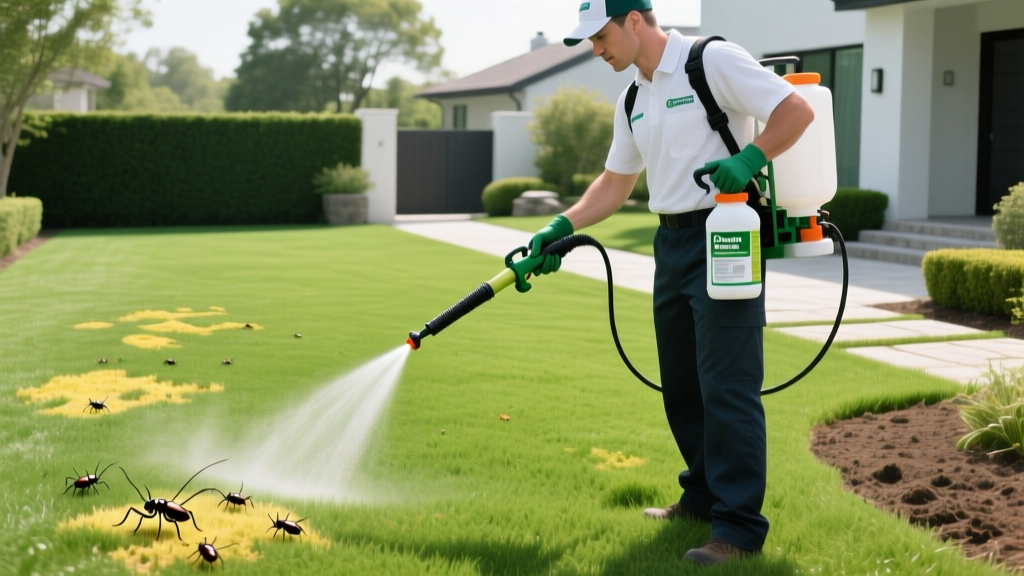
Chinch Bug Killer Dosage, Coverage & Cost Guide 2026
The Biology of the Damage: Why Dosage Precision Matters
Southern chinch bugs (Blissus insularis) are the most destructive insect pests of St. Augustine grass, though they also heavily target Zoysia, Centipede, and Bermuda varieties. Unlike grub worms that chew on roots, chinch bugs pierce grass stolons with their mouthparts, suck out plant juices, and inject a toxic saliva that blocks water transport. This causes rapid, localized yellowing that quickly turns into dead, sunken brown patches.
Because chinch bugs live and reproduce in the thatch layer—the spongy organic matter between the soil and the grass blades—surface-level applications often fail. The insecticide must penetrate the thatch and reach the soil surface. According to University of Florida IFAS extension guidelines, achieving the correct water volume during application is just as critical as the chemical dosage itself to ensure the active ingredient reaches the target zone.
⚠️ Critical Warning: The Pyrethroid Resistance Crisis
If you live in South Florida, Texas, or the Gulf Coast, standard over-the-counter pyrethroid sprays (like basic Bifenthrin or Lambda-cyhalothrin) may fail completely. Texas A&M AgriLife Extension and UF/IFAS have documented severe genetic resistance to pyrethroids in regional chinch bug populations. If your first liquid spray fails to reduce the population within 48 hours, do not reapply the same chemical. You must rotate to a neonicotinoid (like Imidacloprid or Clothianidin) or a combination product (e.g., Allectus) to break the resistance cycle.
Active Ingredient Breakdown & Dosage Matrix
Selecting the right chinch bug killer depends on whether you need a fast-acting curative treatment (to kill an active infestation) or a long-residual preventive treatment (to stop nymphs from maturing). Below is the precise dosage and coverage matrix for professional-grade and consumer-available active ingredients.
| Active Ingredient | Product Example | Type | Dosage per 1,000 sq ft | Water Volume Required |
|---|---|---|---|---|
| Bifenthrin (7.9%) | Talstar P | Curative (Liquid) | 0.5 - 1.0 fl oz | 2 - 3 Gallons |
| Lambda-cyhalothrin | Spectracide Triazicide | Curative (Granular) | 2.0 lbs (approx) | Water in with 0.5" irrigation |
| Imidacloprid (0.5%) | Merit 0.5G | Preventive (Granular) | 1.4 - 1.8 lbs | Water in with 0.25" irrigation |
| Clothianidin + Bifenthrin | Aloft LC G | Combo (Granular) | 1.8 - 2.7 lbs | Water in with 0.25" irrigation |
Pro Tip on Water Volume: Most hose-end sprayer labels suggest mixing 1 ounce of concentrate per gallon of water. However, 1 gallon of spray only covers about 500 square feet if you are moving at a normal walking pace. To treat 1,000 square feet, you must mix your dose into at least 2 gallons of water to ensure enough liquid is applied to drench the thatch layer where the bugs are hiding.
Step-by-Step Sprayer Calibration Protocol
Guessing your walking speed or sprayer output is the primary reason DIY chinch bug treatments fail. Over-applying wastes money and harms the environment; under-applying leaves survivors that will breed resistant offspring. Follow this exact calibration method before mixing any chemical:
- Mark a Test Area: Measure out a 10 ft x 10 ft square (100 sq ft) on your driveway or a sparse patch of lawn.
- Fill with Water: Fill your pump sprayer or hose-end sprayer with exactly 1 gallon of plain water.
- Spray the Area: Spray the 100 sq ft test area at your normal walking pace, maintaining consistent overlap.
- Measure the Remainder: Pour the leftover water into a measuring cup. If you used 32 oz (1 quart) to cover 100 sq ft, your output is 3.2 gallons per 1,000 sq ft.
- Calculate the Mix: If your output is 3 gallons per 1,000 sq ft, and the label requires 1 oz of Bifenthrin per 1,000 sq ft, you will mix 1 oz of chemical into every 3 gallons of water in your tank.
2026 Cost Breakdown: DIY vs. Professional Treatment
Pricing for pest control chemicals has stabilized in 2026 following the supply chain fluctuations of previous years. Below is a realistic cost analysis for treating a standard 5,000 square foot St. Augustine lawn experiencing an active mid-summer chinch bug outbreak.
Option 1: DIY Liquid Concentrate (Most Cost-Effective)
- Product: Talstar P (Bifenthrin 7.9%) - 3/4 Gallon Jug
- Upfront Cost: ~$55.00
- Total Coverage: Up to 43,000 sq ft (at 0.5 oz per 1,000 sq ft)
- Cost per 5,000 sq ft Application: $6.40
- Verdict: Unbeatable cost per square foot. Requires a $40-$80 upfront investment in a quality 2-gallon pump sprayer or hose-end sprayer, but the jug will last for multiple seasons and treats other pests like ants and mosquitoes.
Option 2: DIY Granular Application (Easiest, No Mixing)
- Product: Spectracide Triazicide Insect Killer Granules
- Upfront Cost: ~$22.00 for a 20 lb bag
- Total Coverage: 10,000 sq ft
- Cost per 5,000 sq ft Application: $11.00
- Verdict: Excellent for homeowners who lack spraying equipment. Granular formulations require immediate watering (0.5 inches) to activate the chemical and push it into the thatch. If it doesn't rain and you forget to irrigate, the treatment will fail.
Option 3: Professional Pest Control Service
- Service: Licensed turf and ornamental pest control visit
- Cost per Visit: $95 - $150 (depending on regional labor rates)
- Required Visits for Eradication: Usually 2 visits spaced 14-21 days apart to catch hatching nymphs.
- Total Cost for 5,000 sq ft: $190 - $300
- Verdict: Best for severe infestations where pyrethroid resistance is suspected. Pros have access to restricted-use combination chemicals (like Clothianidin + Bifenthrin) that instantly knock down resistant adults while providing 90-day residual control against nymphs.
"The most expensive chinch bug treatment is the one you have to do three times because you under-watered the granules or miscalibrated your sprayer. Spend 15 minutes calibrating your equipment, and you will save hundreds of dollars in replacement sod and repeat chemical purchases." — Turfgrass Pathology Best Practices, 2025
Post-Treatment Lawn Recovery Protocol
Killing the chinch bugs is only half the battle. The injected toxins leave the grass stolons necrotic. To recover the damaged patches:
- Do Not Scalp: Keep your St. Augustine grass mowed at 3.5 to 4 inches. Taller grass shades the soil, retains moisture, and promotes faster stolon recovery.
- Thatch Management: Chinch bugs thrive in thatch thicker than 0.5 inches. Once the lawn has recovered (usually 4-6 weeks post-treatment), perform core aeration or use a vertical mower (dethatcher) in the early fall to remove the habitat.
- Targeted Nitrogen: Apply a slow-release, sulfur-coated urea fertilizer (e.g., 1 lb of Nitrogen per 1,000 sq ft) exactly 10 days after your insecticide application. Avoid high-nitrogen quick-release fertilizers during peak summer heat, as lush, rapid growth actually attracts chinch bugs and makes the grass more susceptible to their toxic saliva.

